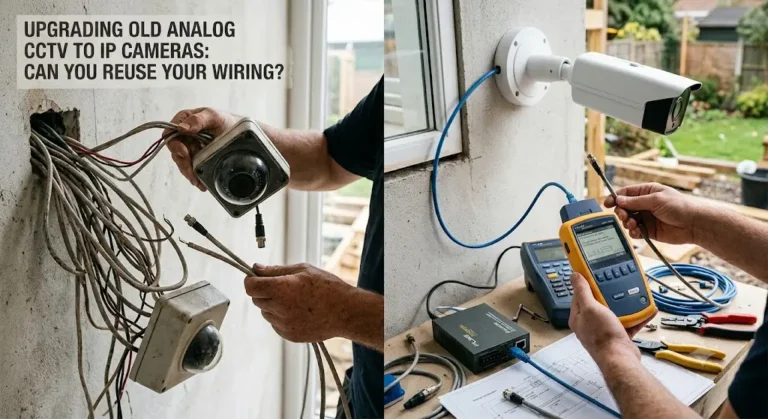
Budgeting for business connectivity is rarely as simple as getting “a price per cable run.” Commercial network cable installation pricing depends on the cable type, number of drops, building layout, ceiling access, labour, testing, and the level of finish required.
That is why two quotes for what looks like the same job can land far apart.
In this guide, we break down what commercial network cabling is, when a business needs it, what affects the cost, and what Toronto companies should expect before approving a project.
Whether you are planning a new office, upgrading an older setup, or comparing contractor quotes, this article will help you understand the numbers, spot missing line items, and budget with more confidence.
What Is Commercial Network Cable Installation?
Most people do not search this term because they are curious about cables. They are usually thinking about a practical business need. They may be planning a new office, adding workstations, fixing weak connectivity, setting up access points, or preparing for phones, cameras, and other connected systems.
In their mind, it is a mix of cables in ceilings, wall ports, server room equipment, and a cleaner, more dependable network.
These thoughts all connect to one thing: commercial network cable installation.
Commercial network cable installation is the process of designing, running, terminating, organising, and testing the physical cabling that allows a business network to work properly. This can include structured cabling, Ethernet cabling, Cat6, Cat6A, and fibre optic cabling, depending on the size of the space, the speed requirements, and the type of equipment being used.
In simple terms, it is the wired foundation behind your business network. It connects computers, phones, wireless access points, printers, point-of-sale systems, security devices, and other networked equipment back to the main system in an organised way.
A standard commercial cabling setup often includes:
- Data drops where staff plug devices into the network
- Ethernet runs that carry the connection from one point to another
- Data jacks mounted at workstations or wall plates
- Patch panels that organise and terminate cables neatly
- Network switches that distribute the connection across devices
- Network racks or server rooms where the core equipment is housed
When these parts are installed properly, the network is easier to manage, easier to expand, and far more reliable day to day. That is why businesses treat structured cabling as infrastructure, not just wiring.
However, businesses do not invest in structured cabling just to have neat wiring. They invest in it because it affects performance, uptime, expansion, and the reliability of the systems connected to it. And this is exactly what we will cover next, so you do not end up focusing on price before understanding the value behind the work.
Also Read: Network Cabling For New Office Construction.
Why Commercial Network Cabling Matters for Business Performance
Commercial network cabling still plays a central role in business infrastructure because day-to-day operations depend on stable physical connections, not just strong Wi-Fi signals.
In offices, retail units, warehouses, and commercial buildings, the network supports far more than desktop computers. It carries voice traffic, device communication, security data, wireless backhaul, and access control activity across the site.
When that cabling is planned properly, the network performs more consistently under load and becomes easier to maintain as the business grows. For companies that rely on uptime, connected systems, and predictable performance, structured cabling remains a practical investment rather than an outdated one.
It improves connection stability across the workplace
A wired network delivers more consistent performance than a wireless-only setup. That matters in commercial spaces where dropped connections, weak signal areas, and inconsistent device behaviour can disrupt work.
Reduces dead zones and weak coverage areas
Proper Ethernet cabling supports better placement of wireless access points throughout the building. This helps spread the signal more evenly and improves usability in offices, boardrooms, warehouses, front counters, and other high-use areas.
Supports VoIP and other business-critical communication tools
VoIP phone systems rely on reliable, low-latency connections. Poor cabling can lead to call quality issues, jitter, or dropped calls, especially when multiple users are active at once.
Provides the backbone for access points
Access points do not work well in isolation. They depend on structured cabling to carry data back to the switch and out to the wider network. Strong Wi-Fi usually starts with strong cabling behind it.
Supports IP cameras and video surveillance systems
Commercial IP cameras often run over Ethernet and may use PoE for both power and data. A solid cabling layout helps maintain video quality, recording stability, and clean device integration.
Supports access control systems
Card readers, door controllers, intercoms, and related security hardware often depend on dependable low-voltage network connections. Poor cabling can create communication faults that affect building security and system response.
Handles higher bandwidth demands more effectively
Modern businesses move large volumes of data through cloud platforms, shared files, video meetings, connected devices, and internal systems. Cabling such as Cat6, Cat6A, and fibre optic cabling helps support that demand more effectively.
Strengthens the performance of Wi-Fi 6 and Wi-Fi 7 environments
Newer wireless standards can deliver faster speeds and better device handling, but only when the wired backbone can keep up. Outdated or poorly terminated cabling limits the benefit of advanced access points.
In professional environments, network cabling supports much more than internet access. It supports the systems, hardware, and daily workflows that keep the business operating smoothly.
However, even a strong cabling system is not installed just because a business wants a cleaner infrastructure. There is usually a clear reason the need appears in the first place.
You can check this guide on structured cabling pricing.
When Does a Business Need New Network Cabling?
Most businesses do not think about commercial network cabling until the existing setup starts limiting performance, expansion, or day-to-day operations. In some cases, the need appears during a move or renovation.
In others, it shows up through weak connectivity, crowded work areas, outdated Ethernet cabling, or the addition of new systems that the current infrastructure was never built to support.
This is usually the point where commercial network cable installation becomes a practical requirement rather than a future upgrade. For offices, retail units, warehouses, and mixed-use commercial spaces, new cabling is often tied directly to business growth, equipment changes, and rising bandwidth demands.
Below are some of the most common situations where businesses need new commercial network cabling, upgraded structured cabling, or a more capable business network infrastructure to support daily operations properly.
Moving into a new office
A new location rarely comes with the right structured cabling layout for your team, devices, and workflows. Businesses often need new data drops, better workstation placement, cleaner patch panel organisation, and proper network rack planning before the space is ready for daily use.
Renovating or reconfiguring the workspace
Office renovations often change desk locations, meeting rooms, front counters, and equipment areas. That usually means the old cabling layout no longer matches the new floor plan. This is one of the best times to improve office network cabling while ceilings, walls, and pathways are more accessible.
Adding staff, desks, or workstations
As teams grow, so does the demand for more ports, more cable runs, and stronger switching capacity. Adding workstations often requires additional Ethernet cabling, new data jacks, and a better distribution setup to keep the network organised and stable.
Upgrading from older Cat5e cabling
Many older commercial spaces still rely on infrastructure that was installed for lower-speed demands. When businesses begin using more cloud services, video calls, large file transfers, or newer equipment, older cabling can become a bottleneck. Upgrading to Cat6, Cat6A, or even fibre optic cabling can improve performance and support higher bandwidth requirements.
Dealing with poor network performance inside the office
Slow speeds, unreliable connections, and inconsistent coverage are not always caused by the internet provider. In many cases, the problem sits inside the building. Poor terminations, weak cable pathways, outdated wiring, and badly placed access points can all affect internal performance. New commercial network cabling can help correct those issues at the infrastructure level.
Adding access points, VoIP phones, IP cameras, or access control
Modern commercial systems rely heavily on physical network infrastructure. Wireless access points, VoIP phones, IP cameras, and access control systems often need dependable cabling and, in many cases, PoE support. Once these systems are added, the existing network may need to be expanded or rebuilt to support them properly.
Preparing for future growth
Some businesses install new cabling before problems appear because they know expansion is coming. Planning ahead makes it easier to support more users, more devices, more bandwidth, and new technologies without constant patchwork changes later.
Structured cabling was valued at roughly USD 20 billion in 2025, and forecasts show it reaching USD 31.8 billion by 2035 as commercial properties depend on more connected infrastructure.
You can see why that matters. When your current setup starts limiting performance or expansion, the conversation quickly turns practical. That is where we move from need to numbers.
Let’s now get into the main point, where we will break down commercial network cable installation pricing.
Commercial Network Cable Installation Pricing: Average Cost in Toronto
If you ask five contractors for a network cabling quote in Toronto, you probably will not get five similar numbers. And that throws a lot of business owners off.
On paper, the job can look straightforward. A certain number of drops. A certain office size. Maybe Cat6, maybe Cat6A. But once the work starts getting priced properly, the differences show up fast. Open ceiling versus finished ceiling. Standard office versus medical clinic. Simple workstation drops versus backbone cabling between floors. It all changes the cost.
That is why this part of the guide matters. We are not looking for a vague “it depends” answer here. We are looking at real commercial network cable installation pricing in Toronto, broken down in the way businesses actually think about it: price per drop, cable type, and total cost by project size.
Average Cost Per Drop
The first number most buyers want is the cost per drop.
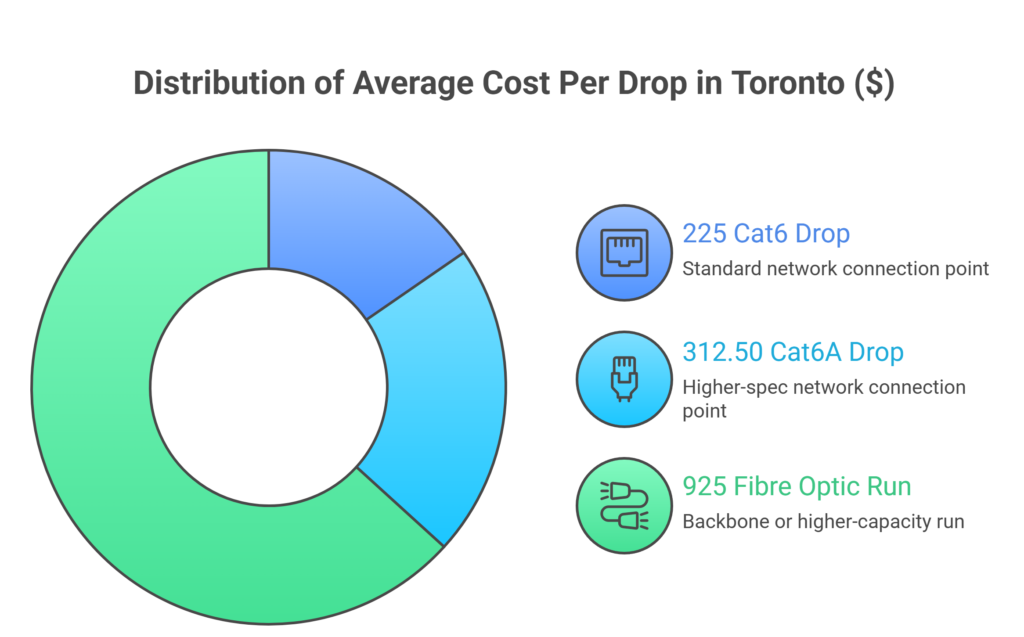
A drop is one terminated cable endpoint. In plain terms, it is one network connection point, usually ending at a wall plate or data jack and tied back to a patch panel. It is the standard unit used in commercial cabling quotes because it gives everyone a simple way to measure scope.
In Toronto, most commercial Cat6 drops land somewhere between $175 and $300. Cat6A drops usually come in higher, often around $225 to $400, depending on the building and the installation conditions. Fibre is priced differently and is usually quoted per run rather than like-for-like with desk drops.
| Drop type | Typical Toronto price range | Typical scope |
| Standard Cat6 drop, open ceiling | $155 – $250 | Cable, jack, wall plate, patch panel port, basic testing |
| Cat6 drop, finished space/retrofit | $225 – $350 | More labour for routing through existing walls or ceilings |
| Cat6A drop, open ceiling | $225 – $375 | Higher-spec cable, more demanding termination, certified testing |
| Cat6A drop, finished space/retrofit | $300 – $450 | Added labour plus higher material cost |
| Fibre optic run, multimode | $550 – $1,200 | Backbone or higher-capacity run with termination and testing |
| Fibre optic run, single-mode | $700 – $1,800 | Longer-distance backbone with full fibre testing |
| After-hours installation premium | +25% to +50% | Added labour cost for evening or weekend work |
Those numbers give you a solid starting point, but they are still only part of the story. Two projects with the same drop count can still land in very different places depending on the cable category and the type of business environment.
Cat6 vs Cat6A vs Fibre Pricing
This is where a lot of budgets move.
The cable type has a direct effect on price, but it also affects how long the installation will remain useful. That is why this choice should never be made on material cost alone.
Cat6 is usually the lower-cost option. It still works well for many offices, retail units, and smaller commercial spaces. If the network demand is moderate and the project is fairly straightforward, it can be a sensible choice.
Cat6A costs more, but it is where many commercial projects are heading now. It handles higher bandwidth better, supports modern access points more comfortably, and makes more sense in spaces where the business plans to stay put for years. For offices using VoIP, IP cameras, access control, and dense wireless coverage, Cat6A is often the better long-term fit.
Fibre is different again. It is usually not selected for every endpoint. It is more commonly used for backbone runs, inter-floor links, and high-capacity connections where copper cabling starts running out of road.
| Cable type | Typical installed price in Toronto | Best fit |
| Cat6 | $155 – $300 per drop | Small offices, retail, and lighter commercial environments |
| Cat6A | $225 – $400 per drop | Professional offices, clinics, and higher-density workplaces |
| Fibre optic | $550 – $1,800 per run | Backbone cabling, multi-floor buildings, long-distance links |
And if we look at it by business type, the pattern becomes even clearer.
| Business type | Cable that usually makes sense | Why |
| Professional office | Cat6A | Better long-term value and stronger support for modern devices |
| Medical clinic | Cat6A shielded | More stable performance in a more demanding environment |
| Retail store | Cat6 | Usually enough for POS, cameras, and basic back-office traffic |
| Warehouse | Cat6A shielded or fibre | Better for long runs, EMI, and larger coverage areas |
| Hotel | Cat6A plus fibre backbone | Supports guest connectivity, cameras, room systems, and shared infrastructure |
| Tech office | Cat6A | Better fit for dense access point use and future upgrades |
This is usually the point where buyers start to see why one quote looks modest and another looks expensive. It is not always padding. Often, it is the cable spec.
Small Office vs Large Office Pricing
Once the cable type is set, the next question is usually the scale.
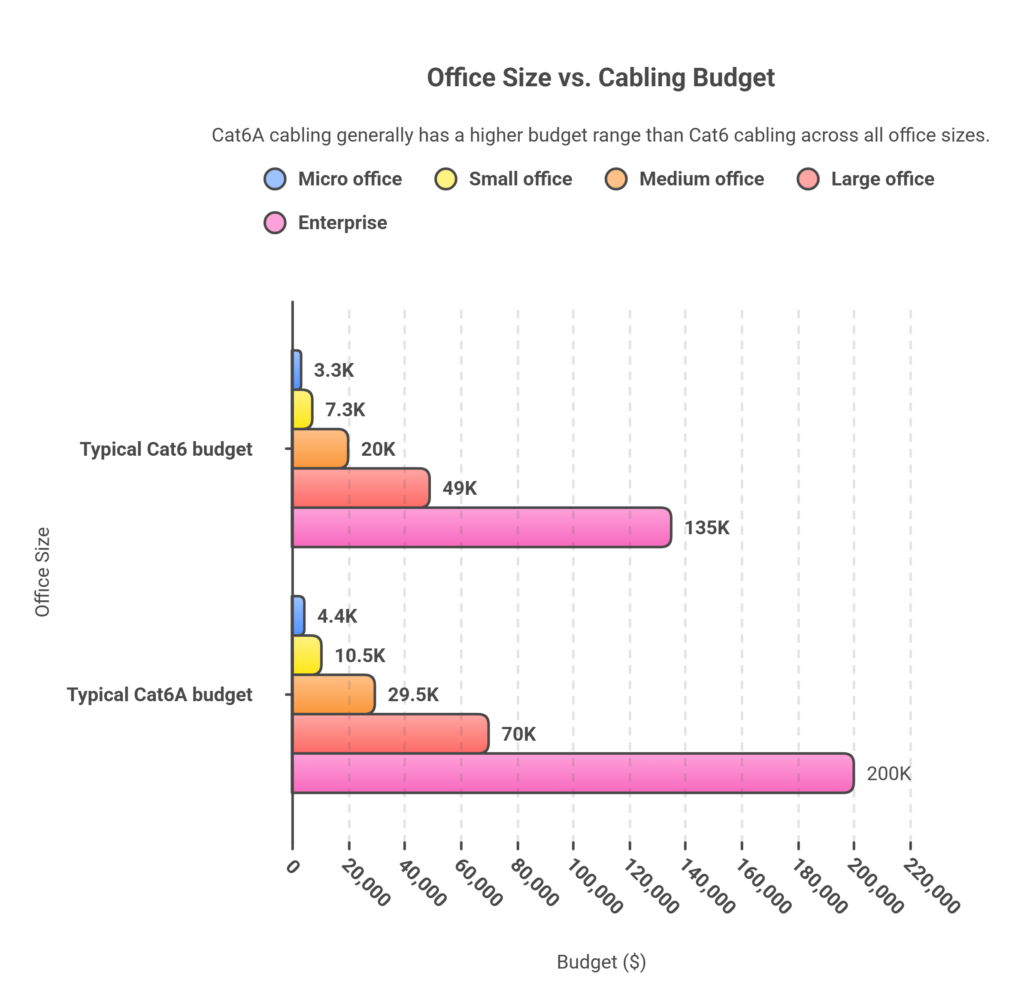
A ten-drop office does not price the same way as a hundred-drop office. Not just because it is smaller, but because smaller projects carry a bigger share of fixed cost. Travel, setup, crew time, and mobilisation do not disappear just because the scope is lighter.
That is why a small project can look expensive on a per-drop basis, even when the quote is fair.
| Office size | Estimated drops | Typical Cat6 budget | Typical Cat6A budget |
| Micro office | 8 – 15 | $2,000 – $4,500 | $2,800 – $6,000 |
| Small office | 20 – 45 | $4,500 – $10,000 | $6,000 – $15,000 |
| Medium office | 50 – 150 | $10,000 – $30,000 | $14,000 – $45,000 |
| Large office | 150 – 400 | $28,000 – $70,000 | $40,000 – $100,000 |
| Enterprise / multi-floor | 400 – 1,000+ | $70,000 – $200,000+ | $100,000 – $300,000+ |
These ranges are useful because they help businesses stop guessing. A company moving into a small Toronto office can quickly see whether the budget is likely to land in the five-figure range or below it. A larger company planning a multi-floor rollout gets a more realistic sense of what a serious commercial cabling project can cost.
Industry also matters. The price for a professional office will not match the price for a warehouse, a clinic, or a hotel, even if the square footage looks similar.
| Business type | Typical drops | Estimated Toronto project cost | Typical cable spec |
| Professional office | 40 – 100 | $12,000 – $35,000 | Cat6A |
| Medical clinic | 45 – 80 | $14,000 – $32,000 | Cat6A shielded |
| Retail store | 15 – 30 | $5,000 – $12,000 | Cat6 |
| Warehouse/distribution | 30 – 80 | $9,000 – $30,000 | Cat6A shielded |
| Hotel/hospitality | 200 – 350 | $55,000 – $130,000 | Cat6A plus fibre backbone |
| School/education facility | 150 – 300 | $40,000 – $110,000 | Cat6A |
Now the averages are on the table. One thing is for sure: the price only tells part of the story. Businesses do not hesitate to invest when the network supports daily operations, future growth, and reliable performance.
What causes frustration is not the cost itself, but a quote that feels vague or hard to judge. We cannot treat every commercial cabling job as the same package, because the site conditions, building type, and technical scope can change the number quickly.
However, that is exactly where the next part helps. We are going to break down the factors that actually shape commercial network cable installation pricing in real Toronto projects.
What Can Increase the Cost of a Commercial Cabling Project?
Commercial cabling is growing because business networks are carrying more than they used to.
Market forecasts show the network cabling installation services market rising from about USD 8.1 billion in 2025 to roughly USD 14.08 billion by 2033, while broader structured cabling research also shows continued growth in commercial demand.
At the same time, copper cabling still dominates most installations today, while fibre is gaining ground faster in high-bandwidth upgrades.
That trend shows up in pricing, too. Two projects can look similar on paper and still cost very different amounts once the real job is priced properly. What changes the number is usually not guesswork.
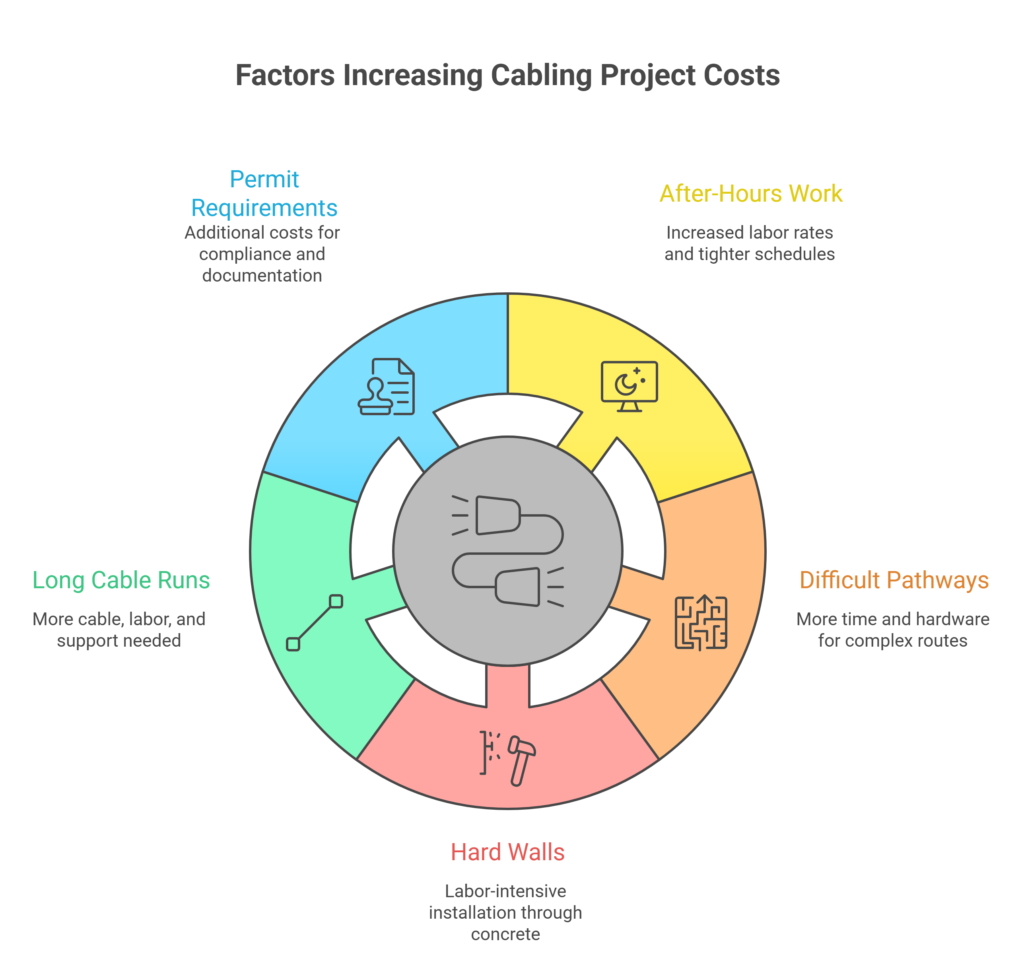
Here are some factors that can easily and anytime increase the commercial cabling project costs:
After-Hours or Weekend Work
A lot of commercial work has to happen when the space is quiet. That usually means evening, overnight, or weekend work. And that comes with a premium. The labour rate goes up, the working window gets tighter, and the crew often has less freedom to move through the building.
So even when the physical scope stays the same, the project cost can rise simply because the work has to fit around the business.
Difficult Cable Pathways
In retrofit spaces, there is often no direct route from the network rack to the final device location.
That slows the job down. More time goes into finding safe, clean cable routes. More support hardware may be needed. In some cases, the installer has to reroute entire runs to avoid conflict with existing services. The longer that takes, the more the labour side of the quote starts climbing.
Concrete or Block Walls
Hard-wall construction pushes cost up quickly. Concrete, masonry, and block walls are common in older Toronto commercial stock, industrial units, and many mixed-use buildings. They are durable, but they are not simple to work through.
So a project that looks ordinary at first can become much more labour-heavy once the building structure starts working against the route plan.
Long Cable Runs
Long runs increase cost in a very direct way. More distance means more cable, more labour, and usually more pathway support along the way.
Permit or Compliance Requirements
Some jobs come with rules that are easy to underestimate. That can include plenum-rated cable, fire code considerations, landlord approvals, building management requirements, inspection steps, or extra documentation.
What raises the cost is not always the hardest job. Sometimes it is simply the most interrupted one. Timing issues, building conditions, longer runs, and last-minute scope changes all put pressure on the price. That is why a low quote is not always a safe quote.
Remember, cheap network cabling quotes often cost more later.
Also, learn about who provides the best Ethernet wiring service.
Commercial Network Cabling Installation Services for Toronto Offices, Warehouses, and Retail Spaces
At Sense Group, we provide commercial network cabling for businesses that rely on stable, day-to-day performance. We work in offices, retail stores, warehouses, and multi-unit commercial spaces across Toronto and the GTA. Each project is planned around clean routing, organised infrastructure, and reliable network performance.
Here are the main types of commercial properties we serve across Toronto and the GTA.
Office Cabling
We install structured cabling for commercial offices across Toronto, Mississauga, Hamilton, Barrie, Kitchener, and the GTA. We focus on clean layout, stable performance, and a professional finish. Our work includes data cabling for desks, patch panels, network racks, and wireless access points. We also plan the setup so that the office is easier to expand later.
Retail Store Network Cabling
Retail spaces need strong, stable connections. Every day. POS systems, cameras, access control, Wi-Fi, and back-office devices all rely on the network behind the walls and ceiling.
We provide retail network cabling for stores that need dependable performance without disrupting trade.
Warehouse Network Infrastructure
Our work focuses on clear pathway planning, proper routing, and stable coverage across large open areas. We also built the infrastructure to support future growth.
Multi-Unit Commercial Spaces
Multi-unit commercial properties need a more organised approach. Shared pathways, risers, separate business units, backbone planning, and future tenant changes all affect the way the cabling should be installed. In these environments, a rushed job creates problems that last.
We handle commercial network cabling for multi-unit office and mixed-use spaces with a focus on clean structure, future flexibility, and reliable backbone design.
If your business is planning a new office, a retail upgrade, a warehouse network build, or a full commercial cabling project in Toronto or the GTA, we can help you scope the work properly and price it clearly. The right installation starts with the right plan, and that is exactly where we come in.
Final Thoughts on Commercial Network Cable Installation Pricing
By the time a business starts pricing cabling, the network is usually already becoming a serious operational issue. Maybe the team is expanding, or the space is being renovated. Whatever the reason, the decision should be made with a long view.
If you are comparing options, focus on clarity. Look at the cable type, the number of drops, the building conditions, the testing standard, and the completeness of the quote. That tells you far more than the bottom-line number alone.
And if this guide helped you, share it with your friends.