Yes. Most existing coax can be reused when upgrading analog CCTV to IP cameras. Small adapters at each end turn that cable into a network link. Water damage and aluminum cable are the usual dealbreakers.
Most owners hear about a full rewire first. The price shocks them, so the project waits another year. In our experience, that quote is often unnecessary. Sometimes it is fair, though, and the reasons are worth knowing. Either way, your cable sets the budget long before you choose a camera. Read on to find out which situation you are in.
What Type of Wiring Does Your Existing CCTV System Use?
Look at the back of your recorder right now. Round screw-on connectors mean coax. Rectangular clip-in connectors mean network cable. That single check sets your whole upgrade path and your budget.
Coaxial Cable (RG59, RG6)
RG59 and RG6 are the most common coaxial cables used in analog CCTV systems. Both have a solid copper core surrounded by a braided metal shield that carries the video signal. RG6 is thicker than RG59, making it a better choice for longer cable runs.
These cables connect to cameras using 75-ohm BNC connectors, which are specifically designed for CCTV systems
Siamese Cable
Siamese cable combines RG59 coaxial cable and a separate 18/2 power wire inside a single outer jacket. The RG59 cable carries the video signal, while the 18/2 wire supplies power to the camera. Because the power wiring is already in place, you can often reuse it during an IP camera upgrade, reducing installation work.
Cat5e or Cat6 Cable
Cat5e and Cat6 hold four twisted pairs and end in a clip-in plug. They send data and power together, which the industry calls PoE. Cat6 uses thicker 23-gauge copper. Both stop working past 100 metres.
Hybrid Installations
Many older buildings have a mix of wiring types. You might find RG59 coaxial cable running to older cameras around loading bays, while Cat5e cable was added later for office expansions or newer cameras. In some cases, cable routes can be difficult to identify because multiple contractors or tenants modified the system over the years without leaving updated documentation.
How to Identify Your Current Wiring
Read the jacket first. Manufacturers print RG59, RG6, CAT5E or CAT6 on the outside. Then look for the words “solid copper”. Finally, find the fire rating: FT1, FT4 or FT6. Photograph both ends for your installer.
Can You Reuse Existing CCTV Wiring When Upgrading to IP Cameras?
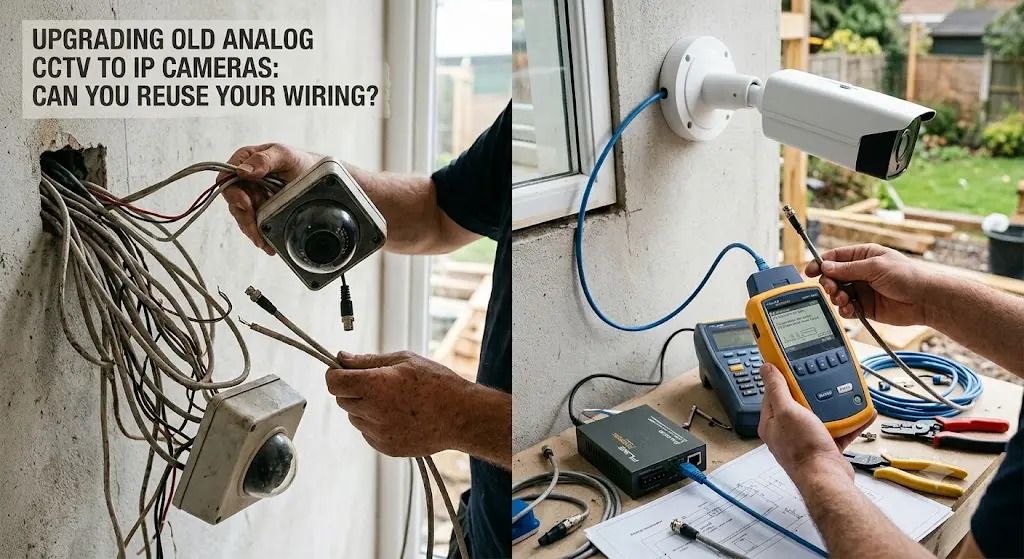
Yes, in most cases. Small boxes called Ethernet over Coax adapters do the work. You fit one at the camera and one at the recorder. Many models send power down the cable as well.
The manufacturer specifications back this up. Veracity’s HIGHWIRE Powerstar sends 25W of power along 300m of RG59. It also reaches 400m on RG6 and 500m on RG11. That runs a 4K camera comfortably.
By comparison, no network cable travels that far. One warning, though: a cheap video balun does the opposite job and will not work.
Analog CCTV vs. IP Camera Systems
The real difference is not picture quality. Rather, it is whether your footage can prove anything.
| Factor | Analog CCTV | IP Cameras |
| Resolution | 480i, roughly 0.3MP | 2MP up to 4K and beyond |
| Cable needed | Coax plus separate power | One network cable |
| Maximum run | 300m and further | 100m limit |
| Recorder | DVR | NVR or cloud platform |
| Smart features | None | Object detection, plate reading, alerts |
| Remote viewing | Limited | Full access from any device |
| Evidence quality | Often too blurry to identify | Clear enough for police and insurers |
Read More: Recurring Cloud Fees vs One-Time NVR Cost: Which Is Cheaper Over 5 Years?
How to Upgrade an Analog CCTV System Without Rewiring
You have more options than most quotes admit. Below are eight ways to keep your cable exactly where it is. Better still, your business stays open throughout.
1. Fit Ethernet over Coax adapters
Put one adapter at each end of every run. Your coax then works as a network link. From there, you install proper IP cameras and a modern recorder. No ceiling work, no dust, no downtime.
2. Switch to HD-over-coax cameras
HD-TVI, HD-CVI and AHD push 4K down plain RG59. You change the cameras and recorder only. This is the cheapest route. However, it is a closed system with no smart features later.
3. Reuse the power pair in Siamese cable
Check whether your installer ran Siamese. Many did across older industrial buildings. If so, power already sits at every camera. Your quote loses an electrician, and your budget drops immediately.
4. Install a hybrid recorder and phase the work
A hybrid recorder accepts old coax cameras and new IP cameras together. So upgrade the loading dock first. Do the office next quarter. Your coverage never drops to zero meanwhile.
5. Use multi-channel adapters at the recorder
Instead of one adapter per camera, use a single rack unit. Some handle 32 channels in one box. Your equipment room stays tidy, and cost per camera falls past roughly eight cameras.
6. Pull new Cat6 using the coax as a rope
Where coax sits inside conduit, it works as a pull string. Your installer ties the new cable on and pulls it through. The old cable does the hardest part for free.
7. Keep your cameras and add encoders
An encoder turns an old analog camera into a modern digital feed. Your cameras stay put. Many platforms count four encoder channels as one licence, which cuts software costs on larger sites.
8. Book a cable test before you buy anything
Test first, then decide. This costs an hour and saves thousands. That is why our expert commercial CCTV installation team starts every project this way.
When Can You Reuse Coaxial Cable?
Reusing your existing coaxial cable is often the best option when the wiring is in good condition and replacing it would add unnecessary cost or disruption.
- Long cable runs: If your cameras are far from the recorder, reusing coaxial cable can save both time and money. Standard Ethernet cable is generally limited to 100 metres, but Ethernet-over-Coax (EoC) adapters can often extend reliable connections beyond 300 metres.
- Good cable condition: Before replacing anything, have the cable tested. If the BNC connectors are secure, the signal is clean, and there are no damaged sections or hidden splices, the existing wiring is often worth keeping.
- Indoor installation: Cable that has remained inside ceilings, walls, or conduit is usually well protected from moisture and physical damage. Even older RG59 cable can still deliver reliable performance when it has been properly maintained.
- Leased building: If you rent your commercial space, your landlord may not allow new cable runs or additional drilling. Reusing the existing wiring keeps the upgrade simple and avoids unnecessary building modifications.
- Minimal downtime: When your business cannot afford long interruptions, reusing existing cabling speeds up the installation. Ethernet-over-Coax (EoC) adapters allow many upgrades to be completed after business hours with minimal disruption.
- Difficult rewiring: Some buildings make running new cable challenging. Older properties with plaster walls, concrete construction, metal conduit, or heritage features are often much easier and more cost-effective to upgrade using the existing coaxial cable.
When Should You Replace the Existing Wiring?
In some situations, replacing your existing CCTV wiring is the better long-term investment. If the cable is damaged, outdated, or cannot support your future needs, installing new wiring will give you a more reliable system.
- Copper-clad aluminum (CCA) cable: If your system uses copper-clad aluminum (CCA) instead of solid copper, replacement is recommended. CCA has higher electrical resistance, which can cause voltage drops over long distances. As a result, cameras may lose power, restart unexpectedly, or perform unreliably.
- Damaged cable or corroded connectors: Check the cable jacket and BNC connectors for signs of wear. Cracks, corrosion, or moisture damage can reduce signal quality and lead to camera failures. Outdoor cable exposed to years of changing weather is especially vulnerable.
- Cable routed with high-voltage wiring: If your CCTV cable runs alongside electrical power cables, replacing and rerouting it is the safer option. Keeping low-voltage security wiring separate from high-voltage electrical wiring reduces interference and meets electrical best practices.
- Too many cameras on one cable: If multiple cameras share a single cable through Ethernet-over-Coax (EoC) equipment, you may be reaching the network’s bandwidth limit. As camera resolution and recording quality increase, performance can quickly suffer.
- Planning for 4K and AI features: If you plan to upgrade to 4K cameras, AI analytics, or other advanced security features, new Cat5e, Cat6, or Cat6A cabling provides greater bandwidth and better long-term performance than adapter-based solutions.
- The walls or ceilings are already open: If you’re renovating or remodeling your building, it’s the ideal time to replace old wiring. Installing new cable during construction is much easier and far less expensive than reopening finished walls later.
Read More: Can I Install Ubiquiti or UNV Cameras Myself, or Do I Need a Pro?
Cost Comparison: Reuse Wiring vs. Install New Cabling

| Cost item | Reuse coax with adapters | Install new Cat6 |
| Cable purchase | $0 | Cat6 prices have climbed since 2017 |
| Adapter hardware | Two units per camera | None needed |
| Electrician | $0 if Siamese exists | Often required |
| Labour hours | Low, no ceiling access | High, especially in occupied space |
| Business downtime | Hours | Two to four days for a warehouse |
| Ceiling and wall repair | $0 | Drywall, paint, cleanup |
| Removing old cable | Not applicable | Required in plenums by law |
| Ten-year replacement | Adapters wear out | Cat6 lasts the decade |
Don’t overlook compliance costs. If your building has plenum ceilings, abandoned cable may need to be removed before new wiring is installed, which can add to labour costs.
Commercial projects also require the correct FT-rated cable, typically FT6 for plenum spaces and FT4 for most other areas to meet Canadian fire and electrical code requirements.
If your quote uses CMP or riser cable ratings, ask whether it meets Canadian standards. Our Cat6 network cabling installation uses the correct FT-rated cable for every commercial project.
Read More: How to Secure Your Backyard Against Intruders
Is It Worth Upgrading From Analog CCTV to IP Cameras?
For most businesses, yes. Modern IP cameras deliver higher image quality, remote access, AI-powered analytics, and easier integration with other security systems.
Another reason is long-term support. In 2025, Innovation, Science and Economic Development Canada (ISED) ordered Hikvision Canada to cease operations in Canada. While existing Hikvision cameras remain legal to use, future support, warranty services, and system expansion may become more challenging.
Many businesses are now upgrading to trusted IP camera brands such as Axis, Verkada, Ubiquiti, and UNV to ensure long-term reliability and ongoing support.
The business case is also strong. Retail theft continues to rise across Canada, and warehouses, distribution centres, and commercial properties face increasing security risks. Unlike analog CCTV, IP camera systems can integrate with access control systems, allowing events like a door entry or access card swipe to automatically display the associated camera footage for faster investigations.
Cities Where Sense Group Upgrades Analog CCTV to IP Cameras
We test legacy coax and install commercial IP camera systems across the Greater Toronto Area and beyond.
We also cover Mississauga, Vaughan, King City, Brampton, Orillia, Innisfil, Collingwood, Uxbridge, Muskoka and Peterborough.
Conclusion
Upgrading old analog CCTV to IP cameras rarely needs a full rewire. So test your runs before you budget anything. Long runs favour reuse, while damaged cable and open ceilings favour replacement. Our team has completed over 1,600 commercial projects across the region. We test every run and hand you a written verdict.
Book a free onsite cabling assessment today. It takes an hour and costs nothing.
Frequently Asked Questions
Can I mix analog and IP cameras on the same system?
Yes. A hybrid recorder accepts both types at once, so you can upgrade in stages without losing coverage.
Do I need a new NVR, or will my old DVR work?
Your old DVR cannot record IP cameras. You need an NVR or a hybrid recorder instead.
How far can PoE run over coax cable?
Roughly 300m on RG59 and 500m on RG11. Standard network cable, by comparison, stops at 100m.
Can I use MoCA adapters for my security cameras?
No. MoCA moves data but sends no power. Camera adapters do both, and they need proper 75-ohm coax.
Is HD over coax as good as IP?
The picture can match at 4K. However, you lose smart features, remote access and integration with other systems.
Does my commercial camera system need a permit in Ontario?
Not on private property. Privacy rules still apply, though. Our guide to Ontario’s security camera laws for business owners covers signage, retention and monitoring policies.