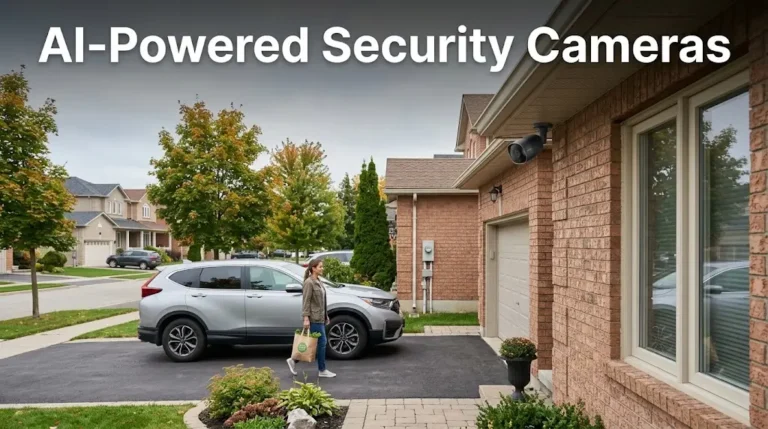
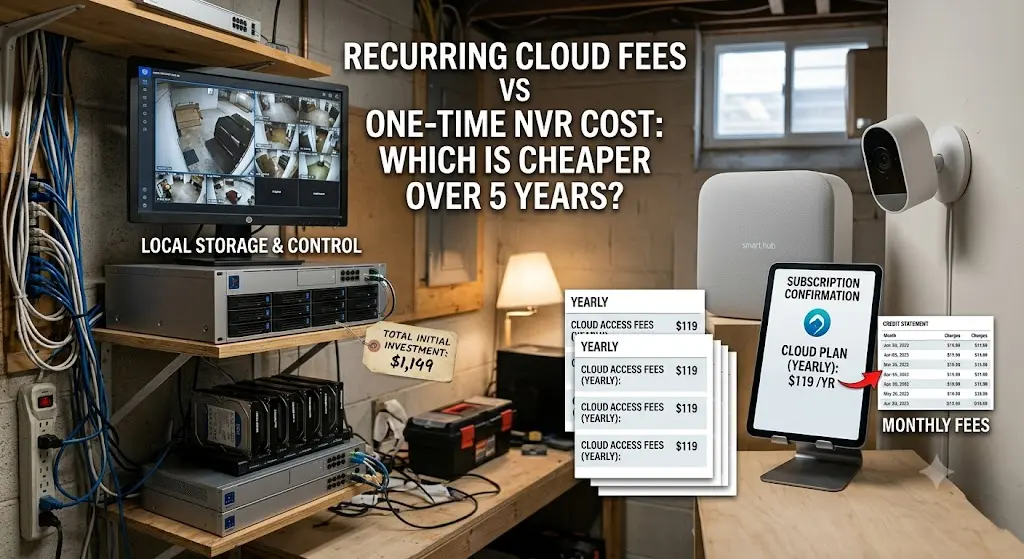
A one-time NVR system is almost always cheaper than recurring cloud fees over 5 years. For most commercial properties, a local NVR costs roughly half of a comparable cloud setup.
That gap matters more than ever right now. Operating costs keep climbing, and high-value theft keeps rising too. Across the Greater Toronto Area, owners want protection that works. Nobody wants a bill that never ends. Yet many quotes hide the true five-year number behind a low monthly rate.
The sections below break down the real math, the hidden costs, and the smarter choice.
Cloud Storage vs. NVR: What’s the Cost Difference?
The core difference comes down to how you pay. An NVR is a one-time purchase you own outright. Cloud storage, by contrast, is a recurring fee charged per camera, indefinitely. In short, one is a capital cost you settle once. The other is an ongoing cost that grows with every camera added.
NVR Security Camera System Cost
A commercial NVR system represents a single upfront investment. In the GTA, a typical 8-camera 4K setup runs roughly $3,500 to $7,000 installed.
That figure covers the cameras, the recorder, cabling, and professional setup. From then on, the entire system belongs to you. As a result, no monthly fee stands between you and your own footage.
Cloud Storage System Cost
Cloud storage follows a very different model. Here, you pay a per-camera subscription that renews yearly. These fees commonly run $5 to $15 per camera monthly.
For an 8-camera property, that adds up to $40 to $120 monthly. Across a full year, the total reaches as high as $1,440. Longer retention tiers then push it higher still.
The Real Cost of Cloud Camera Storage Over 5 Years
Over five years, cloud storage for 8 cameras can reach $7,000 to $18,000 or more. The subscription, rather than the camera, becomes the real expense. The breakdown below shows where that money actually goes.
- Per-camera licences. Every camera needs an active licence to record and stream. Consequently, a missed renewal strips the camera of its cloud features.
- Retention tiers. Storing 30, 60, or 90 days of footage sets your monthly price. Longer retention for theft investigations then raises the fee across every camera.
- Annual price increases. Subscription pricing rarely holds steady over time. As providers raise their rates, your five-year total climbs with each renewal.
- Bandwidth demands. Streaming constant video to the cloud consumes serious upload speed. Because of this, many businesses end up paying for a pricier internet plan.
- Retrieval and export fees. Some platforms charge you to pull or download footage. During an incident, those small fees add up right when evidence matters.
- Support tiers. Faster response times and advanced features often sit behind higher plans. That cost gap tends to surface exactly when you need help most.
- Multi-year lock-in. Contracts bundle hardware and licences together for years at a time. Once the term ends, renewal resets your per-camera math all over again.
Read More: How to Secure Your Backyard Against Intruders
The Real Cost of an NVR Security System Over 5 Years
An NVR system for 8 cameras typically totals $4,000 to $7,500 over five years. Although the upfront cost sits higher, the ongoing spend stays close to zero. The full picture looks like this.
- Upfront hardware and install. The cameras, recorder, cabling, and labour form one fixed cost. You pay it once, and the system then remains yours.
- Hard drive replacement. Surveillance drives generally last four to seven years. Most businesses therefore set aside one swap of $100 to $220 over five years.
- Electricity. A recorder running around the clock adds only a few dollars monthly. Across five years, power remains a minor line item.
- Optional health check. An annual lens cleaning and firmware update runs $100 to $150. Even so, this upkeep stays entirely optional.
- No monthly fees. No subscription ever stands between you and your own cameras. Remote viewing through the app comes included at no added cost.
- Own your footage. Every recording lives on hardware you fully control. As a result, no third-party server holds your video, and nothing leaves your building.
Our professional commercial CCTV installation services are built around exactly this ownership model. You keep full control from day one.
5-Year Cost Comparison: Cloud Storage vs NVR
Cloud vs. NVR Cost by Number of Cameras
The camera count ultimately decides how wide the cost gap grows.
| Cameras | NVR (5-year) | Cloud (5-year) |
| 4 | $2,500 to $4,500 | $1,200 to $3,600 |
| 8 | $4,000 to $7,500 | $7,000 to $18,000 |
| 16 | $7,000 to $15,000 | $14,000 to $29,000+ |
Is Cloud Cheaper for 1–2 Cameras?
At 1 to 2 cameras, cloud storage can come out cheaper. At that small scale, the subscription stays low, and you skip the recorder entirely. In practice, a one or two-camera setup rarely justifies a full NVR. The modest monthly fee, combined with the hardware savings, tips the balance toward cloud. That said, almost no commercial property operates on two cameras alone.
Which Is Cheaper for 4–8 Cameras?
At 4 to 8 cameras, an NVR becomes the clear cost saver. This range is the sweet spot for most Ontario businesses. At this scale, per-camera subscriptions pile up quickly.
A cloud system often passes the cost of a $4,000 NVR within two years. After that point, the NVR keeps saving money every single month. For a busy retail store or a mid-size office, the decision becomes straightforward.
Read More: How Much Should A Commercial Camera Install Cost Per Camera?
Hidden Costs That Can Change the 5-Year Total
The sticker price tells only half the story. Several often-missed costs can swing your five-year total in either direction.
Cloud Subscription Price Increases
Cloud fees rarely hold steady over the years. Providers raise their prices, and each renewal reflects the increase. In fact, many owners report a subscription outrunning the hardware cost within a few years.
Internet and Bandwidth Requirements
Cloud recording depends heavily on strong upload speed. Constant streaming can choke your connection and slow daily operations. Many rural and remote sites simply cannot sustain that load. As a result, some businesses face a costlier internet plan they never planned for.
Additional Cloud Storage Fees
Basic plans cover only short retention windows. Longer storage and footage exports typically cost extra. On top of that, retrieval charges appear whenever you download clips for an incident.
NVR Hard Drive Upgrades
Surveillance drives naturally wear out under constant recording. Across five years, one replacement at $100 to $220 is a fair estimate. Fortunately, this remains a small and predictable cost. A quality drive keeps your footage safe and your system reliable.
Hardware Replacement
Cameras and recorders can fail over time. In these cases, solid warranty coverage makes a real difference. For that reason, our installations come backed by a three-year warranty. Quality hardware and proper mounting also reduce surprise costs later.
Professional Maintenance
Both systems benefit from occasional upkeep. Lens cleaning, firmware updates, and routine checks keep footage clear. A realistic figure sits around $200 to $500 a year for a well-maintained system.
System Expansion Costs
Growing your coverage carries a cost either way. With cloud, each new camera adds a fresh monthly fee. With an NVR, you pay once per camera and add channels as needed. Expansion often calls for extra cable runs, too. Here, clean professional network cabling keeps that growth tidy. Over the long term, therefore, local scaling stays the cheaper path.
Is an NVR Cheaper Than Cloud Storage Over 5 Years?
Yes, an NVR is cheaper than cloud storage over five years. This holds true for nearly every single-site business. The one-time cost outweighs years of stacked subscriptions. You pay more upfront, then very little afterward.
Cloud, meanwhile, keeps billing monthly, so the totals separate quickly. For most GTA warehouses, retail stores, and offices, local recording remains the more economical choice.
When Is Cloud Storage the Better Financial Choice?
Cloud storage earns its price in specific situations, though not most. It tends to make financial sense under these conditions:
- Your business runs multiple locations and needs one central dashboard.
- Your team has no on-site IT staff and prefers a hands-off system.
- Your footage must survive a break-in, fire, or stolen recorder.
- Your site already has fast, reliable upload bandwidth to spare.
- Your budget favours predictable monthly costs over a large upfront spend.
When Does an NVR Offer Better Long-Term Value?
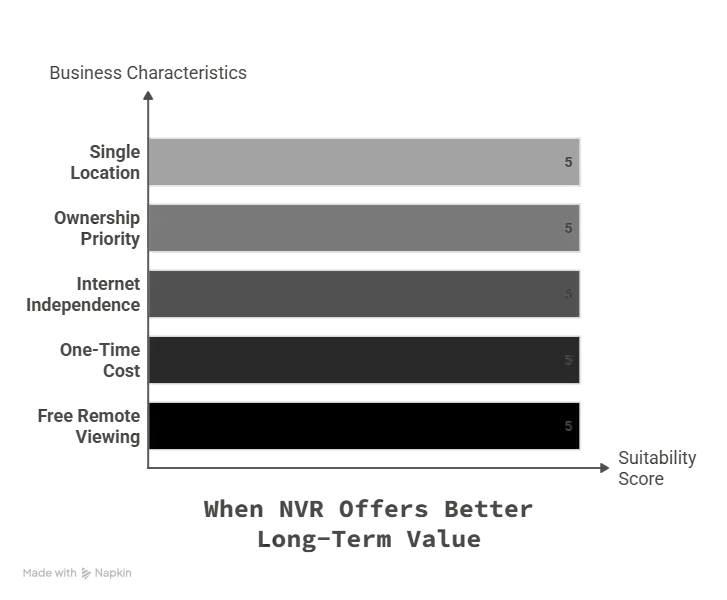
An NVR delivers stronger long-term value for most single-site businesses. It suits your operation when these points apply:
- Your business runs from one main location with a fixed camera count.
- Your priority is owning the system and footage outright.
- Your coverage must keep recording even if the internet drops.
- Your budget favours a one-time cost over ongoing fees.
- Your team wants free remote viewing on a phone.
On that point, modern NVRs from brands like Ubiquiti include free remote access as standard. You review live footage from anywhere, with no cloud fee attached. Some remote sites, however, struggle with weak internet.
Some remote sites, however, struggle with weak internet. There, the national benchmark sits at just 50 Mbps download and 10 Mbps upload. Many rural areas cannot reach it. For those properties, our professional Starlink installation services supply a dependable connection for viewing.
The Bottom Line: Which Should Your Business Choose?
For most commercial properties, a one-time NVR beats recurring cloud fees over 5 years. An NVR fits businesses that run one site and prefer to own their footage. Cloud suits operations with multiple locations or no on-site IT.
If the right path still feels unclear, a free on-site assessment settles it quickly. Sense Group installs both systems. As a result, our recommendation reflects genuine savings, not a sales pitch.
Frequently Asked Questions
Do all security cameras require a monthly fee?
No. Local NVR systems record and store footage without any subscription. A monthly fee applies only with cloud storage or professional monitoring.
Can I view NVR cameras on my phone without paying cloud fees?
Yes. Modern NVR apps offer free remote viewing over your existing internet. Remote access and cloud storage remain two separate things.
How long do NVR hard drives last?
Surveillance-rated drives typically last four to seven years with proper use. Most businesses plan for one replacement across a five-year period.
Can you combine local and cloud storage in one system?
Yes. A hybrid setup records locally and backs up key footage to the cloud. It keeps recording during outages, then uploads once the connection returns.
Does an NVR keep recording if the internet goes down?
Yes. An NVR records to a local drive throughout any internet outage. Cloud-only systems, by comparison, stop capturing when the connection drops.