The choice between an Axis vs Hikvision vs Ubiquiti security camera is one of the most common questions GTA business owners bring to our team. Each brand tells a different story.
Axis is built for enterprise-grade longevity and forensic image precision. Ubiquiti offers full ecosystem integration with no ongoing subscription fees. Hikvision was once the clear value option, but now carries a federal compliance issue that changes the equation entirely for Canadian buyers.
These three brands did not come from the same market. Each one was built around a completely different commercial security philosophy. A clear picture of each brand makes the comparison easier to follow.
At Sense Group, we have installed all three across Ontario commercial properties. This guide gives you an honest security camera brand comparison and a direct recommendation for your business.
What Are Axis, Hikvision, and Ubiquiti Security Cameras?
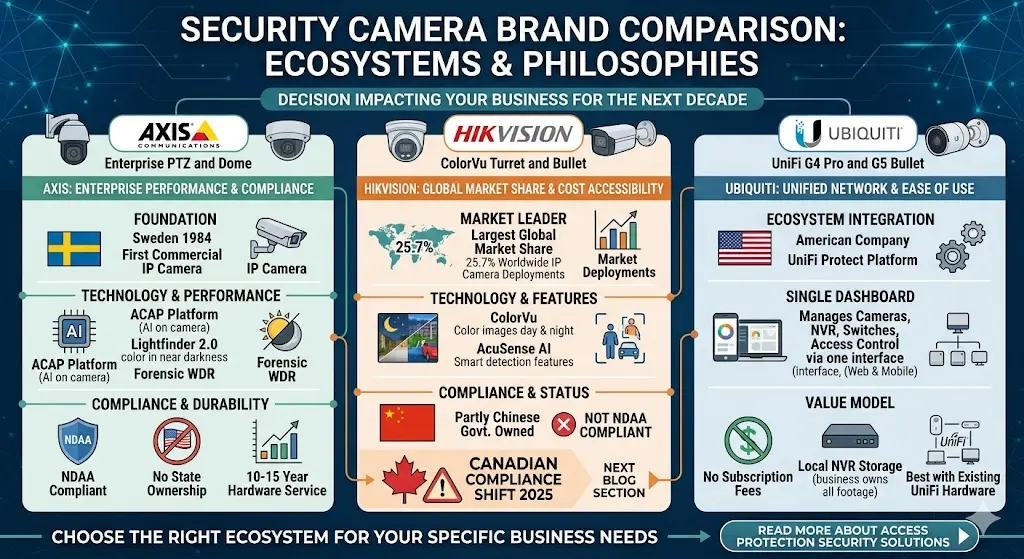
Choosing a security system brand today used to be much simpler when commercial surveillance relied on basic analog hardware. Now, navigating the market requires understanding that companies like Axis, Hikvision, and Ubiquiti are not just manufacturers making identical products.
Each brand represents a completely different philosophy regarding network architecture, processing power, and software integration for a business.
It is a decision that locks you into a specific ecosystem for the next decade.
Below is a breakdown of what these three major industry giants actually offer your business:
Axis Communications
Axis was founded in Sweden in 1984. The company released the first commercial IP network camera. Today, Axis is the global benchmark for enterprise surveillance hardware.
Their cameras run the ACAP platform, which processes AI analytics directly on the camera. Lightfinder 2.0 delivers sharp colour images in near total darkness.
Forensic WDR balances footage across extreme lighting variation in a single frame. Every Axis product is NDAA compliant. The company has no state government ownership of any kind. Axis hardware typically serves a commercial property for ten to fifteen years.
Hikvision
Hikvision is a Chinese manufacturer with the largest global camera market share. JVSG 2025 data confirmed their share at 25.7 percent of worldwide IP camera deployments. ColorVu and AcuSense AI brought strong detection features to more accessible price points.
The company is partly owned by the Chinese government. That ownership triggered a major Canadian federal action in June 2025, which the next section covers fully. Hikvision does not meet NDAA compliance standards.
Ubiquiti
Ubiquiti is an American company built on commercial network infrastructure. Their UniFi Protect platform manages cameras, NVR storage, network switches, and access control readers together.
All of these devices operate through a single web and mobile dashboard. The G4, G5, and G6 camera series range from 2K to 4K resolution per unit.
No subscription fees apply to the UniFi Protect model at any point. All footage is recorded locally to an NVR that the business owns outright. The platform delivers the best results where existing UniFi network hardware is already running on site.
One part of this comparison deserves its own space before the technical data. Hikvision’s standing in Canada shifted permanently in 2025, and every GTA business needs to understand the full concept before making any purchase decision.
Learn more about access protection security solutions from this blog.
Is Hikvision Still a Safe Purchase for Canadian Businesses in 2026?
The Government of Canada issued an Order in Council on June 27, 2025. It was made under the Investment Canada Act. Industry Minister Mélanie Joly directed Hikvision Canada to cease all operations.
The company was given 120 days to comply fully. A national security review conducted by Canada’s intelligence community led to the decision.
The minister stated publicly that Hikvision was injurious to Canadian national security. Several countries have now restricted Hikvision from government use, including the United States, the United Kingdom, India, and Australia.
What the Order directly covers:
- Federal departments and Crown corporations cannot buy or use any Hikvision products
- All Hikvision equipment on government properties is under active review for removal
- Hikvision Canada Inc. was ordered to fully wind down its Canadian business operations
What private GTA commercial operators need to know:
- Using already installed Hikvision hardware is not explicitly illegal for private sector operators
- New purchases are not legally banned for private commercial businesses in Canada
- The Industry Minister strongly encouraged all Canadians to reconsider Hikvision, regardless of the sector
- Local warranty and manufacturer support in Canada are now effectively unavailable
- Businesses with federal tenants or regulated industry obligations carry real compliance exposure
At Sense Group, we do not recommend Hikvision for any new commercial deployment across the GTA. Axis and Ubiquiti are both NDAA-compliant and maintain full manufacturer support structures active in Canada.
With the compliance context fully established, the technical comparison can now do its job.
What follows is the most complete Axis vs Hikvision vs Ubiquiti security camera breakdown built specifically for GTA commercial buyers in 2026.
How Do Axis, Hikvision, and Ubiquiti Security Cameras Compare?
To choose between Axis, Hikvision, and Ubiquiti, you have to look beyond basic video recording. A real-world comparison requires analyzing how each platform handles processing loads, cybersecurity threats, and system expansion under a heavy business workload.
Most store owners look at specification sheets and assume that a 4K camera from one manufacturer delivers the same performance as a 4K camera from another.
In reality, the difference shows up in how the hardware processes fast-moving objects in low light and how easily your team can retrieve specific evidence during an emergency.
The table below covers every factor that matters for commercial CCTV surveillance in Ontario. It is built around the real buying decisions GTA business owners face today.
| Category | Axis | Hikvision | Ubiquiti |
| Max video resolution | 4K with Forensic WDR | 4K with ColorVu | 4K on G5 Pro and G6 series |
| Low-light technology | Lightfinder 2.0 near total darkness colour | ColorVu full colour night mode | Smart IR night vision up to 30m |
| On-camera AI platform | ACAP deep learning analytics | AcuSense and DeepInView | UniFi Protect smart detection |
| AI detection capabilities | Object detection, facial recognition, perimeter analytics | Motion detection, vehicle and person filtering | People, vehicle, and animal detection |
| Outdoor weather rating | IP66 and IP67 | IP66 and IP67 | IP65 to IP66 |
| Minimum operating temperature | Minus 40°C | Minus 30°C | Minus 25°C to minus 30°C |
| Vandal resistance | IK10 and IK10 Plus | IK10 on outdoor models | IK08 on G5 and G6 Dome |
| Software platform | AXIS Camera Station plus open VMS | Hik-Connect and iVMS-4200 | UniFi Protect local NVR |
| Third-party VMS support | Yes, via the VAPIX open API | Yes via ONVIF | Not supported |
| Subscription fee required | No with local NVR | No with local NVR | No always local |
| NDAA compliant | Yes | No | Yes |
| The Canadian government approved | Yes | Banned June 2025 | Yes |
| Canadian manufacturer support | Full network active | Unavailable since June 2025 | Full network active |
| Camera hardware cost in CAD | $400 to $1,200 per unit | $130 to $400 per unit | $200 to $600 per unit |
| Expected product lifespan | 10 to 15 years | 5 to 8 years | 6 to 10 years |
| Best commercial fit | Enterprise, critical sites, government adjacent | Not recommended for new GTA deployments | SMB to mid-market, unified IT environments |
Axis Lightfinder 2.0 produces usable colour footage at illumination levels where most cameras go to black and white infrared mode. For commercial properties needing footage that holds up in insurance claims or police investigations, that specific capability matters.
Ubiquiti Smart IR on the G5 and G6 series handles standard commercial surveillance very well. The output gap between the two brands only becomes significant in the most demanding low-light situations, such as unlit loading docks or perimeter areas at night.
Axis is a Swedish company with no foreign government ownership. Its cybersecurity track record among enterprise buyers is strong globally. Ubiquiti is US-based and NDAA compliant.
A data breach was reported in 2021 involving unauthorized access to Ubiquiti’s cloud infrastructure. Local NVR storage significantly reduces that exposure for commercial operators.
Hikvision’s documented firmware vulnerabilities and government ownership create data sovereignty risks. Those risks sit outside the control of any private GTA business operating Hikvision hardware on site.
Purchase price at installation is only one piece of the financial picture. Ownership over five years looks quite different for each of these three brands.
Which Security Camera Brand Costs Less Over Five Years in Ontario?
Purchase price on installation day tells you very little about what a commercial security camera system actually costs your business over time. Subscription fees, firmware support cycles, warranty access, and hardware lifespan all change the five-year number significantly.
For GTA commercial operators comparing the total cost of ownership across Axis, Ubiquiti, and Hikvision, the table below gives you the complete financial picture in one place.
| Cost Category | Axis | Ubiquiti | Hikvision |
| 16-camera installed cost GTA | $12,000 to $22,000 | $7,000 to $15,000 | $5,000 to $10,000 |
| Cost per camera hardware CAD | $400 to $1,200 | $200 to $600 | $130 to $400 |
| Monthly subscription fee | None with local NVR | None always local | None with local NVR |
| Cloud storage per camera per month | Optional add-on | Not available | Optional add-on |
| 5-year platform cost | Hardware only | Hardware only | Hardware plus risk cost |
| Firmware and security updates | Full lifecycle support | Active via UniFi Protect | No Canadian support after June 2025 |
| Local warranty support Canada | Full manufacturer network | Full manufacturer network | Unavailable after June 2025 |
| Expected hardware lifespan | 10 to 15 years | 6 to 10 years | 5 to 8 years |
| Replacement cycle over 10 years | Once | Once to twice | Twice or more |
| NDAA compliance cost impact | None | None | Regulatory risk exposure |
| Best-suited commercial budget | Enterprise and high security | Small to midsize GTA properties | Not recommended for new deployments |
Our commercial CCTV installation service manages Axis deployments across Ontario from site assessment through to final system handover.
Ubiquiti delivers the strongest five-year cost story for most small to midsize commercial operators in the GTA.
On the other hand, Hikvision enters the comparison with the lowest purchase price by a clear margin. After June 2025 that upfront savings carry a high hidden cost.
Every commercial property type carries a different set of security priorities. Brand selection should always reflect what the specific operation genuinely needs from its surveillance infrastructure.
Which Security Camera Brand Is the Right Fit for Your GTA Business?
Warehouses and logistics facilities
Large warehouses need wide area coverage and reliable nighttime footage at loading docks. Hardware must also survive extreme outdoor exposure throughout an Ontario winter.
Our team documented what this scale genuinely involves in a 270,000 square foot Milton warehouse project.
For high-value asset storage needing forensic footage and AI perimeter analytics, Axis is the strongest choice. For high camera count deployments where cost per unit matters more than enterprise analytics depth, Ubiquiti performs very well.
Retail stores
Retail store CCTV covers entry points, checkout areas, and stockroom visibility. Ubiquiti G5 Dome and Turret cameras handle standard retail floor layouts at competitive pricing.
For retailers with high-value merchandise, Axis footage holds up better in insurance and legal proceedings where evidence-grade video is required.
Corporate offices
Office security cameras serve lobby areas, corridors, and controlled entry points. Ubiquiti suits commercial office environments well, where existing UniFi network hardware is already in place.
The UniFi Protect interface is accessible for internal IT teams without specialist training. Axis suits office environments where data sensitivity is high or where tenants carry compliance-driven security requirements.
Construction sites
Construction site CCTV involves repositionable hardware operating in fully exposed outdoor conditions. Ubiquiti PoE cameras powered through temporary network switches perform well in active construction environments.
Axis outdoor models suit permanent perimeter monitoring at sites where asset values require the highest available hardware standard.
A security camera system delivers its full value when it connects to the broader site infrastructure. Access control and network cabling bring everything together into one operational security platform.
Final Thoughts
The Axis vs Hikvision vs Ubiquiti security camera decision for GTA commercial properties is more straightforward today than it was just twelve months ago.
Hikvision’s June 2025 federal ban removes it from serious consideration for any new commercial deployment in Ontario. What remains is a genuine two-brand choice.
Axis earns its place in high-security commercial environments where forensic image quality and extreme weather performance are non-negotiable. Ubiquiti makes clear sense for most Ontario businesses that want full site integration and zero ongoing subscription costs.
Both are strong commercial choices when matched properly to the right property and use case.
Share this guide with your facilities or IT team if it helped you work through the decision. Our commercial security system cost breakdown gives you the full pricing framework to plan your installation budget from there.