Types of access control systems in Ontario vary depending on the type of commercial property, security risk level, and operational structure. A warehouse in Mississauga does not require the same system as a condo building in North York or a retail store in Downtown Toronto.
Choosing the wrong system can lead to limited scalability, weak audit trails, or unnecessary costs.
Ontario businesses today rely on RFID credentials, biometric authentication, mobile access, and cloud-managed platforms to control entry, track activity, and strengthen compliance.
In this guide, we break down the major types of access control systems used across Toronto, Mississauga, Vaughan, Kawartha Lakes, Hamilton, and Uxbridge. You’ll learn which system fits your industry, how they differ in security level and cost, and what commercial properties benefit most from each type.
What Is an Access Control System?
An access control system is a commercial security solution that manages who can enter a building, which doors they can access, and at what time. Instead of relying on traditional keys, businesses use electronic credential authentication such as RFID cards, key fobs, mobile credentials, PIN codes, or biometric verification.
Across Ontario, commercial access control systems are widely used in:
- Retail stores in Downtown Toronto (M5V, M4B)
- Warehouses in Mississauga (L5T, L4W)
- Condo buildings in North York (M2N)
- Logistics facilities in Brampton (L6T)
- Manufacturing units in Vaughan (L4K)
- Medical clinics in Hamilton (L8P)
A properly installed commercial access control system in Ontario allows business owners and property managers to assign role-based access permissions, create time-based schedules, monitor entry activity, and generate audit trail reports.
Unlike mechanical lock and key systems, electronic access control provides:
- Instant credential activation or deactivation
- Entry log reporting tied to individual users
- Scalable multi-door management
- Integration capability with CCTV and alarm systems
- Compliance documentation support
For Ontario businesses handling inventory, sensitive records, residents, or regulated products, structured door access management is no longer optional. It is a foundational part of modern commercial security infrastructure.
What Are the Main Parts of an Access Control System?
Before understanding the different types of access control systems in Ontario, it is important to understand the core components that make up a standard commercial installation. Regardless of whether the system is cloud-based or on-premises, the main hardware structure remains similar.
Door Reader and Credential
The door reader is the visible device installed beside the entry door. It reads the credentials presented by the user.
Common credential types used in Ontario commercial buildings include:
- RFID access cards
- Key fobs
- Mobile phone credentials
- PIN codes entered on a keypad
- Biometric identifiers such as fingerprint or facial recognition
When a user presents a credential, the reader captures the data and sends it to the door controller for authentication.
For example, in a Toronto retail store, employees may use RFID cards to access the stockroom. In a North York condo building, residents often use key fobs to enter the lobby and parking garage.
The reliability of the reader and credential pairing directly impacts system security and long-term durability.
Access Control Panel and Door Controller
The access control panel, often referred to as the door controller, is the system’s central processing unit. It verifies credentials, checks user permissions, and decides whether the door should unlock.
This component stores:
- User database
- Role-based access control settings
- Time schedules
- Entry event logs
In larger installations such as warehouses in Mississauga or industrial units in Vaughan, multiple door controllers may be networked together for centralized management.
The panel communicates with either a cloud dashboard or a local server, depending on system type. This is where commercial access control systems gain scalability and centralized monitoring capability.
Electric Strike vs Magnetic Lock
The locking hardware physically secures the door. Two common types used in Ontario commercial properties are electric strikes and magnetic locks.
Electric Strike
An electric strike modifies the existing door latch mechanism. When access is approved, the strike releases and allows the door to open. This option is common in office buildings and retail storefronts in Toronto.
Magnetic Lock (Maglock)
A magnetic lock uses electromagnetic force to hold the door closed. When power is interrupted or authorization is granted, the magnet releases. Maglocks are frequently used in glass door systems, condo entrances, and high-traffic commercial properties.
The choice between electric strike and magnetic lock depends on door type, building code requirements, traffic level, and security needs.
Entry Log Reporting and Audit Trail
One of the most valuable features of a commercial access control system is structured entry log reporting.
Every access attempt generates data that includes:
- User identity
- Date and time
- Door location
- Access granted or denied status
This audit trail reporting allows Ontario businesses to:
- Investigate incidents quickly
- Monitor after hours access
- Maintain compliance documentation
- Support insurance claims
For example, a warehouse in Brampton (L6T) can verify which employee accessed the loading dock during a specific shift. A medical clinic in Hamilton (L8P) can maintain documented access records for restricted storage areas.
Entry logs transform access control from a simple door locking system into a documented commercial security platform.
Understanding these core components provides the foundation for evaluating the different types of access control systems available in Ontario. Each type uses the same structural elements but differs in authentication method, management style, and level of security sophistication.
What Are the Main Types of Access Control Systems Used in Ontario?
When businesses research types of access control systems in Ontario, they are usually comparing functionality, security level, cost structure, and scalability. A retail store in Downtown Toronto does not require the same system as a logistics warehouse in Mississauga or a condo corporation in North York.
Below is a clear commercial breakdown of the main access control system types used across Toronto, Mississauga, Vaughan, and Hamilton.
Keypad and PIN Access Control Systems
Keypad systems require users to enter a numeric code to unlock a door. These are commonly installed in:
- Small retail stores in Toronto (M5V)
- Restaurants in Mississauga (L5B)
- Small office units in Vaughan (L4K)
They are cost-effective and easy to deploy. However, PIN codes can be shared, which reduces accountability. For small businesses with limited staff, keypad systems offer basic commercial door access control but may not be ideal for higher-risk environments.
Best for: Low-budget entry control, secondary doors, small teams
RFID Card Access Control Systems
RFID card systems use proximity or smart credentials to authenticate users. These are widely used in:
- Office buildings in North York (M2N)
- Medical clinics in Hamilton (L8P)
- Corporate facilities in Toronto
Most Ontario commercial buildings use either 125 kHz proximity cards or 13.56 MHz smart cards. Smart credentials provide stronger encryption and better protection against cloning.
RFID access control systems in the GTA are popular because credentials can be issued, revoked, and tracked individually.
Best for: Offices, clinics, and corporate environments requiring entry log reporting.
Key Fob Access Control Systems
Key fobs operate similarly to RFID cards but are designed as thicker, keychain-style credentials. They are heavily used in:
- Condo buildings in North York (M2N)
- Toronto high-rise apartments
- Warehouse employee access in Mississauga (L5T)
Fobs are durable and practical for high-traffic commercial and residential buildings. They are less likely to bend or crack compared to PVC cards.
Best for: Condos, parking garages, and industrial staff access.
Mobile Access Control Systems
Mobile access systems use smartphones as digital credentials. Authentication occurs through Bluetooth or NFC technology.
This system type is growing in:
- Retail chains across Toronto and Mississauga
- Multi-location businesses in the GTA
- Modern office buildings in Vaughan
Mobile credentials allow remote user management and instant deactivation. Cloud dashboards allow administrators to grant access without physically issuing cards.
Best for: Multi-site businesses and properties requiring remote management.
Biometric Access Control Systems
Biometric systems use fingerprint, facial recognition, or iris scanning for identity verification.
In Ontario, biometric access control is common in:
- Cannabis dispensaries in Scarborough (M1P)
- Restricted warehouse inventory rooms
- Server rooms and data storage facilities
- Medical clinics handling sensitive records
Because biometric credentials cannot be shared easily, they provide higher identity assurance. These systems often integrate with role-based access control and detailed audit trail reporting.
Best for: High security commercial environments with compliance requirements.
Cloud-Based Access Control Systems
Cloud-based access control systems store user data and management software on a hosted server. Administrators log in through a browser or secure dashboard.
Common across:
- Toronto condo corporations
- Multi-location retail businesses
- Growing companies in Mississauga and Brampton
Cloud systems allow remote monitoring, centralized credential management, and scalable expansion across multiple properties.
Best for: Businesses needing flexibility and multi-location oversight.
On-Premise Access Control Systems
On-premises systems store data on a local server inside the building. The system operates through the internal network.
Frequently used in:
- Warehouses in Mississauga (L5T, L4W)
- Manufacturing facilities in Vaughan (L4K)
- Logistics hubs in Brampton (L6T)
These systems are controlled by internal IT teams and do not require recurring cloud subscription fees. They are preferred by industrial properties that prioritize local network control.
Best for: Industrial and warehouse operations requiring infrastructure control.
Each of these access control system types serves a different commercial purpose. The right choice depends on your needs. In Ontario’s commercial environment, selecting the correct access control type is not about choosing the most advanced technology.
It is about choosing the system that matches your operational workflow, security requirements, and growth plans.
How Do Keypad and PIN-Based Access Control Systems Work in Small Ontario Businesses?
Keypad and PIN-based systems are often the starting point for small businesses looking for an affordable access control system in Ontario. Instead of issuing physical credentials like cards or key fobs, employees enter a numeric code on a keypad installed beside the door. The system verifies the code through the access control panel and unlocks the electric strike or magnetic lock if authorized.
This type of commercial door access control system for small businesses is common in:
- Restaurants in Mississauga (L5B)
- Small retail stores in Toronto (M5V)
- Service offices in plaza units across Vaughan and Brampton
How It Works in Practical Terms
Each employee is assigned a unique PIN. When the code is entered:
- The keypad sends the input to the door controller.
- The controller checks whether the code is active.
- The system verifies time-based access rules.
- If approved, the door unlocks for a preset duration.
- The entry is recorded in the access log.
Even though it is a simple system, it still provides entry log reporting and audit trail tracking, which is a major upgrade from traditional keys.
Why Small Ontario Businesses Choose Keypad Systems
Budget-Friendly Setup
Keypad systems require fewer hardware components. There are no card printing costs, no key fob inventory, and no mobile credential licensing. For a small retail store in Downtown Toronto (M5V), this can keep initial installation costs manageable.
Limited Credential Management
For businesses with five to ten employees, managing PIN codes is straightforward. Codes can be changed quickly if an employee leaves. There is no need to collect physical credentials.
Simple Operation
Restaurant owners in Mississauga (L5B) often prefer PIN-based systems because staff turnover can be high. Updating a code in the access management software takes seconds.
Limitations to Consider
Lower Security Level
PIN codes can be shared between employees. This reduces accountability. If multiple staff members know the same code, the audit trail cannot clearly identify who entered.
Risk of Shared Codes
In small retail stores, it is common for staff to share codes during busy hours. This weakens role-based access control and makes internal investigations more difficult.
Not Ideal for High Risk Areas
Keypad systems alone are not recommended for restricted inventory rooms, cannabis storage areas, or sensitive medical record zones.
For small Ontario businesses with limited staff and tight budgets, keypad access control is a practical entry-level solution. However, as businesses grow or security needs increase, many upgrade to RFID or mobile credential systems for stronger accountability and scalability.
Why are RFID cards and Key Fob Systems Popular in Toronto and Mississauga?
RFID-based systems are among the most widely installed commercial access control systems in the GTA. They offer a strong balance between security, affordability, and ease of management. From condo towers in North York (M2N) to warehouses in Brampton (L6T), RFID access remains the standard for mid to large commercial properties.
Understanding 125 kHz vs 13.56 MHz Smart Credentials
There are two primary RFID technologies used in Ontario commercial buildings.
125 kHz Proximity Credentials
These are traditional proximity cards and fobs. They transmit a fixed identification number when presented to a reader. They are affordable and widely compatible with older systems.
13.56 MHz Smart Credentials
These use encrypted communication and secure key exchange protocols. They are more resistant to cloning and support stronger authentication methods.
For office buildings in Vaughan (L4K) and medical clinics requiring compliance documentation, 13.56 MHz smart credentials are increasingly preferred.
HID and Honeywell Compatibility
Many commercial buildings across Toronto and Mississauga rely on established manufacturers such as HID and Honeywell. These brands support encrypted RFID technologies and integrate easily with commercial access control panels and video Management Systems.
Choosing widely supported credential technologies improves future upgrade flexibility and system expansion.
Role-Based Access Control and Audit Trails
RFID systems allow precise role-based access control. Each card or key fob is assigned to an individual user profile. Permissions can be structured by:
- Department
- Time schedule
- Specific door access
- Temporary contractor access
For example:
- Condo buildings in North York (M2N) assign residents access to the lobby, parking, and amenities only.
- Office buildings in Vaughan (L4K) restrict server room entry to IT staff.
- Warehouse access in Brampton (L6T) can limit loading dock entry to supervisors during certain shifts.
Each access attempt generates an entry log reporting, creating a clear audit trail for investigations or compliance checks.
Why the RFID Access Control System GTA Market Favors This Type
An RFID access control system that GTA businesses install offers:
- Individual credential tracking
- Easy replacement of lost cards
- Stronger accountability than shared PIN codes
- Compatibility with cloud-based and on-premises systems
- Integration capability with CCTV systems
In Toronto and Mississauga commercial environments, RFID systems strike the right balance between cost and security level. They are scalable, commercially proven, and adaptable across property types.
For businesses planning long term growth, RFID card and key fob systems often serve as the foundation of a structured commercial security infrastructure that can later expand to include mobile credentials or biometric authentication.
When Should Ontario Businesses Use Biometric Access Control Systems?
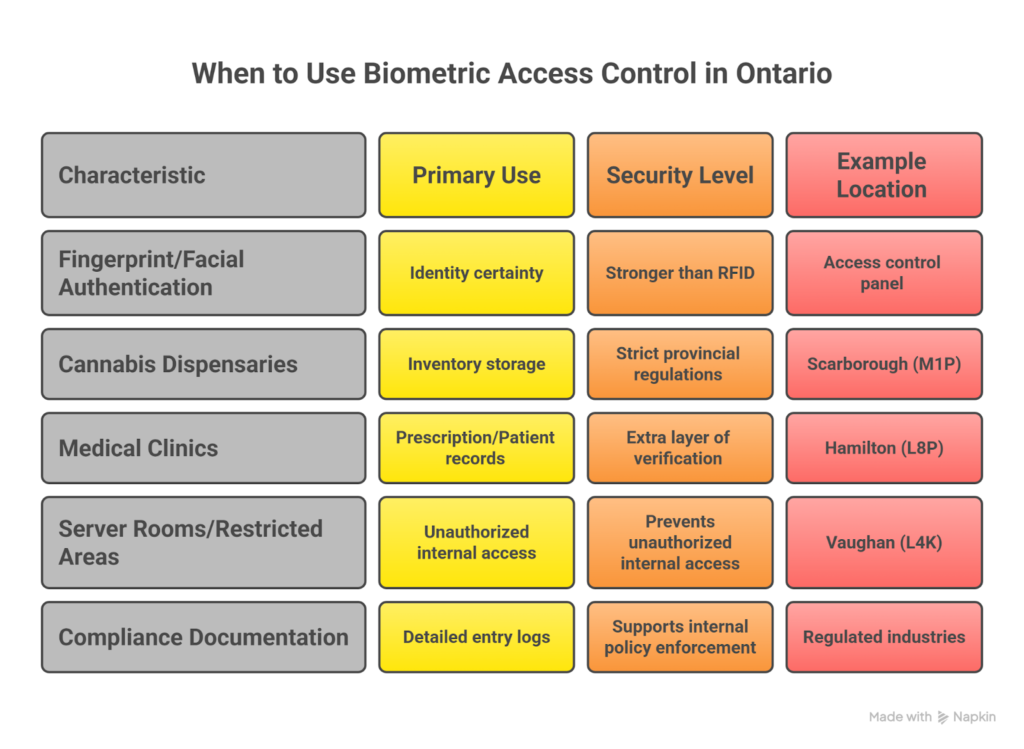
Biometric access control systems are best used when identity certainty is critical and shared credentials are no longer acceptable. Unlike cards, fobs, or PIN codes, biometric systems verify a person using fingerprint recognition or facial authentication. The credential cannot be borrowed or casually shared, which increases accountability.
Fingerprint and Facial Authentication
Fingerprint readers scan and match a stored biometric template before granting access. Facial recognition systems analyze facial features and compare them against encrypted data stored in the access control panel or cloud database. Once authenticated, the door controller releases the electric strike or magnetic lock and logs the event in the audit trail.
This level of authentication is stronger than standard RFID systems, especially for restricted zones.
Cannabis Dispensaries in Scarborough (M1P)
Cannabis retailers in Scarborough operate under strict provincial security regulations. Inventory storage rooms and vault areas require documented access control and precise entry log reporting.
Biometric systems help dispensaries demonstrate compliance during inspections by clearly showing who accessed controlled storage spaces and at what time.
Medical Clinics in Hamilton (L8P)
Medical clinics in Hamilton often use biometric authentication for:
- Prescription storage areas
- Patient record rooms
- Laboratory access
- Controlled medication cabinets
Because healthcare environments must protect personal health information, biometric access adds an extra layer of identity verification and strengthens compliance documentation.
Server Rooms and Restricted Manufacturing Areas
Industrial facilities in Vaughan (L4K) and logistics hubs in Mississauga (L5T) frequently protect:
- Server rooms
- Control panels
- Engineering departments
- Restricted production zones
In these environments, biometric access control prevents unauthorized internal access and improves accountability. Many facilities combine biometrics with RFID credentials as a multi-factor authentication setup.
Compliance Documentation and Audit Trails
Biometric access control systems generate detailed entry logs tied directly to verified individuals. For regulated industries in Ontario, this documentation supports internal policy enforcement, insurance claims, and regulatory audits.
Biometric systems are not required for every door. They are most effective when used in high security zones within a larger commercial access control infrastructure.
What Is Mobile and Cloud-Based Access Control in Ontario Commercial Buildings?
Mobile and cloud-based systems are increasingly popular across the GTA because they offer centralized management and remote control. A cloud-based access control Ontario businesses install stores user data and system management tools on a secure hosted platform rather than only on a local server.
Cloud Dashboard
Administrators log into a secure online dashboard from a laptop or mobile device. From this interface, they can:
- Add or remove users
- Modify access permissions
- Adjust time-based schedules
- Review entry log reporting
- Monitor real-time door activity
This is ideal for property managers overseeing multiple buildings across Toronto, Mississauga, and Vaughan.
Remote Credential Management
Mobile credentials allow employees or residents to use their smartphones as digital access passes. Instead of issuing physical cards, administrators send encrypted credentials remotely.
For example, a multi-location retail chain operating in Toronto and Mississauga can activate staff access without visiting the site. A condo corporation in North York (M2N) can issue temporary access for contractors through the cloud dashboard.
Multi-Location Retail Chains
Retail operators with several storefronts benefit from centralized control. Cloud-based systems allow managers to monitor multiple locations from a single platform, reducing administrative workload and improving oversight.
Condo Corporations
Condo buildings in Toronto and North York rely on cloud access control to manage resident credentials, visitor entry, and amenity access. When residents move out, credentials can be deactivated immediately without replacing hardware.
Integration With CCTV
Cloud-based systems can integrate with commercial CCTV platforms. Access events can sync with IP camera footage, allowing managers to match entry logs with recorded video. This strengthens theft prevention and investigation efficiency.
Mobile and cloud-based access control provides flexibility, scalability, and remote management for modern Ontario commercial buildings.
What Is On Premise Access Control for Warehouses and Industrial Units?
On-premises access control systems store data and management software on a local server inside the building. Unlike cloud platforms, the entire system operates through the internal network infrastructure.
An on-premises access control for warehouse installation is common in industrial and logistics environments across Ontario.
Local Server Infrastructure
In an on-premises setup:
- The access control panel connects to a dedicated server
- User databases are stored locally
- Entry logs are managed internally
- System updates are handled by internal IT
This approach gives businesses full control over their security infrastructure.
Internal IT Control
Manufacturing facilities in Vaughan (L4K) and logistics hubs in Mississauga (L5T) often have dedicated IT teams. These teams prefer to manage access control on their internal network, maintaining direct oversight of data storage and cybersecurity policies.
Manufacturing and Industrial Use
Industrial properties frequently require:
- Reliable LAN-based connectivity
- No dependency on internet uptime
- Secure internal server management
- High door volume control
On-premises systems are well-suited for high-traffic industrial facilities where network reliability and internal control are priorities.
Server-Based Security Infrastructure
Server-based access control allows businesses to manage large user databases, multiple door controllers, and detailed audit trails without recurring cloud subscription fees.
For warehouses and industrial units handling high-value inventory or proprietary manufacturing processes, local server infrastructure offers stability and direct control over system configuration.
Each of these system types serves different operational needs across Ontario’s commercial landscape. The right choice depends on risk level, property type, IT capacity, compliance requirements, and long-term growth plans.
What Is Role-Based Access Control and Why Does It Matter for Ontario Businesses?
Role Based Access Control, commonly known as RBAC, is a structured permission model used in modern commercial access control systems. Instead of assigning access door by door for every employee, permissions are grouped by job role, department, or responsibility level.
In simple terms, RBAC means people access what they need for their role, and nothing more.
RBAC Explanation in Commercial Settings
In an Ontario commercial building, employees are assigned to roles such as:
- Store Manager
- Warehouse Supervisor
- Administrative Staff
- Maintenance Technician
- IT Personnel
Each role is preconfigured inside the access control software. When a new employee joins, administrators assign the appropriate role. The system automatically applies the correct door permissions and time schedules.
This reduces human error and improves consistency.
Department Level Permissions
Department-level access control is critical in larger facilities such as:
- Warehouses in Mississauga (L5T)
- Manufacturing plants in Vaughan (L4K)
- Corporate offices in Toronto
For example:
- Sales staff can access front office areas only.
- IT staff can access server rooms.
- Warehouse workers can access loading docks during assigned shifts.
This structure prevents over-permissioning, which is a common internal security risk.
Audit Trail Reporting and Entry Log Management
RBAC strengthens audit trail reporting. Because permissions are tied to specific individuals and roles, entry logs clearly show:
- Who accessed a door
- At what time
- Under which permission group
- Whether access was granted or denied
For Ontario businesses handling inventory, personal data, or regulated products, entry log management becomes a key part of risk mitigation.
Commercial Compliance Benefits
Industries such as cannabis retail in Scarborough (M1P) and medical clinics in Hamilton (L8P) often require structured access documentation. RBAC supports compliance by limiting access to sensitive areas and generating documented proof of controlled entry.
For growing companies across Toronto and the GTA, Role-Based Access Control is not just a technical feature. It is an operational security strategy that reduces internal risk, simplifies user management, and improves accountability.
Which Type of Access Control System Is Best for Your Property Type in Ontario?
Choosing the right system depends on property type, operational complexity, and risk level. Below is a practical commercial comparison based on common Ontario business environments.
| Property Type | Recommended System Type |
| Retail – Toronto (M5V) | RFID card system or cloud-based access control for centralized management |
| Warehouse – Mississauga (L5T) | On-premises RFID system with CCTV integration for loading dock and inventory monitoring |
| Condo – North York (M2N) | Key fob access control combined with a cloud dashboard for resident management |
| Cannabis – Scarborough (M1P) | Biometric authentication with detailed audit logs and restricted area permissions |
| Manufacturing – Vaughan (L4K) | Role-based access control with on premise server infrastructure |
| Medical Clinic – Hamilton (L8P) | Smart card access control system with entry log reporting and compliance documentation |
If your property has:
- Multiple departments consider RBAC-enabled systems
- High compliance requirements choose smart card or biometric options
- Multi-location oversight, cloud-based access control
- Industrial infrastructure on a premise server-based system
- Residential resident turnover goes with a key fob with centralized management
Ontario commercial security is not one size fits all. Matching the access control type to the property’s operational reality ensures long-term reliability, scalability, and proper documentation.
The right system supports growth, reduces internal exposure, and strengthens physical security across your building.
What Are Common Mistakes Ontario Businesses Make When Choosing Access Control Types?
Choosing the wrong access control type can create long-term operational and security problems. Across Toronto, Mississauga, Vaughan, and Brampton, many commercial property owners focus only on price and overlook technical planning. Below are the most common mistakes seen in Ontario commercial installations.
Picking Old 125 kHz Credentials
Many businesses still install outdated 125 kHz proximity cards because they are cheaper. While functional, they offer limited encryption and are more vulnerable to cloning compared to 13.56 MHz smart credentials.
For offices in Vaughan (L4K) or retail stores in Toronto (M5V), choosing older credential technology may save money upfront but limit future scalability and integration flexibility.
No Battery Backup Planning
Ontario winters can cause power interruptions. Without proper battery backup, doors may default to fail-safe or fail-secure mode depending on configuration.
Warehouses in Mississauga (L5T) and logistics facilities in Brampton (L6T) must plan for uninterrupted operation during outages. Failing to include backup power supplies weakens reliability.
No Visitor Workflow for Condos
Condo corporations in North York (M2N) often install access control but forget to design a proper visitor management workflow.
Without structured temporary access permissions, audit trail reporting, and time-limited credentials, lobby entry management becomes inconsistent. This reduces the effectiveness of the entire system.
Underestimating Cabling and Door Hardware
Many business owners assume the cost revolves only around readers and credentials. In reality, structured cabling, electric strikes, magnetic locks, and proper door alignment significantly impact performance.
Industrial buildings in Vaughan (L4K) frequently require heavy-duty locking hardware. Ignoring this leads to installation delays and added cost later.
No Future Door Expansion Plan
A growing business in Toronto may start with two doors but expand to six within a year. Installing a non-scalable system forces hardware replacement instead of simple expansion.
Access control systems should be selected based on projected growth, not just current door count.
Avoiding these common mistakes improves long term reliability and cost efficiency across Ontario commercial properties.
When Should You Upgrade or Change Your Access Control System?
An access control system is not a one-time installation. Commercial security needs evolve. Below are clear indicators that it may be time to upgrade.
Growing Staff
As businesses hire more employees, managing shared codes or outdated credentials becomes inefficient. Role-based access control and structured credential management become necessary.
Retail chains expanding across Toronto and Mississauga often reach this stage quickly.
Multiple Locations
Managing separate standalone systems across multiple properties increases administrative workload.
Cloud-based or centralized management systems allow businesses operating in Vaughan, Brampton, and Toronto to control access from one dashboard.
Increased Theft or Security Incidents
If internal shrinkage or after-hours access concerns are rising, upgrading to encrypted smart credentials or integrating with CCTV strengthens investigation capability.
Warehouses in Mississauga (L5T) often upgrade when inventory discrepancies appear.
Legacy Hardware
Older access control panels, outdated NVR systems, and unsupported software limit integration options. Replacing legacy hardware improves cybersecurity, compatibility, and scalability.
Compliance Pressure
Industries such as cannabis retail in Scarborough (M1P) and medical clinics in Hamilton (L8P) face regulatory expectations for documented access control. Upgrading ensures proper audit trail reporting and restricted area enforcement.
If your current system no longer matches operational risk or compliance demands, an upgrade becomes a practical security investment rather than an optional improvement.
Final Thoughts: Choosing the Right Access Control System for Ontario Businesses
Selecting the right access control system in Ontario requires evaluating security level, scalability, compliance needs, operational workflow, and long-term cost efficiency. A small retail store in Downtown Toronto will not require the same infrastructure as a warehouse in Mississauga or a manufacturing facility in Vaughan.
Businesses should consider:
- Required security strength
- Future expansion plans
- Integration with CCTV and alarm systems
- Credential management structure
- Regulatory documentation requirements
The goal is not simply to install a door reader. The goal is to build a structured commercial security system that supports accountability, protects assets, and adapts to growth.
At Sense Group, we design and install commercial access control systems across Toronto, Mississauga, Vaughan, Brampton, North York, Hamilton, and surrounding GTA regions. Our approach focuses on proper hardware selection, scalable configuration, secure credential technology, and clean professional installation.
With the right planning and expert implementation, Ontario businesses can deploy an access control system that delivers long-term reliability, operational control, and measurable security value.