

Before your team mounts the next security camera at your Ontario facility, do you know what three separate laws have to say about where it points, what it records, and who you are required to notify?
Most commercial operators in the GTA approach security camera installation as a procurement and logistics problem. They pick a camera, find a location, run the cable, and get it live. The legal side rarely comes up until something goes wrong.
Installing cameras without meeting the requirements of PIPEDA, the Employment Standards Act, and the Criminal Code creates more than regulatory risk. It can expose your business to privacy investigations, civil lawsuits, employment standards fines, and, in specific cases involving audio recording or prohibited locations, criminal liability.
These obligations are clear and manageable.
This guide covers what that looks like in practice of security camera laws in Ontario. Let’s find out everything one by one from next.
What Are Security Camera Laws in Ontario Business?
Security camera laws Ontario rules are legal guidelines that govern how commercial operators can capture, use, and store surveillance footage. These rules do not come from a single document. Instead, they are a combination of federal privacy statutes, provincial labour codes, and common-law principles.
For the vast majority of private companies in Ontario, the primary law you must follow is PIPEDA, which stands for the Personal Information Protection and Electronic Documents Act.
This federal law treats a person’s physical image as protected personal data, meaning any video recording must follow clear privacy rules. Additionally, Ontario operators must comply with the province’s Electronic Monitoring Act, which requires specific company policies if you track your employees through surveillance gear.
Essentially, these laws ensure that your commercial security tools do not infringe on a citizen’s reasonable expectation of privacy. While you have a clear legal right to deter theft and secure your property, Ontario law requires you to be completely transparent about your surveillance.
This means you must limit your recording to public business areas, provide clear public notifications, and handle all your video storage with a high level of security.
Where Can Ontario Businesses Legally Install Security Cameras?
This is the practical question most warehouse managers and operations leads start with. You can monitor most operational areas of a commercial property. Specific zones are restricted. Others are completely off-limits regardless of the business reason you give.
The determining factor in every case is whether individuals have a reasonable expectation of privacy in that location. Courts and the OPC apply that test consistently. Building entrances and warehouse floors carry a low expectation. Washrooms carry an absolute one.
Locations Where Cameras Are Permitted on Commercial Property
Building entrances and exits are completely legal to monitor. You can also place cameras at loading docks, warehouse floors, parking lots, and retail sales floors. POS stations, server rooms, and construction perimeters are also permitted.
To record these areas, you must post proper signage. You also need to document your clear business purpose for the surveillance.
For shared lobbies in multi-tenant commercial buildings, cameras are allowed. However, you must notify all tenants first. You must also post warning signs at every single building entrance.
Locations Where Cameras Are Restricted
Break rooms and dedicated employee rest areas carry a higher expectation of privacy than warehouse floors or retail stockrooms. Cameras in these areas are not automatically prohibited, but they require stronger documented justification. The OPC expects a specific and demonstrable need, not a general one.
Private individual offices are treated on a case-by-case. An employee who works alone in a closed office has a reasonable expectation that they are not being monitored continuously. That expectation must factor into placement decisions.
Union meeting rooms may be restricted under collective agreements. Manufacturers, logistics operations, and construction companies with unionized workforces should review their collective agreements before placing cameras near these areas.
Locations Where Cameras Are Prohibited
Washrooms, change rooms, and locker areas are completely off-limits. Installing a camera in these locations is not a privacy complaint. It is a criminal offence under Section 162 of the Criminal Code, which covers voyeurism. The prohibition applies regardless of the business justification offered.
Cameras Pointed at Public Streets and Sidewalks
A camera mounted on the exterior of a warehouse or retail building will often capture part of a public sidewalk or street. That is generally tolerated when incidental to legitimate perimeter coverage. The camera cannot be positioned primarily to monitor public space.
Check local rules before mounting any exterior camera. You can also review our guidance on where to place cameras on commercial properties for practical positioning decisions.
For the vast majority of commercial installations across the GTA, warehouses, retail stores, offices, and construction sites, overt cameras are both legally appropriate and operationally sufficient.
What Does Ontario Law Say About Security Cameras in the Workplace?
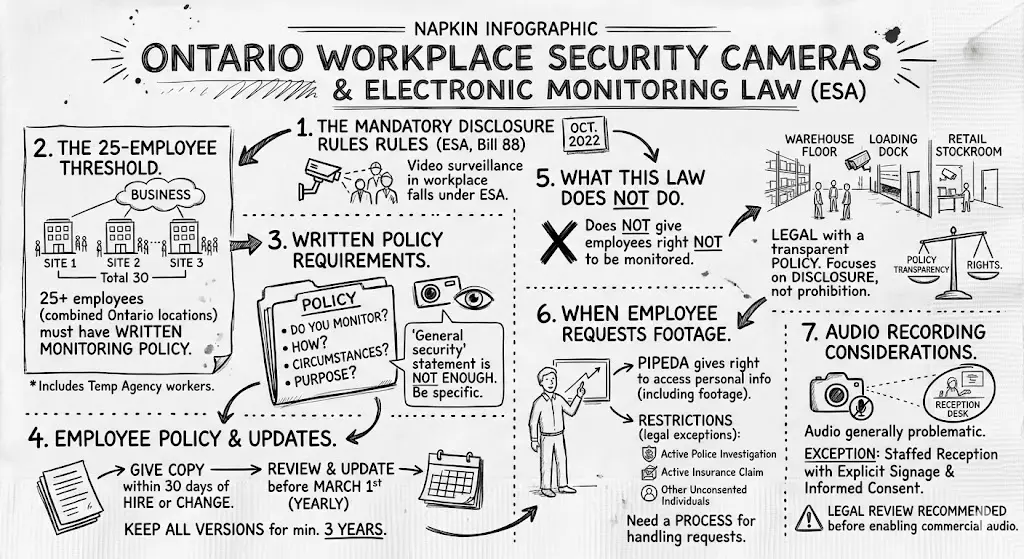
Ontario’s Employment Standards Act (ESA), amended by Bill 88, the Working for Workers Act, introduced mandatory electronic monitoring disclosure rules that came into effect in October 2022. Video surveillance in a workplace falls under this legislation. If you have cameras in your facility, these rules apply to you.
The 25-Employee Threshold
Any Ontario business with 25 or more employees must have a written electronic monitoring policy in place. The count includes all Ontario locations combined. Three sites with ten employees each put you at thirty, above the threshold. Temporary agency workers assigned to your facility count toward the total.
What the Written Policy Must Cover
The policy must state whether the employer monitors employees electronically. If you do, it must describe how monitoring occurs, under what circumstances, and for what purpose. A general statement that cameras are used for security is not sufficient. The policy should be specific enough that an employee reading it understands what is captured, where, and why.
How and When Employees Receive the Policy
Every employee must receive a copy within 30 days of being hired or within 30 days of any change to the policy. The policy must be reviewed and updated before March 1 of each year. You are required to keep a copy of every version of the policy for a minimum of three years.
What This Law Does Not Do
The ESA electronic monitoring rules do not give employees the right not to be monitored. They require transparency. You can legally monitor your warehouse floor, your loading dock, and your retail stockroom, provided employees are informed through a written policy. The law is about disclosure, not prohibition.
When an Employee Asks to See Footage of Themselves
PIPEDA gives individuals the right to request access to personal information an organization holds about them. And, that includes security camera footage. If an employee or a customer asks to see footage in which they appear, you are generally required to provide it unless a legal exception applies.
Active police investigations, active insurance claims, or footage involving other identifiable individuals who have not consented to disclosure are common grounds for restricting access. You need a process for handling these requests before someone submits one.
You can check whether your cameras record audio and how to verify your current NVR settings.
The one context where audio recording may be permissible is a staffed reception desk where signage explicitly discloses that conversations are recorded and individuals have the opportunity to make an informed decision before speaking.
Even in that scenario, legal review is recommended before enabling audio on any commercial system.
What Are the CCTV Signage Requirements for Ontario Businesses?
We are not yet done fully learning about security camera laws in Ontario. Signage is mandatory. PIPEDA requires businesses to inform individuals that video surveillance is occurring before they enter a monitored area. Properly placed signs constitute implied consent. Missing or inadequate signs are one of the most common reasons Ontario businesses face privacy complaints from employees and the public.
What a Compliant Sign Must Include
A compliant sign must state that video surveillance is in use. It must identify the purpose for loss prevention and site security is a common and acceptable formulation. It must include the business name or an individual the public can contact with questions or footage access requests.
Where the Signs Must Be Posted
Signs go at the entry point to the monitored area before individuals step into the zone being recorded. A sign posted inside a warehouse after the entrance does not satisfy the requirement. Every access point to a monitored zone needs coverage.
Large commercial sites with multiple entrances, loading areas, and side doors each need their own signage. One sign at the front entrance of a facility with ten camera-covered access points does not meet the standard.
What Fails the Legal Standard
A small sticker on the inside of a glass door does not meet the standard. A generic security in use placard with no business contact and no stated purpose does not meet the standard.
Signage must be visible and legible enough that a person approaching the entry can read it before they step inside. For office security camera installations and multi-floor commercial buildings, a signage plan should be part of the installation scope from day one.
How Long Can Ontario Businesses Keep Security Camera Footage?
PIPEDA requires that footage be retained only as long as necessary for the purpose for which it was collected. There is no fixed number written into the legislation. Industry practice and OPC guidance point to 30 to 90 days as the standard range for most commercial operations in Ontario.
Standard Retention Periods by Business Type

| Business Type | Standard Retention | Key Note |
| Warehouses and logistics operations | 30 to 90 days | Document your retention period in your surveillance policy |
| Retail stores and franchise locations | 30 to 60 days | Adjust upward if incident rate justifies it |
| Construction sites and equipment yards | Project duration plus 30 days | Equipment theft and subcontractor liability coverage |
| Corporate offices | 30 to 90 days | Higher-traffic areas may warrant longer retention |
| Financial sector businesses | 6 to 12 months | Regulatory requirements may extend the standard |
| Multi-tenant commercial buildings | 30 to 90 days | Retention policy must be disclosed to all tenants |
Footage Tied to an Active Incident or Insurance Claim
If a theft, injury, insurance claim, or workplace investigation is underway, the relevant footage must be preserved until the matter is fully resolved. Export that footage from your NVR immediately and store it separately. Loop recording will overwrite it otherwise, and you will not be able to retrieve it.
Insurance underwriters in Ontario increasingly require NVR-based systems with verified retention capacity for footage to be admissible in commercial liability claims.
A cloud-only consumer setup with subscription-dependent storage typically does not meet this standard. For guidance on managing footage across multiple sites effectively, see our separate guide.
Secure Destruction and Access Controls
Once the retention period expires, footage must be permanently deleted, not just passively overwritten through loop recording. Your surveillance policy should document the destruction procedure in writing.
NVR access should be restricted to authorized personnel only through role-based permissions, with audit logs tracking who views or exports footage.
When Police or Insurers Request Footage
Police can request footage voluntarily. You are not required to hand it over without a production order or warrant, but cooperating with law enforcement during an active investigation is generally the appropriate course.
Insurance companies and legal counsel may also request footage in connection with a liability claim. Have a clear internal process for handling these requests before one arrives at your facility.
What Security Camera Rules Apply to Ontario Warehouses Retail Stores and Construction Sites?
The law is the same across industries. What changes are the application, the specific zones that matter, the employee count thresholds that trigger ESA obligations, the insurance documentation requirements, and the practical risks each operation is managing day-to-day?
Warehouses and Distribution Centres
Loading docks, inventory aisles, forklift zones, vehicle access gates, and perimeter fencing are all standard camera positions for warehouse operations. Footage from these areas supports loss prevention and documents incidents for WSIB claims and OHSAS compliance purposes.
Sense Group has installed systems in facilities from Milton warehouses to distribution operations across Barrie and Mississauga.
Integrating cameras with access control in Barrie or across your GTA facility lets you match access card events to camera footage automatically.
Retail Stores and Franchise Operations
Sales floors, POS stations, and stockrooms are standard coverage areas for retail operations. If you use camera footage to analyze customer behaviour patterns, traffic flow, dwell time, product interaction, that purpose must be stated specifically on your signage.
Loss prevention documentation from POS cameras has repeatedly helped GTA retailers defeat fraudulent slip-and-fall claims.
Our retail CCTV installation service covers single locations and multi-branch franchise networks in Toronto, Hamilton, and Kitchener. See how Toronto businesses are using CCTV to reduce shrinkage and build liability documentation.
Construction Sites and Equipment Yards
After-hours perimeter monitoring of equipment yards and material storage areas is clearly justified and operationally straightforward.
Temporary camera setups, trailer-mounted or pole-mounted, must still carry PIPEDA-compliant signage even on active job sites. Subcontractor agreements should reference surveillance disclosure so all parties on site understand they are being recorded.
Our construction site camera installations are built for temporary deployment and extended outdoor operation in Ontario weather conditions.
Corporate Offices and Multi-Tenant Commercial Buildings
Entrances, corridors, parking structures, and reception areas are appropriate camera positions for office and commercial building environments.
Private offices and meeting rooms require documented justification before placement. Facilities managers handling multi-tenant commercial buildings must notify all tenants and post signage at every access point in common areas.
Integrating camera systems with building-wide access control gives property managers a complete picture of movement through the facility. Read our guide on integrating cameras with access control systems for a full picture of how the two systems work together.
What Are the Consequences of Non-Compliance for Ontario Businesses?
PIPEDA Violations
A complaint filed with the Office of the Privacy Commissioner triggers a formal investigation. If the OPC finds a violation, it can issue orders requiring you to remove cameras, delete footage, or revise your surveillance practices.
Civil lawsuits from employees or customers under the tort of intrusion upon seclusion are also possible. Ontario courts have recognized this as a valid legal claim.
Ontario ESA Violations
Failing to produce a written electronic monitoring policy when you have 25 or more employees carries a fine of $250 per employee per contravention. That number scales quickly in a warehouse or retail operation with 50, 100, or 200 staff. The fine applies per affected employee, not per incident.
Criminal Code Violations
Illegal audio recording through commercial surveillance cameras, where no consent exists, carries a maximum penalty of five years imprisonment under Section 184.
Installing cameras in washrooms or change rooms is prosecuted under Section 162 with similar penalties. These are criminal charges, not regulatory fines.
Insurance and Contractual Exposure
Footage obtained in violation of Ontario privacy law may be inadmissible in an insurance claim or legal proceeding. A system that was never configured correctly can work against you at the exact moment you need it most.
Commercial underwriters are increasingly reviewing CCTV compliance as part of property and liability policy renewals, particularly for warehouses and multi-tenant commercial buildings.
Sense Group Installs Compliant Commercial Security Camera Systems Across the GTA
We have installed commercial CCTV systems across Ontario for 15 years. Our work covers warehouses, retail chains, construction sites, corporate offices, and multi-tenant commercial buildings throughout Toronto, Mississauga, Hamilton, Barrie, Kitchener, Guelph, Milton, Huntsville, and Caledon.
Every system we configure ships with audio disabled, privacy masking set where required, retention periods programmed, and role-based NVR access established. We work with commercial-grade equipment from Axis, Ubiquiti, UNV, and Verkada, systems built for continuous commercial operation in Ontario conditions.
Our installations cover the full scope: site assessment, camera placement documentation, network cabling in GTA infrastructure, NVR configuration, and handover documentation, including as-built drawings.
We also integrate CCTV with access control systems and structured cabling, which reduces total project cost when both are scoped together.
Final Thoughts on Security Camera Laws in Ontario
Ontario’s security camera laws are not obstacles. They are the framework that makes your surveillance system legally defensible in a privacy complaint, a civil lawsuit, an insurance claim, or a criminal investigation.
Get the placement right. Disable audio. Post the signs before cameras go live. Write the policy. Set your retention period and document your destruction procedure.
That is what a compliant commercial system looks like. If you want it installed correctly from day one, Sense Group handles the technical side across the GTA. Reach out through our contact page to get started.