Integrate access control with CCTV to create a smarter and more accountable commercial security system. For businesses across Ontario, managing doors and cameras separately often leaves gaps during investigations.
When systems operate together, every credential swipe, denied entry, or forced door event can instantly link to recorded video footage.
Retail stores in Toronto, warehouses in Mississauga, condo buildings in North York, and industrial units in Vaughan increasingly rely on integrated security platforms to strengthen theft prevention and compliance documentation. Instead of reviewing hours of footage manually, managers can match access logs with time-stamped camera recordings in seconds.
In this guide, we explain how integration works, what equipment is required, and how Ontario commercial properties can build a centralized security system that improves visibility, accountability, and operational control.
What Does It Mean to Integrate Access Control With CCTV Systems?
To integrate access control with CCTV systems means connecting your door access system and video surveillance system so they communicate in real time. Instead of operating separately, the access control panel, door controller, and camera system share data through a centralized security platform.
In commercial environments across Ontario, this integration allows every door event to link directly to recorded video footage. The result is synchronized visibility. When a credential is presented at a reader, the system does not just unlock the door. It also communicates with the Video Management System VMS or Network Video Recorder NVR to mark or trigger associated camera footage.
Below are the core outcomes of integrating access control with CCTV systems:
Access Event and Video Synchronization
When a user taps a key fob or card, the door controller processes credential authentication. Once authorized, the access control panel logs the event and sends a signal to the VMS. The system creates an event-triggered recording or camera bookmark tied to that specific access event.
This synchronization means:
- The access log shows the user name and timestamp
- The VMS displays the exact IP camera footage from that moment
- Managers can review entry activity instantly without scanning hours of recordings
For retail theft prevention in Toronto (M5V), this is critical. If inventory goes missing from a stockroom, management can check which employee accessed the room and view the corresponding time-stamped video clip immediately.
Credential Authentication Linked to Camera Footage
Credential authentication verifies identity through a key fob, access card, PIN, or mobile credential. When integrated properly:
- Each approved entry is paired with a video confirmation
- Each denied access attempt can trigger recording and alerts
- Forced door events automatically create flagged footage
In warehouse facilities in Mississauga (L5T), loading dock access can be matched with camera views to confirm deliveries and employee activity. This improves accountability and reduces internal risk.
Entry Log Reporting With Time-Stamped Video
A standalone access control system generates entry log reporting. A standalone CCTV system records video. But when integrated, entry logs are enhanced with visual verification.
The VMS displays:
- User identity
- Door location
- Exact timestamp
- Linked video playback
For regulated businesses such as cannabis dispensaries in Scarborough (M1P) or medical clinics in Hamilton (L8P), this dual record strengthens compliance documentation and incident investigation workflow.
Standalone Systems vs Integrated Security Platform
In a standalone setup:
- Access control and CCTV operate independently
- Investigations require manual cross-checking
- Time matching can be inaccurate
- Monitoring is fragmented
In an integrated security platform:
- The access control panel communicates directly with the VMS
- IP cameras respond to door events
- Event-triggered recording improves efficiency
- All data appears within one dashboard
For condo buildings in North York (M2N), this means a property manager can see who entered the lobby and immediately view camera footage from the same screen.
Integration transforms separate hardware systems into a centralized commercial security infrastructure. Instead of managing doors and cameras individually, Ontario businesses gain synchronized event monitoring, faster investigations, and stronger operational control across retail, warehouse, industrial, and multi-tenant properties.
What Are the Key Benefits of Integrating Access Control With CCTV for Ontario Businesses?
For commercial properties across Ontario, integrating access control with CCTV is not just a technical upgrade. It directly improves operational visibility, accountability, and risk management.
Below are the measurable business advantages of commercial access control and surveillance integration.
Faster Incident Investigation
When systems operate separately, investigations require manually matching timestamps between access logs and video recordings. This process is slow and often inaccurate.
With integration:
- Entry events automatically link to recorded footage
- Camera bookmarks are created at the exact time of credential authentication
- Security managers can review incidents within minutes
In Downtown Toronto retail environments, where shrinkage can impact margins quickly, faster investigation reduces loss exposure and operational downtime.
Video Verification of Entry Events
An access log alone confirms that a credential was used. It does not visually confirm who used it.
Integrated systems provide:
- Visual confirmation of the individual entering
- Verification of tailgating incidents
- Confirmation of denied access attempts
For medical clinics in Hamilton (L8P), this ensures that only authorized staff enter restricted file rooms or medication storage areas, adding a layer of visual validation to credential data.
Reduced Internal Theft
Internal loss remains a concern in warehouses and logistics hubs. In warehouse access control CCTV integration, each loading dock entry can be paired with video footage.
In Brampton logistics units (L6T), this means:
- Monitoring after-hours access
- Confirming inventory movement
- Linking employee credentials with physical activity
The presence of synchronized monitoring alone often acts as a deterrent.
Stronger Compliance Documentation
Regulated industries require documented proof of restricted access. Integrated systems provide:
- Time-stamped entry logs
- Linked video confirmation
- Searchable audit trail reports
For cannabis dispensaries in Scarborough (M1P), compliance inspections may require evidence of controlled access to inventory rooms. Integration simplifies this process by providing both access records and supporting video within one platform.
Improved Insurance Claim Support
When theft or vandalism occurs, insurance providers often request detailed evidence.
Integrated systems strengthen claims by providing:
- Verified entry timestamps
- Associated camera footage
- Documented access control history
Retail theft prevention in Downtown Toronto benefits significantly from having synchronized logs and footage ready for submission.
Real Time Security Alerts
Integrated systems can trigger alerts when:
- Access is denied repeatedly
- A door is forced open
- Entry occurs outside scheduled hours
The system can activate camera recording, send notifications, or flag events inside the VMS dashboard. This real-time response improves proactive security management.
Centralized Multi-Site Monitoring
For businesses operating multiple locations across Ontario, integration allows centralized monitoring through one interface.
Retail chains, condo corporations, and warehouse operators can:
- Monitor multiple doors and cameras
- Review events across different cities
- Maintain standardized reporting
This is particularly valuable for businesses with sites in Toronto, Mississauga, Vaughan, and Hamilton.
Integrating access control with CCTV transforms isolated hardware systems into a coordinated commercial security infrastructure. It reduces investigation time, strengthens documentation, and enhances accountability across retail, warehouse, medical, and regulated commercial environments throughout Ontario.
How Does Access Control and CCTV Integration Work in Commercial Buildings?
In commercial properties across Ontario, integration is not theoretical. It follows a structured event chain that connects physical door activity to recorded video inside a centralized security platform. Whether it is a warehouse in Mississauga (L5T) or a condo lobby in North York (M2N), the process works in a clear sequence.
Structured Process of Integration
1. Credential Authentication at the Reader
An employee, resident, or contractor presents a key fob, access card, mobile credential, or PIN at the door reader. The credential data is sent to the door controller for verification.
2. Door Unlock Event Sent to Access Control Panel
The access control panel validates permissions based on role-based access control and time schedules. If approved, the system unlocks the door through an electric strike or magnetic lock.
3. Event Transmitted to the VMS
At the same moment, the access event is transmitted to the Video Management System VMS through integration software or API connection. The VMS receives metadata, including user ID, door location, and timestamp.
4. Camera Bookmark or Event Trigger Created
The system initiates event-triggered recording or creates a camera bookmark within the Network Video Recorder NVR. The IP camera positioned at that door is automatically tagged.
5. Video Linked to Entry Log
The access log entry now includes a direct link to the corresponding video footage. Security personnel can click the event and immediately review the associated recording.
This synchronized workflow eliminates manual cross-checking between separate systems.
In cloud-based environments, integration occurs through hosted platforms where both systems share event data securely. In on-premises installations, the access control server communicates directly with the VMS over the local network.
Real Commercial Use Cases in Ontario
Warehouse Loading Dock – Mississauga (L5T)
When a warehouse employee accesses a loading dock door, the credential authentication event triggers the exterior IP camera to record and bookmark footage. If inventory discrepancies occur, management can instantly verify who accessed the dock and review visual confirmation of truck activity.
Condo Lobby – North York (M2N)
When a resident taps a key fob at the main entrance, the lobby camera records the event. Property managers can review time-stamped footage alongside entry logs, improving visitor monitoring and reducing unauthorized access concerns.
In commercial buildings, integration transforms separate systems into a coordinated security infrastructure. It improves investigation speed, increases accountability, and provides structured documentation that standalone access control or CCTV systems cannot deliver independently.
What Equipment Is Required to Integrate Access Control With CCTV?
Integrating access control with CCTV in a commercial building requires more than simply connecting a camera near a door. It involves coordinated hardware, compatible software, and properly configured network infrastructure. For Ontario retail stores, warehouses, condo buildings, and industrial facilities, the goal is to create a reliable and synchronized security ecosystem.
Below is a clear commercial breakdown of the required components.
Access Control Panel
The access control panel acts as the decision-making unit. It receives credential data from door readers, verifies permissions, unlocks doors, and generates event logs.
For integration, the panel must support communication with a Video Management System through API or software-level integration. Commercial-grade systems from HID, Honeywell, or cloud platforms like Brivo often support this functionality.
Without a capable panel, video synchronization cannot occur.
Door Readers and Credentials
Door readers capture credential authentication events. These may include RFID readers, smart card readers, or mobile credential readers.
Every access attempt generates a data event. That event is what triggers the CCTV system to mark or record video. Reliable reader hardware ensures accurate timestamping and event logging.
IP Cameras
IP cameras are essential for integration. Analog cameras connected to basic DVRs typically do not support advanced event syncing.
Commercial-grade IP cameras from Axis Communications, Hanwha Vision, or Avigilon provide:
- High-resolution video
- Event tagging capability
- ONVIF compatibility
- Network connectivity
These features allow the camera feed to be linked directly to door access events.
VMS Software
The Video Management System VMS is the central platform where integration happens. Solutions such as Genetec Security Center or Avigilon Control Center allow access control events to appear inside the video dashboard.
The VMS:
- Receives event data from the access control system
- Creates bookmarks or triggers recording
- Displays entry logs beside camera footage
- Enables fast search using timestamps
Without VMS software, integration remains limited.
Network Switch and Infrastructure
Because both systems operate over IP networks, a commercial-grade network switch is required.
The network must support:
- Stable bandwidth
- Secure segmentation
- Reliable connectivity between the panel and the cameras
In Ontario warehouses and multi-door facilities, unmanaged consumer-grade networking often leads to performance issues. Structured network planning is critical.
Structured Cabling
Low-voltage structured cabling connects:
- Door readers to controllers
- Controllers to network switches
- IP cameras to recording systems
Clean installation ensures signal reliability and long-term system stability, especially in industrial areas like Mississauga (L5T) or Vaughan (L4K).
Integration Licensing
Most VMS platforms require integration licensing. This software license allows the access control system to communicate with the video system.
Licensing cost depends on:
- Number of doors
- Number of cameras
- Type of integration module
Commercial properties must account for this during planning.
Same Brand vs Cross Brand Integration
Many Ontario businesses ask whether both systems must be the same brand.
Same Brand Integration
When both systems come from a single ecosystem, such as Avigilon or Genetec, integration is typically smoother. Configuration is simplified, compatibility is verified, and support is centralized.
This is common in new commercial developments or full security upgrades.
Cross Brand Integration
Cross-brand integration is also possible when systems support:
- API connectivity
- ONVIF standards
- Open platform compatibility
For example, an HID access control system may integrate with Axis IP cameras through a compatible VMS.
However, compatibility planning is critical. Legacy NVRs or outdated controllers may not support modern integration modules.
Before integrating systems in a Toronto retail store, North York condo, or Mississauga warehouse, a compatibility review must confirm:
- Controller firmware version
- VMS integration support
- Camera protocol compatibility
- Network capacity
- Licensing requirements
Skipping this step often leads to partial functionality or unstable synchronization.
Proper equipment selection and professional configuration transform separate security components into a fully integrated commercial security platform.
Cloud Based vs On Premise Integration: What Is the Difference?
When integrating access control with CCTV, Ontario businesses must decide how the two systems will communicate and where the data will be managed. The choice between cloud-based access control and CCTV integration and server-based security system integration in Ontario depends on infrastructure, IT capacity, and operational needs.
Below is a clear commercial comparison.
| Feature | Cloud Integration | On-Premise Integration |
| Data Storage | Stored securely in cloud servers managed by the provider | Stored locally on a server inside the building |
| Remote Monitoring | Built-in remote dashboard accessible via browser or mobile app | Remote access requires VPN configuration |
| Licensing Model | Subscription-based monthly or annual licensing | One-time software license, possible support contracts |
| IT Responsibility | Vendor manages updates, patches, and system security | Internal IT manages server maintenance and cybersecurity |
| System Updates | Automatic updates pushed by the provider | Manual updates scheduled by IT staff |
| Multi-Site Management | Centralized control across multiple Ontario locations | Separate server management at each site |
| Internet Dependency | Requires internet for dashboard access | Operates primarily on the local network |
| Initial Infrastructure Cost | Lower upfront hardware investment | Higher upfront cost due to server hardware |
| Scalability | Easily expandable by adding licenses | May require server upgrades for expansion |
In a cloud-based integration model, access events and video data are synchronized through a hosted platform. The provider manages system updates, cybersecurity patches, and backend infrastructure.
This approach is commonly selected by retail chains in Toronto and condo corporations managing multiple properties across the GTA because it simplifies remote monitoring and reduces internal technical workload.
In contrast, server-based security system integration in Ontario businesses keeps data within the building. The access control panel and Video Management System communicate through a local server inside the facility.
This model is often preferred by warehouses in Mississauga and industrial buildings in Vaughan that maintain dedicated IT teams and require direct control over network policies.
The security performance can be strong in both models. The real distinction lies in who manages the infrastructure, how costs are distributed over time, and how the organization handles cybersecurity and expansion.
What Happens During a Security Incident When Systems Are Integrated?
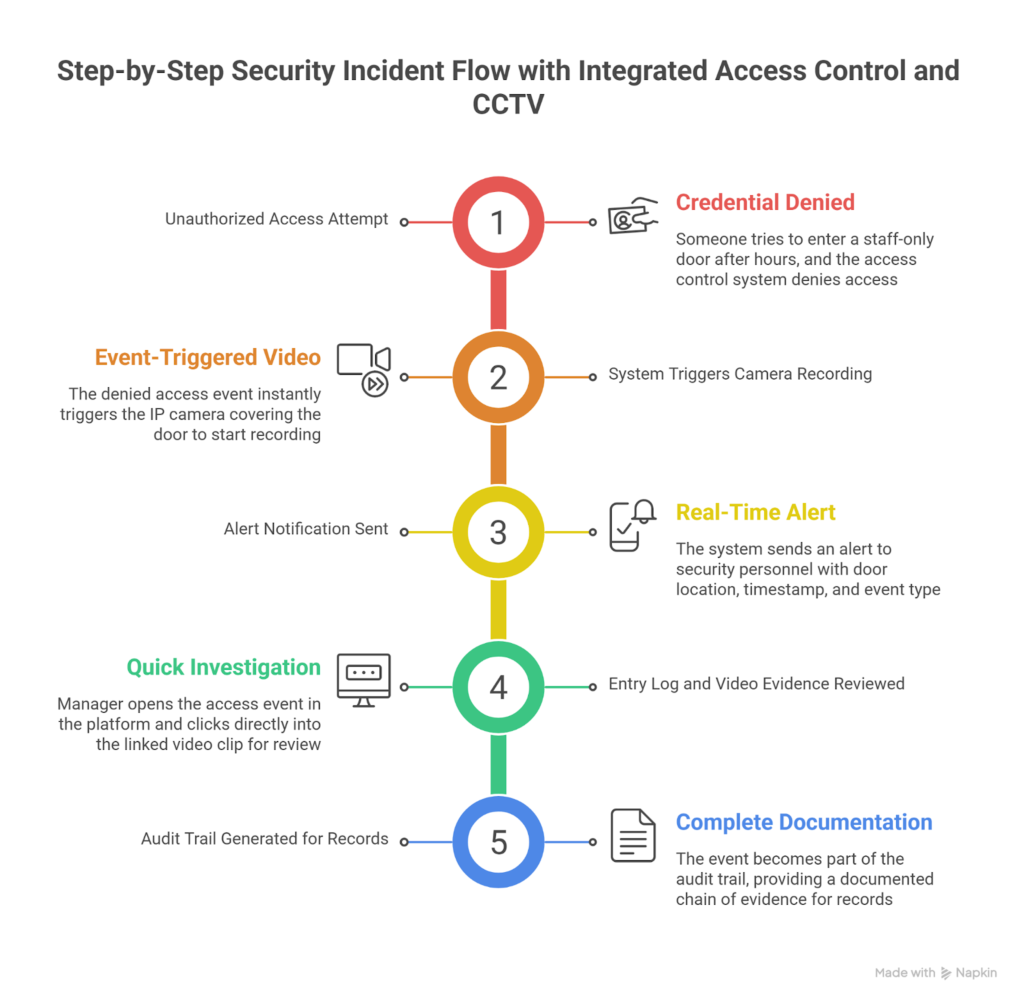
Here’s what a real incident looks like when access control and CCTV are properly integrated in a commercial setting. This is the kind of workflow Ontario businesses want because it turns a messy investigation into a clean, time-stamped sequence.
Step-by-step incident flow
1. Unauthorized access attempt
After hours in a Vaughan industrial unit (L4K), someone presents a credential at a staff-only door or tries a PIN multiple times. The door reader sends the request to the door controller. The access control panel checks permissions and time schedules.
The request is denied because the credential is inactive or access is outside allowed hours.
2. System triggers camera recording
That denied event is instantly pushed to the Video Management System. The camera covering the door, often an IP camera, creates an event marker and starts event-triggered recording. If the setup includes forced door detection, a door contact can also trigger recording if the door is opened without authorization.
3. Alert notification sent
The system generates an alert tied to that event. Depending on the configuration, it can notify a security lead, site supervisor, or monitoring contact. The alert includes the door location, timestamp, and event type, such as denied access or forced entry.
4. Entry log and video evidence reviewed
Instead of searching through hours of footage, the manager opens the access event in the platform and clicks directly into the linked clip. The entry log reporting shows the exact time, door, and credential ID, while the video confirms who was at the door and what happened.
5. Audit trail generated for records
The event becomes part of the audit trail. The business now has a complete record: the denied access attempt, the time-stamped video, and the system response. This is useful for internal documentation, police reporting if needed, and insurance support.
In short, integration turns a security incident into a documented chain of evidence. For commercial properties in Vaughan and across the GTA, that speed and clarity is the difference between guessing and knowing.
Are There Any Limitations or Challenges When Integrating Access Control With CCTV?
Integrating access control with CCTV delivers strong commercial value, but Ontario businesses should understand the practical challenges before upgrading. A well-planned system performs reliably. A poorly planned integration can create performance gaps, compatibility issues, or unnecessary costs.
Below are the most common considerations.
Compatibility Issues With Older Systems
One of the biggest limitations involves legacy hardware. Older access control panels or outdated Network Video Recorders may not support modern API communication or event synchronization.
Legacy NVR compatibility is a common issue in retail stores and industrial buildings that installed cameras years ago. Some older systems lack integration modules or firmware support required for real-time event linking.
Before integration, a compatibility assessment should confirm:
- Controller firmware version
- VMS integration capability
- Camera protocol support
- Licensing availability
In some cases, partial hardware upgrades are required to achieve full functionality.
Network Bandwidth Considerations
Integrated systems operate over IP networks. When access events trigger high-resolution IP camera recording, network traffic increases.
Warehouses in Mississauga (L5T) and multi-camera condo buildings in North York (M2N) must evaluate:
- Switch capacity
- Cable quality
- Network segmentation
- Storage throughput
Insufficient bandwidth can cause delayed event syncing or video buffering during playback.
Licensing Cost
Integration is not just hardware-based. Many VMS platforms require additional integration licensing. Costs may depend on:
- Number of doors
- Number of cameras
- Type of integration module
Businesses planning large-scale deployments across Vaughan industrial units (L4K) or Toronto commercial buildings must account for licensing as part of the total project budgeting.
Initial Configuration Complexity
Integration requires proper configuration between the access control panel and the VMS platform. Event mapping, camera assignment, alert triggers, and permission rules must be set accurately.
Improper setup can result in:
- Events not appearing in the video
- Incorrect timestamp alignment
- Incomplete audit trails
This is not a plug-and-play process. It requires structured configuration.
Requires Professional Setup
Because integration connects multiple systems across networking, access control hardware, and video platforms, professional installation is strongly recommended.
A professional integrator will:
- Verify hardware compatibility
- Configure API connections
- Test event triggered recording
- Validate entry log synchronization
- Optimize network performance
Skipping professional configuration increases the risk of partial functionality.
Upgrade Path From Standalone Systems
Many Ontario businesses currently operate standalone access control and CCTV systems. Upgrading does not always require full replacement.
An upgrade path may include:
- Adding integration modules to existing VMS
- Updating firmware on controllers
- Replacing legacy NVRs with integration-capable platforms
- Adding compatible IP cameras where needed
A structured assessment can determine whether partial upgrades are sufficient or if a full system modernization is more cost-effective.
Integrating access control with CCTV strengthens commercial security infrastructure, but it requires careful compatibility planning, network evaluation, and professional configuration. When executed properly, the system operates as a unified platform rather than separate technologies working in isolation.
How Much Does It Cost to Integrate Access Control With CCTV in Ontario?
The access control and CCTV integration cost Ontario businesses should expect depends on door count, camera count, infrastructure readiness, and licensing model. Below are realistic estimated commercial ranges for GTA properties.
Estimated Integration Cost by Property Type
| Property Type | Doors & Cameras | Estimated Investment Range (CAD) | Typical Scope Included |
| Retail Store – Toronto (M5V) | 2 doors, 2–4 IP cameras | $6,000 – $12,000 | Access control panel, readers, IP cameras, VMS integration license, cabling, configuration |
| Warehouse – Mississauga (L5T) | 10 doors, 8–16 IP cameras | $18,000 – $35,000 | Multi-door controller, industrial readers, warehouse-grade cameras, VMS platform, network setup, integration module |
| Condo Building – North York (M2N) | 20 doors, 15–30 IP cameras | $35,000 – $75,000+ | Scalable access system, centralized VMS, lobby & garage cameras, structured cabling, cloud or server setup |
What Impacts These Costs?
Hardware
Commercial-grade access control panels, door readers, IP cameras, and power supplies.
VMS Licensing
Software platforms such as Genetec or Avigilon require per-door or per-camera licensing for integration.
Integration Module
API connectors that allow access control panels to communicate with the VMS.
Structured Cabling
Low-voltage wiring for doors and network cabling for IP cameras.
Configuration & Testing
Event mapping, camera linking, audit trail verification, and system validation.
Cloud Subscription (if selected)
Monthly or annual fees for hosted dashboards and remote monitoring.
Smaller retail environments in Downtown Toronto usually fall within lower five-figure budgets. Mid-sized warehouses in Mississauga require higher investment due to industrial installation complexity. Larger condo properties in North York involve infrastructure scale, multi-floor wiring, and long-term licensing considerations.
Integration is not just an add-on. It is a structured security upgrade that connects door events with verified video evidence. For Ontario businesses handling inventory, residents, regulated products, or sensitive data, the operational value often outweighs the integration cost over time.
Which Commercial Properties Benefit the Most From Integrated Security Systems?
Not every property requires the same level of security coordination. However, in Ontario’s commercial environment, certain industries gain significant operational and financial value when access control and CCTV function as one integrated platform.
Below is a clear breakdown of where integrated systems deliver the strongest return.
| Property Type | Why Integration Matters |
| Retail Stores | Theft prevention through synchronized stockroom access logs and camera verification. Managers in Downtown Toronto (M5V) can match employee credential use with time-stamped footage during shrinkage investigations. |
| Warehouses | Loading dock monitoring and shift control. In Mississauga (L5T) logistics hubs, integration confirms who accessed shipping areas and visually verifies inventory movement during after-hours operations. |
| Condo Buildings | Visitor entry verification and resident access confirmation. In North York (M2N), property managers can review lobby access events and instantly view corresponding camera footage for incident resolution. |
| Cannabis Retail | Regulatory documentation and controlled inventory room monitoring. In Scarborough (M1P), integrated audit trails support compliance inspections and demonstrate restricted access enforcement. |
| Manufacturing Facilities | Restricted area monitoring within production floors and equipment zones. Industrial units in Vaughan (L4K) use integration to confirm authorized personnel entry into sensitive operational areas. |
| Medical Clinics | Patient data protection and medication storage control. Clinics in Hamilton (L8P) benefit from entry log reporting linked to video verification, strengthening privacy compliance and internal accountability. |
In each of these commercial settings, integration reduces investigation time, improves documentation accuracy, and strengthens operational control. The value is not just in recording activity. It is in synchronizing access data with visual evidence, creating a structured and defensible security workflow that standalone systems cannot provide.
When Should You Upgrade to an Integrated Access Control and CCTV System?
Many Ontario businesses start with standalone access control or basic CCTV. Over time, operational demands increase. Integration becomes necessary when security gaps begin affecting daily workflow, compliance, or risk exposure.
A growing business is often the first trigger. As retail stores expand in Toronto or warehouses scale operations in Mississauga, managing doors and cameras separately becomes inefficient. More employees, more credentials, and more entry points require synchronized monitoring.
Increased theft is another indicator. If internal shrinkage or after-hours incidents are rising, linking entry logs with time-stamped footage provides faster verification and stronger deterrence.
Businesses operating multiple locations across the GTA also benefit from centralized monitoring. Integrated platforms allow managers to review access events and video from one dashboard instead of separate systems.
Compliance pressure is common in regulated sectors such as cannabis retail in Scarborough or medical clinics in Hamilton. Integrated audit trails support inspections and documentation requirements.
Outdated legacy systems are another reason to upgrade. Older NVRs and standalone panels often lack real-time event synchronization, making investigations slow and incomplete.
When security visibility becomes fragmented, integration becomes a strategic upgrade rather than a technical option.
Final Thoughts: Is Access Control and CCTV Integration Worth It for Ontario Businesses?
For commercial properties across Ontario, integration delivers measurable operational value. It provides stronger security visibility by connecting door activity with video evidence in real time.
It shortens investigation time by eliminating manual cross-checking. It builds scalable infrastructure that supports growth, additional doors, and multiple locations.
At Sense Group, we design and install integrated access control and CCTV systems for retail stores, warehouses, condo buildings, medical clinics, and industrial facilities throughout Toronto, Mississauga, Vaughan, Brampton, and surrounding GTA regions.
Our approach focuses on compatibility planning, structured cabling, clean configuration, and long-term reliability.
When properly implemented, integration transforms separate security tools into one coordinated commercial platform. For Ontario businesses focused on risk reduction and operational control, it is a practical and future-ready investment.