If you run a distribution centre, a 3PL fulfillment hub, or a manufacturing warehouse in the GTA, you already know inventory does not always match the ledger. The size of that gap has gotten worse than most operators realize.
Employee theft inside the building accounts for close to 42% of total warehouse shrinkage, on top of that.
Those two numbers explain why warehouse theft prevention cameras have stopped being a nice-to-have and started carrying the weight of a serious loss prevention program.
In this blog, our installers walk you through what a working camera system looks like for a Canadian commercial warehouse.
You get the placement strategy, the technical specs that matter for high-ceiling logistics, the AI features that turn passive footage into live alerts, and the Ontario privacy rules you have to follow before a single camera goes on a wall.
Why Has Warehouse Theft Become Such a Serious Problem in the GTA?
Cargo and warehouse theft is no longer scattered or random across Ontario. It has clustered tightly around the same logistics corridors operators rely on every day. The volume has grown enough that police, insurers, and the trucking industry are all sounding the alarm together.
The numbers below come from cargo theft reports, the Peel Regional Police Commercial Auto Crime Bureau, and Équité Association.
A few patterns matter the most:
- Ontario absorbed roughly 65% of every reported cargo theft incident in Canada last year, with the Greater Toronto Area as the centre of gravity.
- Detective Mark Haywood of the Peel Regional Police has stated publicly that Peel rivals the cargo theft rates of entire U.S. states.
- Équité Association recorded around 1,601 thefts in Ontario in 2025, compared with 240 in Alberta and 180 in Quebec.
- Electronics top the stolen goods list in Canada at 31% of all cargo thefts. Building and industrial materials and auto parts each account for another 17%.
- Full truckload theft remains the dominant method at 61% of incidents, while last-mile courier theft has climbed to roughly 22% as e-commerce volumes keep rising.
- Distribution centres and warehouses are the single most targeted location, accounting for 36% of cargo theft events on the continent.
For an operator running a 100,000 sq ft facility doing $20 to $50 million in throughput a year, an industry typical 1 to 2% shrinkage rate works out to anywhere from $200,000 to $1 million walking out the door annually.
Some of that you can write off as breakage and admin error.
Most of it, you cannot.
The reason these numbers stay invisible for so long is that warehouses are big, busy, and built around throughput rather than scrutiny, which is exactly what makes a properly designed warehouse video surveillance system more than a security purchase.
It quietly becomes a measurement layer on top of your operation.
Warehouse Theft Prevention Cameras: How Modern Systems Stop Internal and External Losses
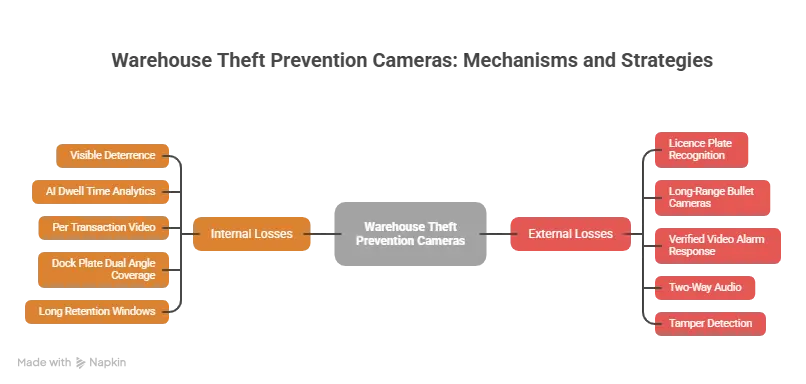
Modern warehouse theft prevention cameras do four jobs at once, and skipping any one of them creates a gap an experienced thief will eventually find.
They deter the casual pilferer with their visible presence. They detect the active threat in real time through AI analytics. Then, they document the incident with footage good enough to terminate or prosecute. And they drive accountability across every shift by making every dock event timestamped and reviewable.
The mechanism splits cleanly along the same internal and external lines we covered above.
Below is how the same camera system addresses both threat categories at the same time, and why the layered approach is what separates a working program from one that exists only on paper.
How Cameras Stop Internal Losses
Internal theft is a behaviour problem more than a hardware problem, which means the camera system has to shape behaviour, not just record it. The mechanisms that work inside a warehouse:
- Visible deterrence at pack stations and will-call counters
A 4K dome mounted overhead, with the indicator LED on, shifts the picker’s awareness for the first three weeks of work. After that, the awareness fades into the background, but the behavioural shift sticks.
Loss prevention research has documented this for decades, and it is why we install overtly rather than covertly.
- AI dwell time analytics in restricted aisles.
A worker standing motionless near a high-value SKU shelf for 90 seconds during a non-pick window fires an alert.
Most legitimate work has motion in it. Stationary loitering inside a sensitive aisle, after hours or during a shift change, is worth a second look.
- Per transaction video on cage entries
Each badge swipe at a cage door pairs with a video clip showing what was taken. The discrepancy between credential identity and visual identity surfaces immediately if a card has been cloned or shared.
- Dock plate dual angle coverage
Two cameras at every active dock door, one on the staging interior and one on the truck bed during the load, catch the extra case scam that single-camera setups miss completely.
- Long retention windows
Internal theft commonly surfaces during a monthly cycle count, which means the incident under investigation is already 30 to 60 days old. Footage retention under 60 days is, in practical terms, gone before you know to look for it.
How Cameras Stop External Losses
External theft is faster-moving and tends to happen outside business hours, which means the system has to alert and respond, not just record. The mechanisms that work at the perimeter:
- Licence plate recognition (LPR) at the gate
Every truck plate gets read, timestamped, and matched against a scheduled pickup or delivery manifest pulled from your TMS. A truck without a matching scheduled pickup raises a flag that the dispatcher sees before the driver reaches the dock.
This is the single most effective tool against fictitious pickup attempts.
- Long-range bullet cameras with thermal optional at the fence line
AI line crossing and intrusion zone alerts fire the moment a perimeter is breached, day or night, regardless of weather.
- Verified video alarm response
When an intrusion event fires, an off-site monitoring operator pulls the live feed, confirms the threat visually, and dispatches police with priority status.
Verified alarms get response times measured in minutes, not the hour-plus that comes with unverified events.
- Two-way audio at gates and after-hours doors
A live voice telling a trespasser they have been seen and recorded turns most opportunistic intrusions around within seconds.
- Tamper detection
Cameras flag if covered, redirected, or sprayed. A modern system catches this within seconds. A legacy system never notices until you go looking.
The four jobs (deter, detect, document, drive accountability) work as a chain. Deterrence cuts the volume of attempts. Detection catches the ones that get past deterrence.
Documentation makes the caught events actionable. Accountability prevents the slow erosion that nobody notices until an audit. Pull any link, and the chain weakens.
This is why a well-designed warehouse CCTV system is fundamentally different from having cameras. It is an integrated layer over the operation, and the rest of this guide covers how to build one that holds up.
Also, read this guide for extra information on how to integrate access control with CCTV for commercial security in Ontario.
What Features Make the Best Security Camera System for a Warehouse?
Specifications matter in a warehouse environment in a way they do not in a small retail shop. Because the conditions are harsher and the consequences of cheap gear are bigger.
A 1080p camera with no WDR mounted above a dock door will give you completely unusable footage of the most important zone in your facility.
On the other hand, a camera rated to -10°C will fail on a January morning in a non-climate-controlled receiving bay.
Cheap PoE switches without enough total wattage budget will brown out half your camera grid the first time you push them. The brief below is the spec sheet we work from when we design commercial warehouse camera systems for clients across the GTA.
Resolution by Zone
Resolution is not a single decision. It is a per-zone decision based on what the camera has to read:
| Zone | Recommended Resolution | What It Has to Capture |
| Loading dock interior | 4K (8MP, 3840 x 2160) | Carton labels, product descriptions, faces under the dock door, backlight |
| Truck bed interior (dock-mounted) | 4MP to 5MP | Carton-by-carton load verification |
| Receiving | 4K (8MP) | Pallet labels, BOL verification, inbound count |
| Aisles and racking corridors | 4MP to 5MP | General movement and identification |
| Perimeter and fence line | 4K (8MP) varifocal | Long-range identification, vehicle ID |
| Gate LPR | Dedicated LPR (often 2MP, narrow lens) | Licence plate at speed, day or night |
| Cages and high-value zones | 4MP to 5MP dome | Per transaction record |
Pushing 4K everywhere is wasteful and inflates storage costs. The bigger mistake is going light on the dock and gate, because those are the zones where a usable image pays for the entire system.
Lens Type: Fixed Versus Varifocal
Fixed lens cameras (typically 2.8mm, 110° field of view) are fine for general aisle coverage and pack stations where the framing will not change.
Varifocal cameras with motorized 2.8 to 12mm zoom give you remote adjustable framing, which matters in a warehouse where rack layouts change, dock priorities shift, and what the camera needs to see at install time is not what it will need to see in three years.
We default to varifocal at every dock door, every gate, and every long aisle. Fixed at pack stations, cages, and choke points where the geometry is locked in.
Night Vision and Low Light Performance
A warehouse running 24/7 needs cameras that produce usable footage at every hour. Two technologies matter:
- Smart IR with 30m or longer illumination: Infrared LEDs that adjust intensity based on subject distance, preventing the blown-out white blob effect of cheap IR cameras when someone walks close.
- Starlight technology: Image sensors that produce colour video in extremely low light, often down to 0.005 lux. Useful for after-hours yard coverage where there is some ambient lighting but not enough for traditional sensors.
For pitch-black perimeter coverage, supplemental IR illuminators or thermal cameras fill the gap.
Weather, Vibration, and Vandal Resistance
The Canadian climate eats cheap cameras. Specifications we will not compromise on for any outdoor or unconditioned indoor mount:
- IP66 or IP67 ingress protection: Dust-tight, weatherproof against heavy rain and snow.
- IK10 vandal-resistant housing: Survives a thrown rock, a baseball bat, and a forklift bump.
- Operating range -30°C to 60°C: For January nights and August dock door sun loading, both.
- Vibration-dampened mounts: At any location with forklift traffic. Repeated vibration walks fixed mounts out of alignment over months.
Network and Power Infrastructure
The cameras get the attention. The infrastructure does the work:
- PoE+ (IEEE 802.3at): Delivers up to 25.5W per port, enough for IR active 4K cameras with heaters. PoE+ is the minimum spec for cold-weather outdoor cameras.
- Cat6 or Cat6a structured cabling: Cat6 is sufficient for most installs. Cat6a if you are running long uplinks or planning for future bandwidth growth.
- Managed PoE switches with VLAN segmentation: Isolate the camera network from the office LAN. This is a security best practice and a stability best practice.
- UPS (uninterruptible power supply) backup: Minimum 30 minutes of runtime for the NVR and core switch. Power blips in industrial parks are common, and an unprotected NVR will eventually suffer drive corruption.
Compression and Bandwidth
H.265 (High Efficiency Video Coding) cuts the bitrate roughly in half compared to H.264 at the same quality. For a 30-camera 4K install, that is the difference between a workable network and a saturated one. Every commercial camera we install supports H.265 by default.
Compatibility and Brand Selection
ONVIF compliance matters more than brand loyalty. ONVIF is the open standard that lets cameras from different manufacturers work with the same VMS (Video Management System), platforms like Milestone, Genetec, or the manufacturer’s native software.
ONVIF compliance protects you from vendor lock-in and lets you mix gear when budget or availability requires it. The brands we install regularly across GTA warehouse projects:
- Verkada: Cloud native enterprise platform, strong AI analytics, premium pricing tier, ideal for multi-site operators who need a single dashboard.
- Axis Communications: The enterprise gold standard, open platform, deep VMS integration, used in mission-critical deployments.
- Ubiquiti UniFi Protect: Strong value, no recurring fees, good for mid-market warehouses.
- UNV (Uniview): Solid mid-tier commercial gear, broad model range.
- Hikvision: Extensive product line, strong AI features.
The right brand depends on your scale, your budget, your existing infrastructure, and whether the operation needs cloud first or on-premises.
None of them is universally best. We would rather under promise on brand and over deliver on placement than the other way around, which is why every quote we send starts with a site survey, never a product list.
What Are the Ontario Privacy and PIPEDA Rules for Warehouse Camera Surveillance?
Camera surveillance in a Canadian workplace operates inside a privacy framework that is stricter than what U.S. operators are used to. The framework gets more attention than ever in 2026 as the Office of the Privacy Commissioner of Canada continues to enforce against employers who get it wrong.
Ontario warehouse operators sit in a hybrid jurisdiction. Federally regulated employers (banks, telecoms, transportation companies, interprovincial trucking) fall under PIPEDA.
Below is a working compliance checklist we walk every Ontario warehouse client through before installation.
The Reasonable, Proportionate, Minimally Intrusive Test
Every form of workplace surveillance in Canada has to pass three tests:
- Reasonable. There is a legitimate business purpose (loss prevention, asset protection, workplace safety).
- Proportionate. The surveillance is no more invasive than the threat warrants.
- Minimally intrusive. There is no less invasive method that would achieve the same outcome.
Cameras at loading docks for cargo theft prevention pass all three easily. Cameras pointed at workstations to monitor productivity rarely pass. Cameras in break rooms, change rooms, washrooms, or private offices fail unambiguously.
What Compliance Looks Like in Practice
The operational checklist for an Ontario warehouse:
- Posted signage at every entrance. Visible, plain language, identifying that video surveillance is in use and the purpose.
- Written video surveillance policy in the employee handbook, identifying what is collected, why, how long it is retained, and who has access.
- Audio is disabled by default. The federal Criminal Code (section 184) restricts conversation recording without consent. We install with audio off unless legal counsel has cleared it.
- Need to know access control on stored footage. Not every supervisor gets the password.
- Defined retention periods in writing, with automatic deletion after the period expires (incident flagged footage excepted).
- Electronic Monitoring Policy for Ontario employers with 25 or more employees, per amendments to the Employment Standards Act, 2000.
- No covert surveillance. Canada’s privacy framework heavily disfavours covert monitoring. The rare exceptions involve serious misconduct investigations cleared by counsel.
Most of the operators we work with have never written a video surveillance policy, and most of the off-the-shelf templates online are written to U.S. standards that do not map onto PIPEDA.
A two-hour conversation with a Canadian employment lawyer at install time saves a much longer conversation with the Privacy Commissioner later.
What Mistakes Should Warehouse Operators Avoid With Their Camera System?
We have audited hundreds of existing warehouse camera installations across the GTA over the years, and the mistakes that cost operators money repeat almost identically from site to site. They are rarely about the cameras themselves.
The equipment is usually fine. The mistakes are about design, placement, retention, and integration.
The list below is the one we hand clients during a system audit, and it doubles as a checklist any operator can run against their own system tomorrow morning.
- Cameras pointed at the dock door, not inside the truck bed
- Cameras mounted at 12 feet or higher, capturing the tops of heads
- No LPR at the gate
- Skipping racking aisle coverage because the perimeter is covered
- Single camera coverage at critical zones
- Cloud only with no local backup, or NVR only with no cloud
- Cameras that do not talk to access control
- No tamper detection
- Treating the system as set and forget
The pattern across these nine mistakes is that none of them is a hardware problem. Every one is a design or maintenance problem, which is also why every one of them is fixable without throwing out the existing camera fleet.
A targeted set of adjustments, supplemental cameras at known gaps, and a retention and integration upgrade usually close most of the holes.
We do system audits as a standalone service for operators who already have cameras and want to know what is working before they spend on more hardware.
What Does a Properly Designed Warehouse Camera System Look Like in the GTA?
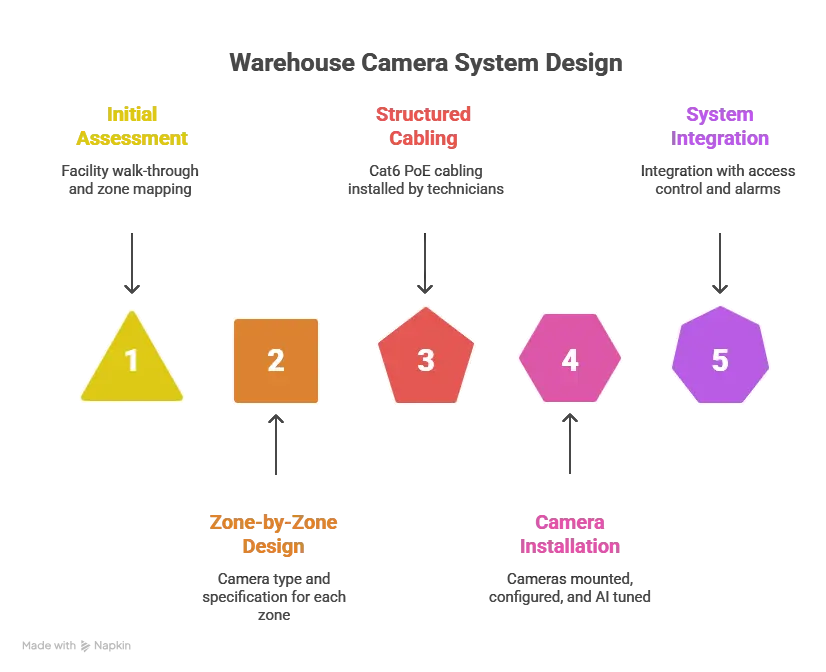
A commercial warehouse camera system from scratch is an exercise in walking the floor, asking questions, and matching equipment to operational reality, never opening a catalogue and ticking boxes.
We have been doing commercial installations across the Greater Toronto Area for fifteen years, with 1,600 plus projects completed and 7,000 plus pieces of security equipment installed across distribution centres, fulfillment hubs, manufacturing facilities, and freight terminals.
The work that goes into a good design is mostly invisible by the time the system goes live, which is part of why so many operators underestimate it. A camera mounted in the right place to the right spec quietly does its job for ten years.
A camera mounted in the wrong place generates frustration every time someone needs it.
The way we run a warehouse camera installation:
Free site survey
We walk the entire facility with your operations team. We map every dock door, every cage, every aisle end, every gate, every blind spot.
We measure ceiling heights, photograph mounting surfaces, identify existing conduit and power, and note lighting conditions at the times of day that matter.
Zone-by-zone design
Each zone gets a priority rating, a camera count, a camera type, and a specification. Loading docks get 4K with WDR. Aisle ends get varifocal turrets. Gates get LPR. The map is the deliverable.
Bill of materials and quote
Transparent pricing, line by line. No surprise charges, no add-ons mid-project.
Cat6 PoE structured cabling
Done by our own technicians, terminated to commercial spec, tested, labelled, and documented. We do not subcontract cabling.
Camera installation, configuration, and AI tuning
Including motion zones, restricted zones, dwell time thresholds, and alert routing.
Integration with access control, alarms, and existing systems
Single dashboard wherever possible.
Training your team
Your operations and security staff get hands-on training with the VMS, the mobile app, and incident response procedures.
Three-year warranty and ongoing support
Quarterly check-in calls are available, and we are a phone call away when something needs attention.
Our service area covers the full GTA and well beyond. Toronto, Mississauga, Vaughan, Brampton, Barrie, King City, Milton, Hamilton, Caledon, Markham, Pickering, Oshawa, Kitchener, Guelph, Peterborough, and the Muskoka and Kawartha regions.
If you are operating warehouse space anywhere in southern Ontario, we can be on site for a survey within a week of your call.
A warehouse camera system that does the four jobs (deter, detect, document, drive accountability) at facility scale, that runs 24/7 in Ontario weather, is what we put together every day.
Not every project needs the most expensive equipment in the catalogue. Every project needs a design that fits the operation, equipment that survives the environment, and an installer who is reachable when you need a clip pulled at 3 AM in March. That is the bar.
Final Thoughts
Warehouse theft prevention cameras work when they sit at the right height, look at the right zones, run on the right network, talk to access control, and store footage long enough to outlive an audit cycle. Miss any of those and the system becomes expensive hindsight.
The GTA is one of North America’s busiest cargo theft regions, and the operators who treat surveillance as a strategic layer rather than a checkbox are the ones whose inventory still matches the ledger at year’s end.
If this guide was useful, share it with your operations team, and have a look at our other resources on security cameras and commercial cable installation pricing in the GTA.
For a free site survey, reach out to Sense Group.