Access control systems for small business are becoming essential for retail stores, offices, clinics, restaurants, and small warehouses across Ontario. Traditional keys are easy to lose, difficult to track, and expensive to replace.
For small business owners in Toronto, Mississauga, Vaughan, and Brampton, managing who enters the building after hours or accesses restricted areas is a growing concern.
Modern access control solutions allow you to issue key fobs, PIN codes, or mobile credentials instead of physical keys.
You can control entry schedules, monitor access logs, and remove permissions instantly when an employee leaves. Even a single door setup can significantly improve security and accountability.
In this guide, we break down the best access control systems for small businesses in Ontario, explain realistic costs, compare cloud and local options, and help you choose a solution that fits your budget and operational needs.
What Is an Access Control System?
An access control system is a secure electronic door management solution that allows small business owners to control who can enter their property, when they can enter, and which areas they can access. Instead of relying on traditional keys, businesses use credentials such as key fobs, access cards, mobile credentials, or PIN codes.
For small businesses in Toronto, Mississauga, Vaughan, and Brampton, this means no more rekeying locks when an employee leaves. It also means full visibility into who entered the building and at what time.
A commercial door access control system for a small business is commonly installed in:
- Retail stores in Downtown Toronto (M5V)
- Dental clinics in North York (M2N)
- Restaurants in Mississauga (L5B)
- Auto shops in Markham (L3R)
- Small warehouses in Brampton (L6T)
Even a single entry door can be upgraded to provide structured access management, employee accountability, and better protection of inventory, equipment, and sensitive records.
How Does an Access Control System Work in a Small Business Setting?
An access control system works through a simple but coordinated process. When someone attempts to enter, the system verifies their credentials, checks permissions, and unlocks the door only if they are authorized.
Below are the main components used in most small business installations across Ontario.
Door Reader
The door reader is installed beside the entrance. It reads the credentials presented by the user. This could be:
- RFID key fob
- Access card
- Mobile phone credential
- PIN entered on a keypad
In a small retail store in Toronto or a clinic in Vaughan, the reader captures the credential information and sends it to the access control panel for verification.
Access Control Panel
The access control panel is the system’s decision maker. It stores user permissions and access schedules. When a credential is presented, the panel checks:
- Is this user authorized?
- Is this credential active?
- Is access allowed at this time of day?
If the answer is yes, it sends a signal to unlock the door.
For small businesses without in-house IT teams, modern panels are often part of a cloud-based access control system that can be managed through a secure online dashboard.
Credential: Key Fob, Card, Mobile, or PIN
Credentials replace traditional keys. Small businesses typically choose:
- Key fobs for durability
- Access cards for office settings
- Mobile credentials for convenience
- PIN codes for cost efficiency
If an employee leaves a restaurant in Mississauga or a warehouse in Brampton, their credential can be deactivated instantly. There is no need to change locks.
Electric Strike or Magnetic Lock
The locking hardware physically secures the door.
An electric strike modifies the door latch and releases when access is granted. A magnetic lock holds the door closed using magnetic force and releases when power is interrupted.
These commercial-grade locking mechanisms are commonly used in Ontario retail stores, offices, and industrial units because they provide secure entry without sacrificing durability.
Access Logs and Entry Reports
Every time someone enters, the system records:
- User name or credential ID
- Date and time
- Door location
- Approved or denied status
These access logs help small business owners track after-hours entry, monitor employee activity, and investigate incidents if needed. Entry reporting also supports insurance documentation and compliance requirements in regulated industries such as medical clinics and cannabis retail.
Practical Example in Ontario
Imagine a small warehouse in Mississauga with three doors. The owner assigns warehouse staff access only during scheduled shifts. Managers receive extended access. If a staff member leaves the company, their key fob is disabled in seconds. The system continues to log every entry event.
This is how a commercial door access control system for small businesses improves day-to-day security while keeping management simple and practical.
Access control is not just for large corporations. For small Ontario businesses, it is a manageable and scalable way to protect property, control employee access, and modernize physical security without complex infrastructure.
Why Do Small Businesses in Ontario Need Access Control Systems?
Many owners still ask, do small businesses need access control, or is it only necessary for large corporations? The reality across Ontario shows a clear shift. Retail theft, employee turnover, after-hours incidents, and insurance requirements are increasing. Traditional keys no longer provide the level of control small businesses require.
Below are the most common pain points driving small businesses in Toronto, Mississauga, North York, and Brampton to upgrade their door security systems.
Lost Keys and Rekeying Cost
Traditional keys create ongoing risk. When an employee loses a key or leaves without returning it, the only safe option is often rekeying the entire lock.
For a retail store in Downtown Toronto (M5V), this can mean:
- Locksmith service fees
- New key cutting
- Business disruption
With an electronic access control system, credentials such as key fobs or access cards can be deactivated instantly. No lock replacement is required. This reduces long term maintenance costs and eliminates key duplication concerns.
Employee Turnover
Small businesses often experience higher turnover compared to large enterprises. Restaurants in Mississauga (L5B) and retail stores across the GTA regularly hire part-time staff.
Each time someone leaves, a physical key becomes a security liability.
With a commercial access control system:
- Access permissions can be revoked immediately
- Temporary staff can be assigned limited schedules
- Role-based permissions can restrict access to storage rooms or offices
This level of control improves operational security without adding administrative burden.
After Hours Access Control
Many incidents occur outside normal business hours. A dental clinic in North York (M2N) may need to restrict access to patient files after closing time. A small warehouse in Brampton (L6T) may run shift operations and require structured access schedules.
Access control systems allow small business owners to:
- Set time-based access rules
- Lock and unlock doors remotely
- Monitor late-night entry attempts
- Receive alerts for denied access
This improves oversight without requiring physical presence on site.
Internal Theft Prevention
Internal theft is one of the most difficult risks for small business owners to manage. Inventory shrinkage, unauthorized storage room access, and cash handling areas are common vulnerability points.
Electronic access control systems provide:
- Entry logs tied to individual credentials
- Controlled access to restricted areas
- Clear audit trail reporting
For a retail store in Toronto or a warehouse in Brampton, knowing exactly who accessed a specific door at a specific time adds accountability. Even the presence of monitored entry systems can reduce internal misuse.
Insurance and Compliance Documentation
Insurance providers increasingly evaluate physical security measures when assessing risk. A documented access control system demonstrates structured entry management.
For medical clinics, cannabis retailers, and businesses handling sensitive information, maintaining entry logs supports compliance requirements.
In Ontario’s competitive small business environment, structured door access management is no longer optional for many industries. It has become a practical investment that protects assets, controls employee access, and strengthens daily operations without requiring enterprise-level infrastructure.
What Types of Access Control Systems Are Best for Small Businesses in Ontario?
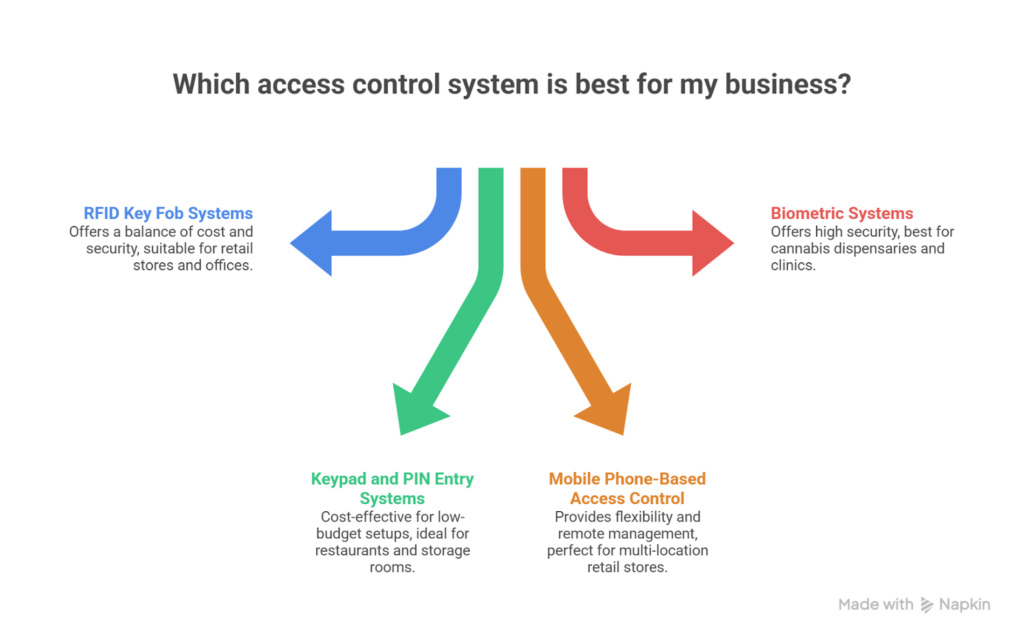
Choosing the right access control system depends on your business type, budget, and daily operations. A small retail store in Toronto does not need the same setup as a warehouse in Brampton or a clinic in North York. The goal is to select a system that balances affordability, security, and ease of management.
Below is a clear breakdown of the most common access control systems used by small businesses across Ontario.
Key Fob and RFID Card Systems
A key fob access control for small business is one of the most popular and practical solutions. Employees receive an RFID key fob or access card that they tap against a door reader to unlock the entrance.
These systems are widely used in:
- Retail stores in Downtown Toronto (M5V)
- Dental clinics in North York (M2N)
- Offices in Vaughan (L4K)
- Small warehouses in Brampton (L6T)
They are easy to manage, affordable, and scalable. If a fob is lost, it can be deactivated instantly. Brands such as HID, Paxton, and Honeywell offer reliable reader and credential options suitable for small commercial setups.
For most small businesses, RFID-based systems provide the best balance between cost and security.
Keypad and PIN Entry Systems
Keypad systems allow users to enter a numeric PIN code instead of using a physical credential. This option reduces the need to distribute cards or fobs.
They are often used in:
- Restaurants in Mississauga (L5B)
- Small offices with limited staff
- Storage rooms inside retail units
PIN codes can be changed when employees leave, but they can also be shared between staff. For higher accountability, many Ontario businesses combine keypads with RFID credentials.
Keypad systems are cost-effective but should be configured carefully to avoid security gaps.
Mobile Phone-Based Access Control
Mobile-based access control allows employees to unlock doors using their smartphones. This is common in modern cloud access control for small retail store environments where remote management is important.
Platforms like Brivo and Avigilon Alta support secure mobile credentials and cloud-based dashboards. Business owners can:
- Add users remotely
- Grant temporary access
- View entry logs from anywhere
- Lock or unlock doors through an app
This system is especially practical for multi-location retail stores in Toronto and Mississauga, where centralized management saves time.
Biometric Systems for High Security Areas
Biometric access control uses fingerprint or facial recognition to verify identity. While not always necessary for small businesses, it is useful for:
- Cannabis dispensaries in Scarborough (M1P)
- Clinics storing sensitive records
- Cash handling rooms
- Server rooms in small office environments
Biometric systems provide strong identity verification because credentials cannot be shared or duplicated. However, they typically cost more than RFID or keypad systems and may not be required for standard retail or office spaces.
Choosing the Right Type
For most Ontario small businesses:
- RFID key fob systems offer the best mix of cost and control
- Cloud-based mobile systems offer flexibility and remote access
- Keypad systems work for low-budget setups
- Biometric systems fit regulated or higher-risk environments
For most Ontario small businesses, the right system should solve real operational problems without adding complexity. A retail store in Toronto may prioritize simple employee access tracking. A clinic in North York may focus on restricted file room entry.
A warehouse in Brampton may require durable hardware and scheduled shift access. The key is selecting a scalable solution that fits today’s needs while allowing future expansion.
When properly planned, even a small access control setup becomes a long-term security investment that supports growth, accountability, and professional standards across your business operations.
How Much Does an Access Control System Cost for a Small Business in Ontario?
The cost of installing access control systems for small businesses in Ontario depends mostly on door count, hardware quality, and whether you choose cloud or local management. A small retail shop in Toronto (M5V) with one entry door will invest far less than a six-door warehouse in Mississauga (L5T).
Hardware such as commercial-grade door readers, electric strikes, magnetic locks, and control panels form the base cost. Installation includes low-voltage cabling, configuration, and system testing. Cloud based systems add monthly licensing, while on-premises setups involve higher upfront server costs.
When evaluating small business access control cost Toronto, it is important to look at five year value rather than just the initial invoice.
Many business owners reviewing options for an affordable access control system in Ontario start by understanding real door requirements before contacting professionals for access control system installation in Toronto.
| Business Type & Example | Hardware & Installation | Cloud Subscription | Maintenance Consideration |
| 1 Door Retail – Toronto (M5V) | Lower range commercial setup | Optional monthly fee | Minimal upkeep |
| 3 Door Clinic – Vaughan (L4K) | Mid range multi door setup | Per door licensing | Moderate system management |
| 6 Door Warehouse – Mississauga (L5T) | Higher due to industrial hardware | Scalable per door fee | Ongoing monitoring and battery checks |
Access control is scalable for small Ontario businesses. A single door setup can start modestly and expand as operations grow.
The key is choosing durable hardware, planning for future door additions, and selecting a management model that matches your technical comfort level. Whether you operate a retail store, clinic, or warehouse, the right system balances upfront investment with long term operational efficiency and security.
Cloud vs Traditional Access Control for Small Businesses: Which Is Better?
For small business owners in Ontario, the choice between cloud access control for small businesses and on-premises access control for small office setups usually comes down to management style, cost structure, and technical comfort level.
Both systems can secure your doors using the same readers, credentials, and locking hardware. The real difference is where the system is managed and how it is maintained over time.
A retail shop in Toronto may prefer remote access from a phone, while a small office in Vaughan with in-house IT may prefer local server control. Below is a clear side-by-side comparison to simplify the decision.
| Feature | Cloud Access Control for Small Business | On-Premise Access Control for Small Office |
| Monthly Fees | Yes. Typically, per door or per location subscription | No cloud fee. May require an annual support contract |
| Upfront Cost | Lower initial investment. No local server required | Higher upfront cost due to server hardware |
| Remote Control | Built-in remote access through mobile app or browser | Remote access requires VPN setup |
| IT Requirement | Minimal internal IT needed | Requires internal IT or service provider |
| Scalability | Easy to add doors and locations | Expansion may require server upgrades |
| Internet Dependency | Requires internet for dashboard access | Operates primarily on the local network |
| Software Updates | Automatic updates managed by the provider | Manual updates handled by IT |
| Multi-Location Management | Centralized dashboard for all sites | Complex setup across multiple servers |
| Data Storage | Stored securely in a cloud data centre | Stored locally inside the building |
| Best Fit | Retail stores, clinics, multi-site small businesses | Small offices with stable IT support |
For most small Ontario businesses without a dedicated IT team, cloud systems provide simplicity and remote flexibility. For offices that prefer full internal control and no recurring subscription, on premise systems remain a solid option. The better choice depends on how you operate, not just the technology itself.
Let’s now look at the essential features small businesses in Ontario should prioritize when selecting an access control system.
What Features Should Small Businesses Look for in an Access Control System?
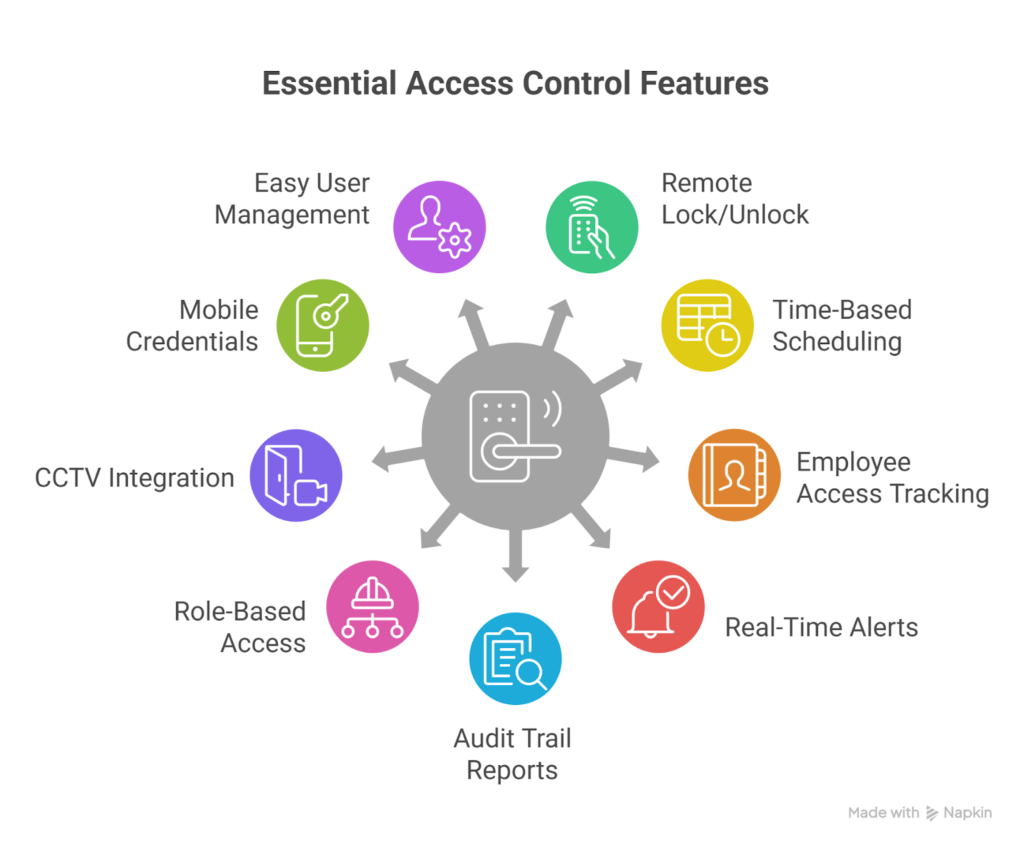
Choosing the right access control system is not about buying the most advanced technology. It is about selecting features that directly support daily operations. For small businesses in Toronto, Mississauga, Vaughan, and Brampton, the goal is simple: better control, clear visibility, and easy management without technical overload.
Below are the essential features that truly matter in a small business environment.
Remote Lock and Unlock
Business owners are not always on-site. Whether you run a retail store in Downtown Toronto or a small office in North York, the ability to lock or unlock doors remotely through a secure dashboard or mobile app adds flexibility. If a staff member forgets a key or arrives early, access can be granted without physical presence.
Time-Based Scheduling
Time-based scheduling allows you to define when certain employees can enter. For example:
- Restaurant staff in Mississauga can access only during shift hours.
- Cleaning crews can be restricted to evening schedules.
- Warehouse staff in Brampton can be assigned entry during operational windows.
This reduces after-hours risk without manual supervision.
Employee Access Tracking
With credential authentication, each employee has a unique key fob, card, PIN, or mobile credential. The system records who accessed which door and at what time.
This improves accountability and reduces internal misuse. For small businesses managing inventory, cash areas, or sensitive documents, this visibility becomes valuable.
Real Time Alerts
Modern systems can send notifications for:
- Denied entry attempts
- Forced door openings
- After-hours activity
This helps business owners respond quickly, especially in high-traffic commercial areas in Toronto.
Audit Trail Reports and Entry Log Reporting
A strong system provides clear audit trail reports and structured entry log reporting. These reports show:
- Date and time of entry
- User identity
- Door location
- Access status
This documentation supports insurance claims, internal investigations, and compliance requirements for regulated businesses.
Role-Based Access Control
Role-based access control allows you to assign permissions by job function rather than by individual setup each time.
For example:
- Managers can access all doors.
- Sales staff can access only the front entry.
- Warehouse workers can access loading areas but not office space.
This simplifies management as your team grows.
Integration with CCTV
Small businesses benefit when access control integrates with video surveillance. When a credential is used, the system can sync the event with recorded footage.
This means if an incident occurs, you can match entry logs with camera recordings instantly.
Mobile Credentials
Mobile access allows employees to use their smartphones instead of physical cards. This reduces lost credential risk and simplifies distribution. It is especially useful for businesses with high staff turnover.
Easy User Management
Finally, the system should be simple to manage. Adding or removing employees, changing schedules, and reviewing reports should not require technical expertise.
For small businesses across Ontario, ease of use often determines whether the system improves operations or becomes an administrative burden.
Can Access Control Systems Integrate with Security Cameras and Alarm Systems?
Integration is where access control becomes a complete security solution rather than just a door lock replacement. Many Ontario businesses choose to integrate access control with CCTV system setups to strengthen monitoring and documentation.
CCTV Integration
When access control integrates with surveillance cameras:
- Every door entry can be linked to video footage.
- Managers can review who entered and visually confirm identity.
- Incidents are easier to investigate.
For Toronto retail theft prevention, syncing access logs with video footage adds accountability and deterrence.
Entry Event Syncing
When a door is opened using a credential, the system can trigger a camera bookmark. This allows fast searching of footage by entry time rather than scanning hours of video manually.
Mississauga warehouse monitoring becomes far more efficient when entry events align with camera timestamps.
Alarm Trigger Integration
Access control systems can also connect with alarm systems. If a door is forced open or accessed outside approved hours, the system can:
- Trigger an alarm
- Send notifications
- Activate recording alerts
This layered security model strengthens protection without adding separate monitoring systems.
Insurance and Risk Reduction Benefits
Integrated security systems demonstrate proactive risk management. For small businesses handling inventory, cash, or sensitive information, combining door access logs with CCTV footage supports insurance documentation and claim validation.
In Ontario’s competitive commercial environment, integration improves both security performance and operational clarity.
Access control works best when it is part of a connected security ecosystem, not a standalone device on the wall.
What Are the Pros and Cons of Access Control Systems for Small Businesses?
Before investing in an electronic door access system, small business owners should look at both advantages and limitations. Access control improves structure and accountability, but it also requires planning and proper installation. Below is a balanced overview based on real commercial environments across Ontario.
| Pros | Cons |
| Improved security: Restricts unauthorized entry and protects inventory, offices, and storage areas | Upfront cost: Hardware and installation require an initial investment |
| No lost keys: Credentials can be deactivated instantly without rekeying locks | Requires power: The system depends on electricity and a backup battery |
| Remote management: Lock or unlock doors and manage users from a dashboard | Monthly fees (cloud): Subscription licensing may apply |
| Employee accountability: Entry log reporting tracks who accessed each door | Installation required: Professional wiring and configuration needed |
| Professional image: Modern entry systems enhance business credibility | Needs proper configuration: Poor setup can reduce effectiveness |
For most small businesses in Toronto, Mississauga, Vaughan, and Brampton, the benefits outweigh the limitations. However, choosing reliable hardware and a professional setup is critical to avoid performance issues later.
Which Small Businesses Benefit the Most from Access Control in Ontario?
Not every small business has the same risk level. Below are the commercial sectors in Ontario that see the strongest return on investment from structured access control systems.
Retail Stores in Toronto (M5V, M4B)
Retail businesses deal with inventory shrinkage and after-hours risk. Access control allows store owners to:
- Restrict stockroom access
- Track employee entry
- Monitor early or late access
In busy commercial districts of Toronto, accountability reduces internal and external theft concerns.
Medical Clinics in Hamilton (L8P)
Clinics handle sensitive patient records and prescription storage. Access control supports:
- Restricted file room access
- Role-based access control for licensed staff
- Audit trail reporting for compliance
This improves privacy protection and aligns with healthcare security standards.
Auto Shops in Markham (L3R)
Auto repair facilities often store customer vehicles, tools, and expensive parts. Access control helps:
- Limit workshop access after hours
- Control entry to tool storage rooms
- Track staff movement
It adds structured entry management without complicating daily operations.
Restaurants in Mississauga (L5B)
Restaurants face high employee turnover and cash handling risk. Access control allows:
- Shift-based scheduling
- Controlled access to the office or storage rooms
- Quick credential deactivation when staff leave
This reduces rekeying costs and strengthens operational control.
Cannabis Dispensaries in Scarborough (M1P)
Regulated businesses require strict documentation. Access control systems provide:
- Entry log reporting
- Restricted inventory room access
- Clear audit records
Compliance requirements make electronic access systems highly valuable in this sector.
Logistics Units in Brampton (L6T)
Small logistics and distribution units manage inventory, equipment, and loading docks. Access control supports:
- Controlled warehouse entry
- Shift management
- Integration with surveillance systems
In industrial areas of Brampton, structured access improves both security and operational efficiency.
For small businesses across Ontario, access control is no longer limited to large corporations. When installed correctly, it provides measurable security improvement, cost control over time, and structured access management that supports growth and professionalism.
How to Choose the Right Access Control System for Your Small Business
Selecting the right system requires a structured evaluation of your operations, security risks, and long-term growth plans. The best access control system for a small business in Ontario is not defined by brand alone. It is defined by alignment with your property type, employee structure, and technical capacity.
Door Count and Layout
Begin by assessing how many entry points require control. A single-door retail store in Toronto may require a simple reader and controller. A clinic in Vaughan with separate staff, storage, and main entry doors will require a multi-door configuration.
Warehouses in Mississauga often require additional control over loading docks and restricted zones. Door count determines hardware scope, panel size, and system capacity.
Remote Management Requirements
Businesses that operate across multiple locations or require off-site oversight benefit from cloud-based dashboards. Remote access enables credential activation, schedule adjustments, and entry log review without being physically present.
For single-location businesses with consistent on-site supervision, remote capability may be less critical but still valuable for flexibility.
Internal IT Capacity
If your business has internal IT support capable of managing servers, updates, and firewall configuration, an on-premises system can be maintained effectively.
However, most small businesses in Ontario operate without full-time IT staff. In those cases, cloud systems reduce technical workload and ongoing maintenance responsibility.
Budget Planning and Cost Structure
Budget evaluation should include hardware investment, installation labor, credential supply, and ongoing subscription costs if applicable. Long-term value should be considered over a five-year period rather than focusing only on initial pricing.
A properly installed system reduces locksmith expenses, key replacement costs, and internal loss exposure.
Future Expansion and Scalability
If your business plans to expand locations or increase staff, scalability becomes important. Systems that support additional doors and multi-site management prevent future replacement costs. Retail chains expanding across Toronto and Mississauga often prioritize centralized management from the beginning.
CCTV and Alarm Integration
Integration with surveillance and alarm systems strengthens overall security. Entry log reporting synced with video footage improves investigation efficiency and supports insurance documentation. For retail theft prevention and warehouse monitoring, integration enhances accountability.
A structured evaluation of these factors ensures that the system supports daily operations while remaining scalable and cost-effective.
Final Thoughts: Is Access Control Worth It for Small Businesses?
Access control systems provide measurable value for small businesses across Ontario. They replace physical keys with controlled credential management, reduce internal risk, and create documented entry accountability. Even a single door installation can modernize security and eliminate ongoing rekeying expenses.
The return on investment comes from reduced operational disruption, stronger employee oversight, and scalable growth potential. As your business expands, the system expands with it.
At Sense Group, we design and install commercial access control systems tailored specifically for small businesses in Toronto, Mississauga, Vaughan, Brampton, and surrounding GTA regions. Our approach focuses on practical system design, clean installation, and long-term reliability.
If you are planning a security upgrade, a professional site assessment will help you determine the right configuration for your property and operational needs.