Key Fob vs Key Card is one of the most common comparisons Ontario property managers and business owners make when choosing an access control system. Whether you manage a condo in Toronto, operate a warehouse in Mississauga, or run a medical clinic in Hamilton, selecting the right access credential directly affects security, durability, and long-term costs.
Both key fobs and key cards use RFID technology to authenticate users and control door access. However, they differ in design, lifespan, convenience, replacement cost, and commercial practicality. Some buildings prioritize durability and ease of use. Others focus on branding, photo identification, or lower upfront credential costs.
In this guide, we break down the real differences, security considerations, cost factors, and commercial use cases to help Ontario businesses choose the right credential for their access control entry system.
What Is a Key Fob in Access Control Systems?
A key fob is a compact electronic access credential used in modern access control systems to authenticate users and unlock secured doors. Instead of using a physical key, the user presents the fob to a door reader. The system verifies the credentials and grants or denies access based on stored permissions.
Key fobs are widely used in commercial buildings across Ontario because they are durable, easy to manage, and simple to carry.
RFID Technology
Key fobs operate using RFID, which stands for Radio Frequency Identification. Inside the fob is a small embedded chip and antenna. When placed near an access control reader, the reader emits a radio frequency signal that powers the chip.
The chip then transmits its unique identification code to the access control panel for authentication and authorization. This process happens instantly and does not require physical contact.
125 kHz vs 13.56 MHz Credentials
Most key fobs operate on either 125 kHz proximity technology or 13.56 MHz smart card technology.
125 kHz proximity fobs are common in older systems. They provide basic credential transmission but limited encryption.
13.56 MHz smart credentials offer stronger encryption and improved security. These are often used in newer commercial access control systems that require higher protection against cloning and unauthorized duplication.
Keychain Style Credential
Key fobs are typically small, thick plastic tokens designed to attach to a keychain. This design reduces bending or cracking, which can happen with thin PVC access cards. Their compact form makes them practical for daily use in high-traffic environments.
Common Use Cases of Key Fobs
Key fobs are commonly used for:
- Condo building entry systems
- Parking garage access
- Office building main entrances
- Warehouse employee access
- Gym and amenity room entry
In Toronto condo buildings, residents often use RFID key fobs to access main doors, elevators, and parking areas. Warehouses in Mississauga rely on key fobs for staff entry into loading docks and restricted inventory zones.
Office buildings in Vaughan use encrypted 13.56 MHz key fobs to control access to secure departments and server rooms.
For commercial properties across the GTA, key fobs offer a reliable, durable, and easily managed credential solution within a professional access control entry system.
What Is a Key Card in Access Control Systems?
A key card is a flat electronic access credential used in modern access control systems to authenticate users and unlock secured doors. Instead of attaching to a keychain, the card is typically carried in a wallet or worn as an employee badge. When presented to a door reader, the system verifies the credential and grants or denies access based on assigned permissions.
RFID Technology
Key cards operate using RFID, which stands for Radio Frequency Identification. Inside the PVC card is an embedded chip and antenna. When the card is placed near an access control reader, the reader sends out a radio frequency signal that activates the chip.
The chip transmits its credential number to the access control panel for authentication and authorization. This process is fast, contactless, and suitable for high-traffic commercial environments.
125 kHz vs 13.56 MHz Credentials
Most key cards operate on either 125 kHz proximity technology or 13.56 MHz smart card technology.
125 kHz proximity cards are commonly used in older office buildings and basic entry systems. They provide simple credential transmission but limited encryption protection.
13.56 MHz smart cards offer encrypted data exchange and stronger resistance against cloning. These are preferred in modern corporate offices, healthcare facilities, and regulated industries across the GTA.
PVC Card Format and Visual Identification
Key cards are thin PVC plastic credentials, similar in size to a credit card. Their flat surface allows companies to print employee photos, names, department titles, and company branding directly on the card.
This makes them ideal for corporate environments where visual identification is required alongside electronic access control.
However, because they are thinner than key fobs, key cards can bend, crack, or wear out faster in industrial or high-impact environments.
Common Use Cases of Key Cards
Key cards are commonly used for:
Corporate office access systems
Employee ID badge programs
Condo resident access credentials
Healthcare facility staff identification
Educational institution entry systems
In Downtown Toronto office towers, key cards are issued as employee badges that control entry to main entrances, elevators, and restricted departments. Condo buildings in North York often use printed access cards for residents and property management staff.
Medical clinics in Hamilton use encrypted smart cards to protect patient record areas and controlled storage rooms.
For commercial properties across the GTA, key cards provide a professional, brandable, and centrally managed credential solution within a modern access control entry system, especially where identification and presentation matter as much as door access.
What is the Difference Between Key Fob and a key card?
When Ontario property managers, condo boards, and commercial facility operators compare key fob vs key card, the real difference is not the RFID technology itself. Both are electronic access credentials used within an access control entry system.
The difference lies in physical design, durability, lifecycle cost, user handling, and operational suitability for specific commercial environments.
In GTA commercial buildings, choosing the right credential affects long term replacement rates, security management, and user convenience.
Below is a clear side-by-side comparison:
| Feature | Key Fob | Key Card |
| Size | Keychain token | Wallet-size card |
| Durability | Strong plastic casing | Can bend or crack |
| Cost | Slightly higher | Lower per unit |
| Printing | Limited surface | Can print logo or photo |
| Cloning Risk | Depends on the encryption level | Depends on the encryption level |
| Replacement | Easy to issue | Easy, but replaced more often |
Physical Design and Handling
Key fobs are thicker and enclosed in a molded plastic housing. They are commonly attached to keys, which reduces the chance of bending or damage. This makes them ideal for warehouses in Mississauga, logistics hubs in Brampton, and manufacturing facilities in Vaughan, where credentials face daily wear.
Key cards are thin PVC credentials designed to fit into wallets or badge holders. They are commonly used in Downtown Toronto office towers and North York condo buildings where visual identification is required.
Operational Differences in Ontario Commercial Settings
In high-traffic industrial environments, key fobs generally last longer due to impact resistance. In corporate office environments, key cards offer branding capability and employee photo identification.
From a lifecycle management perspective, key cards often require more frequent replacement because they can crack or demagnetize under heavy use. Key fobs typically have lower physical failure rates.
For GTA commercial properties, the decision often depends on environment, branding needs, and expected user behavior.
Which Is More Secure: a key fob or a key card?
The physical format does not determine security. A key fob is not automatically more secure than a key card. The real security level depends on the RFID technology, encryption standard, and system configuration behind the credential. Below are the key points that determine security:
Credential Cloning Risks
125 kHz proximity credentials, whether card or fob, are widely used in older Ontario commercial buildings. These credentials send a static identification number. Without encryption, they can be duplicated.
13.56 MHz smart credentials use encrypted communication between the reader and the access control panel. This greatly reduces cloning risk. For warehouses in Mississauga, medical clinics in Hamilton, or cannabis retailers in Scarborough, encrypted smart credentials are strongly recommended.
Encryption Levels Matter Most
Encryption protects the credential data during transmission. Higher encryption standards prevent unauthorized copying and replay attacks.
For regulated commercial properties across the GTA, encrypted smart credentials are the industry standard. This applies equally to both fobs and cards.
Proximity vs Smart Credential Technology
125 kHz proximity credentials provide basic authentication. They are suitable for low-risk environments but not recommended for high-security facilities.
13.56 MHz smart credentials support encrypted authentication and secure key exchange. For commercial properties seeking higher protection, smart technology clearly wins, regardless of whether it is issued as a fob or a card.
HID vs MIFARE Technology
HID and MIFARE are common credential platforms used in commercial access control systems.
HID offers encrypted credential options widely used in North American office towers and industrial buildings.
MIFARE supports encrypted sectors and is commonly used in smart card deployments.
Security strength depends on encryption configuration, not simply the brand name.
Two Factor Authentication for Higher Security
For higher-risk facilities in Toronto, Vaughan, or Brampton, access control systems can require two-factor authentication. This may combine:
- RFID credential plus PIN code
- Credential plus biometric fingerprint
- Mobile credential plus encrypted smart card
This layered approach is common in financial offices, server rooms, and industrial facilities.
Integration With Biometric Systems
Both key fobs and key cards can integrate with biometric authentication systems. The credential serves as the first verification step, and biometric scanning confirms identity.
The Clear Winner
If both use older 125 kHz proximity technology, neither is highly secure. Both transmit a fixed credential number and can be vulnerable to cloning with the right equipment.
If both use modern 13.56 MHz encrypted smart technology, both can provide strong security.
So the winner is not the shape. The winner is encrypted smart credential technology.
Which Is More Durable in Ontario Climate Conditions?
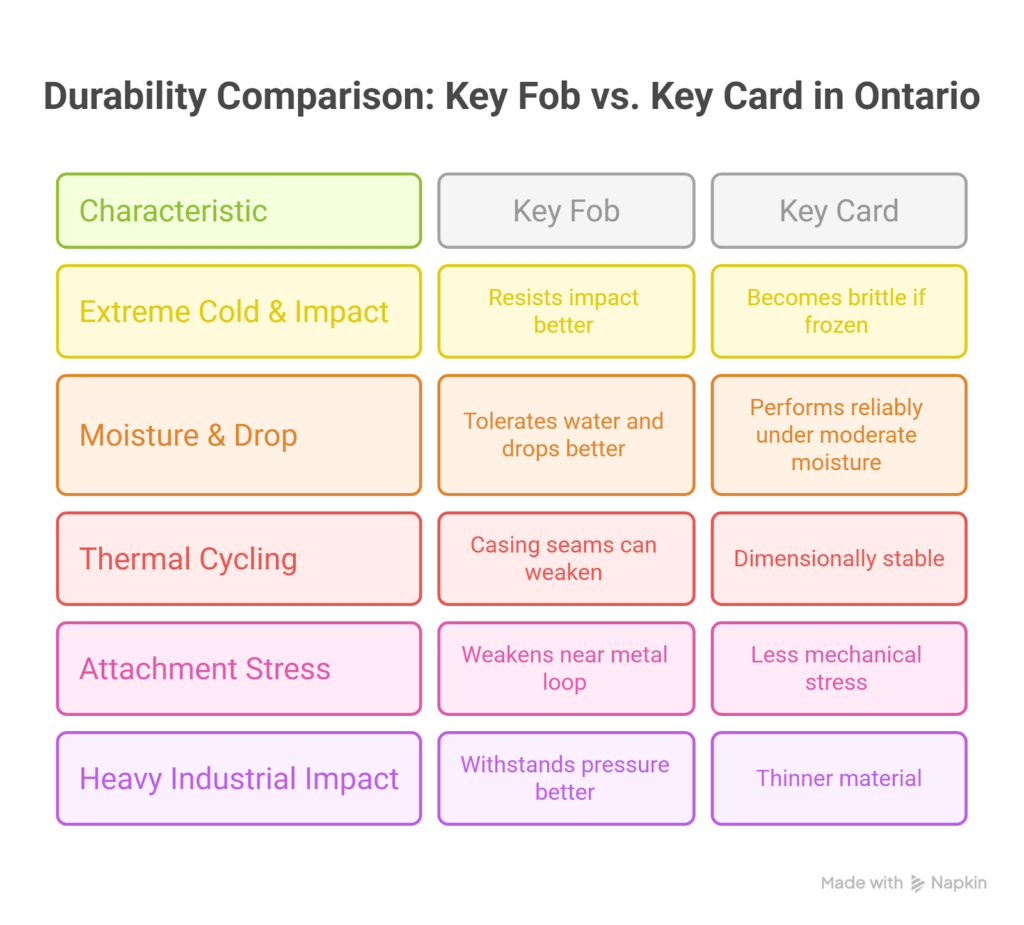
Ontario’s climate includes freezing winters, rapid temperature changes, humid summers, and industrial environments that stress physical credentials. Durability must be evaluated based on environmental exposure, handling pattern, and long-term structural stability, not just thickness.
Extreme Cold and Impact Resistance
In outdoor access points, parking garages, and industrial yards across Brampton and Mississauga, credentials may be exposed to subzero temperatures.
Thin PVC key cards can become brittle if repeatedly exposed to freezing air without protection. If bent while cold, the cracking risk increases.
Key fobs use a thicker molded plastic housing and resist impact better in extreme cold conditions.
Winner in freezing outdoor industrial exposure: Key Fob
Moisture and Drop Resistance
Ontario’s snow, rain, and garage condensation create moisture-heavy environments. Credentials may be dropped in wet conditions.
Sealed key fobs generally tolerate water exposure and accidental drops better.
However, commercial-grade laminated key cards stored in badge holders perform reliably indoors and under moderate moisture.
Winner in heavy wet industrial conditions: Key Fob
Thermal Cycling and Material Stability
Ontario buildings experience repeated temperature transitions — outdoor cold to heated indoor environments.
PVC key cards are engineered to handle thermal cycling and remain dimensionally stable when worn in badge holders. They do not rely on casing seams like fobs.
Over long-term indoor use, key cards maintain flat structural integrity very well.
Winner in climate-controlled buildings with temperature shifts: Key Card
Attachment Stress and Daily Handling
Key fobs are attached to key rings. Over time, constant pulling, twisting, and ring stress can weaken the casing near the metal loop.
Key cards worn in badge holders experience less mechanical stress when properly stored.
In structured office environments across Downtown Toronto and Markham, cards often last just as long or longer than fobs.
Winner in structured corporate usage: Key Card
Heavy Industrial Impact Environments
In warehouses, logistics hubs, and manufacturing plants across Vaughan and Brampton, credentials may be carried alongside tools and equipment.
In these high-impact conditions, thicker fobs generally withstand pressure better than thin cards.
Winner in industrial high-impact settings: Key Fob
Durability depends on how and where the credential is used across Ontario commercial properties, not simply which one is thicker.
Let’s now break down the cost differences between key fobs and key cards in real commercial environments across the GTA.
What Is the Cost Difference Between Key Fobs and Key Cards?
When Ontario property managers compare key fobs vs key cards, cost is often the deciding factor. However, cost should not be viewed as just the price per unit. Businesses must evaluate unit pricing, replacement frequency, lifecycle durability, administrative management, and bulk purchasing impact.
Here is a practical breakdown for commercial properties across the GTA.
Unit Cost
On average, basic PVC proximity key cards are slightly cheaper per unit than molded key fobs.
For large condo buildings in North York or Scarborough issuing hundreds of credentials, this initial difference can reduce upfront rollout costs.
Encrypted smart credentials narrow the price gap, but in most standard deployments:
Winner for lower per-unit cost: Key Card
Replacement Cost
Replacement cost includes both material and administrative handling.
Key cards are more likely to bend, crack, or wear out in high-movement environments. This can increase replacement frequency in industrial or warehouse settings.
Key fobs, being thicker and more impact-resistant, often require fewer replacements in physically demanding environments.
Winner for lower replacement frequency in heavy-use environments: Key Fob
Long-Term Lifecycle Cost
Over several years, the lifecycle cost depends on:
- Breakage rate
- Loss rate
- Re-issuance frequency
- Administrative time
In climate-controlled office buildings in Downtown Toronto, key cards can last many years with proper badge holders.
In industrial warehouses across Mississauga and Vaughan, fobs may last longer due to durability.
Lifecycle cost winner depends on the environment.
Management Cost
Management cost includes:
- Encoding time
- Credential tracking
- Deactivation and reactivation
- Inventory management
Both credentials function similarly within access control software. However, key cards integrate more easily with badge printers and HR systems.
For organizations running employee ID programs and visitor badge systems:
Winner for HR integration efficiency: Key Card
Condo Replacement Frequency
In condo buildings across Toronto and the GTA, the loss rate is often higher than the breakage rate.
Residents frequently misplace small credentials. Key fobs attached to keys are slightly harder to lose compared to wallet cards.
This can reduce replacement frequency in residential settings.
Winner for reduced loss rate in condos: Key Fob
Commercial Volume Pricing
For large commercial deployments, pricing differences shrink when ordering encrypted smart credentials in bulk.
In high-volume corporate rollouts, vendors may offer competitive pricing for both formats.
However, if branding and photo printing are required, key cards provide more built-in value.
Winner for branding plus bulk credential programs: Key Card
When evaluating cost, the real difference between key fobs and key cards is not just the unit price. Ontario businesses must consider replacement rates, loss frequency, durability, and administrative management over time. In some environments, the lower upfront cost of key cards makes sense.
In others, the longer lifespan of key fobs reduces recurring expenses. The smartest decision balances initial investment with long-term operational efficiency and environment-specific usage patterns.
Now let’s look at which option works best for condos, offices, and warehouse facilities across Ontario.
Which Is Better for Condos, Offices, and Warehouses?
Choosing between a key fob and a key card depends heavily on property type, traffic volume, credential management workflow, and security expectations. Across Ontario, condo corporations in Toronto, corporate offices in Vaughan, and warehouses in Mississauga operate very differently.
A residential high-rise focuses on resident convenience and controlled entry points. A corporate office prioritizes employee identification and HR integration. An industrial warehouse demands durability and long shift reliability.
When evaluating key fob vs key card for commercial access control systems in Ontario, the decision must align with the environment, user behavior, and long-term management efficiency.
Condo Buildings in Toronto
Toronto condo buildings require secure resident access, controlled garage entry, and efficient credential revocation. Lost credential replacement frequency is typically higher than breakage. Residents often prefer attaching credentials to their keys.
For many high-rise properties using a professional access control system in Toronto, key fobs reduce loss rates and improve daily convenience. However, luxury condos may choose printed access cards for branding and resident ID presentation.
Office Buildings in Vaughan
Corporate offices in Vaughan, Markham, and Downtown Toronto prioritize structured employee access management.
Key cards support:
- Photo ID printing
- Department labeling
- Time and attendance integration
- HR onboarding workflows
For businesses integrating credentials with security camera installation in Toronto, printed key cards enhance visual verification alongside access logs.
In climate-controlled office environments, durability differences are minimal.
Warehouses in Mississauga
Industrial facilities in Mississauga and Brampton operate in high-impact environments.
Credentials face:
- Vibration and impact
- Tool pocket pressure
- Outdoor loading dock exposure
In these settings, molded key fobs generally outperform thin PVC cards. For warehouses using integrated access and video systems, such as a CCTV video surveillance system integration, durability and reduced replacement frequency are critical.
Property Type Comparison Table:
| Property Type | Key Fob Strength | Key Card Strength | Recommended Option |
| Condo Buildings in Toronto | Lower loss rate, durable garage use | Branding and resident ID printing | Slight advantage: Key Fob |
| Office Buildings in Vaughan | Compact and simple | Photo ID, HR integration, badge programs | Key Card |
| Warehouses in Mississauga | High durability, impact resistance | Limited benefit | Key Fob |
For Ontario condos prioritizing convenience and reduced replacement frequency, key fobs often provide practical advantages. For Vaughan corporate offices requiring employee photo identification and structured badge programs, key cards are operationally stronger. For Mississauga warehouses and industrial facilities, durability clearly favors key fobs.
The correct decision depends on property type, credential management strategy, and integration with your commercial access control and surveillance infrastructure.
What Are the Pros and Cons of Key Fobs and Key Cards?
When comparing key fobs vs key cards for commercial access control systems in Ontario, the decision should be based on durability, management efficiency, branding needs, and operational environment.
Below is a clear breakdown of advantages and limitations for each credential type.
Pros of Key Fobs
- Strong molded plastic casing resists cracking and bending
- Better suited for industrial and warehouse environments
- Performs well in cold Ontario winters and outdoor conditions
- Lower breakage rate in high-impact environments
- Convenient keychain attachment reduces loss frequency
- Ideal for parking garage and loading dock access
Cons of Key Fobs
- Slightly higher per-unit cost compared to PVC key cards
- Limited surface area for printing logos or employee identification
- Not suitable for photo ID badge programs
- Less compatible with corporate HR badge printing systems
Pros of Key Cards
- Lower upfront unit cost in bulk deployments
- Printable surface supports photo ID, branding, and department labels
- Integrates easily with employee onboarding and visitor badge systems
- Professional appearance in corporate office environments
- Suitable for time and attendance integration
Cons of Key Cards
- Thin PVC material can bend or crack in heavy industrial use
- Higher replacement frequency in warehouses or high impact settings
- More likely to be misplaced if not worn in badge holders
- Slightly less durable in harsh outdoor conditions
For warehouses in Mississauga and industrial facilities in Vaughan, key fobs offer stronger durability and lower long-term replacement rates.
For Downtown Toronto office towers and corporate campuses, key cards provide branding, visual identification, and smoother HR integration.
Neither credential is universally better. The right choice depends on property type, operational workflow, and long-term credential management strategy across Ontario commercial environments.
How Do You Choose the Right Credential for Your Commercial Property?
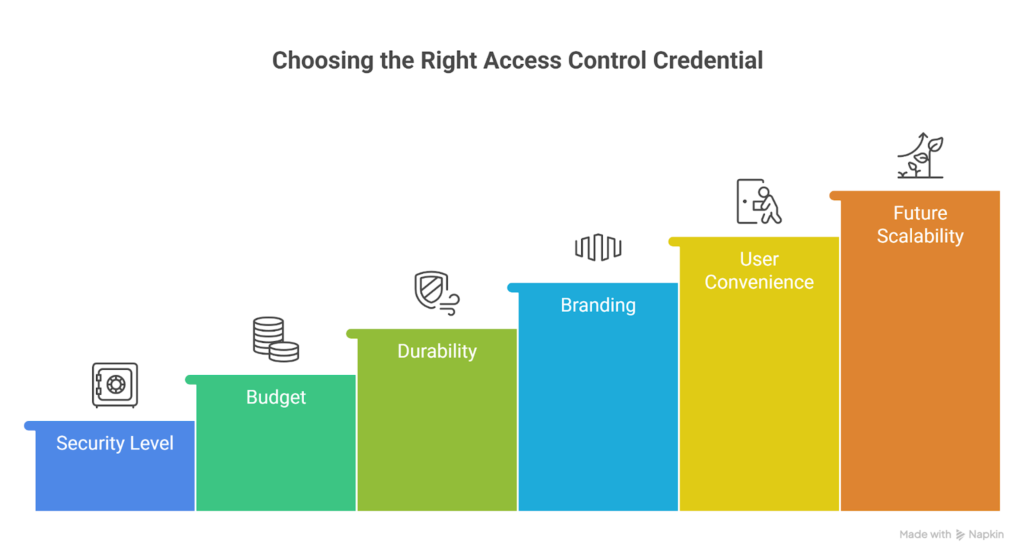
Selecting between a key fob and a key card requires evaluating measurable operational factors. The decision should be based on the following:
Security Level Required
- Do you require encrypted 13.56 MHz smart credentials?
- Is credential cloning protection necessary?
- Will two-factor authentication be implemented?
- Is biometric integration planned?
If the property handles regulated data, financial records, pharmaceuticals, or controlled inventory, encrypted smart credentials are mandatory regardless of format.
Budget
- What is the per-unit credential cost?
- What is the expected annual replacement rate?
- How many credentials will be issued?
- What is the administrative cost of re-issuance?
Large condo deployments may prioritize lower unit cost. Industrial facilities may prioritize lower replacement frequency.
Durability Needs
- Is the environment industrial or climate-controlled?
- Are credentials exposed to moisture or cold?
- Are users carrying tools or heavy equipment?
High-impact environments favour thicker credentials. Controlled office environments reduce physical stress.
Branding Needs
- Is employee photo identification required?
- Does the organization require visible ID badges?
- Is corporate branding part of security policy?
If visual identification is required, printable credentials offer operational advantage.
User Convenience
- Will credentials be attached to keys?
- Will they be worn on lanyards?
- Are users residents, office staff, or industrial workers?
User behavior directly affects loss rate and damage frequency.
Future Scalability
- Will the system migrate to cloud management?
- Is mobile credential support planned?
- Will additional facilities be added?
Encrypted smart technology simplifies future expansion and multi-location management.
Should You Upgrade Your Existing Access Control System?
Instead of asking whether you should upgrade, ask whether your current system meets modern commercial risk standards.
Many Ontario properties still operate legacy 125 kHz proximity systems. These systems lack advanced encryption and are more vulnerable to credential cloning.
Here is how to evaluate your current setup:
If your readers only support 125 kHz proximity credentials, encrypted smart credentials cannot be deployed without hardware replacement.
If your system relies on on-premise software without remote management, administrative control may be limited compared to modern cloud platforms.
If your access logs are not integrated with CCTV systems, investigative efficiency is reduced.
If credential revocation is slow or manual, operational risk increases.
Modern commercial systems across Toronto, Mississauga, Vaughan, and Brampton are moving toward:
- Multi-technology readers
- Encrypted smart credentials
- Cloud-based access management
- Mobile access capability
- Biometric compatibility
- Integrated video and alarm synchronization
Upgrading is not about replacing cards or fobs. It is about closing security gaps, improving administrative control, and aligning with current commercial security standards in Ontario.
A professional infrastructure assessment determines whether you need a credential upgrade, reader replacement, full panel replacement, or a phased migration strategy.
Security infrastructure should evolve with operational risk, not react to incidents.
Final Thoughts
Choosing between a key fob and a key card is not about which credential looks better. It is about aligning your access control system with the operational demands of your property. Condos in Toronto require convenience and controlled resident management.
Corporate offices in Vaughan need structured ID integration and employee onboarding efficiency. Warehouses in Mississauga demand durability and reduced replacement frequency. The right decision depends on the environment, security level, and long-term management strategy.
If your commercial property in Ontario is planning a new installation or considering an upgrade, the most important step is a proper technical assessment.
At Sense Group, we design and install professional access control systems across Toronto and the GTA, integrating encrypted smart credentials, cloud management, CCTV synchronization, and secure door hardware.
We evaluate your doors, readers, infrastructure, and operational workflow before recommending the right credential strategy. Whether you manage a condo corporation, corporate office, medical clinic, or industrial facility, our team delivers secure, scalable, and professionally configured solutions built for Ontario commercial standards.