Access control entry system is one of the most effective ways Ontario businesses control who enters their buildings and secure sensitive areas. Whether you operate a warehouse in Mississauga, a medical clinic in Hamilton, or a retail store in downtown Toronto, managing entry points is critical for safety, compliance, and daily operations.
Unlike traditional locks and keys, modern systems authenticate credentials, track movement, and allow administrators to grant or revoke access instantly. This means no more lost key risks, unauthorized duplication, or security blind spots.
In commercial environments where inventory, data, and staff safety matter, controlled entry is no longer optional. It’s operational protection.
In this guide, we explain how these systems work, what features businesses should prioritize, and why professional installation is essential for long-term reliability and performance across Ontario properties.
What Does Access Control Entry Actually Mean in Modern Security Systems?
Access control entry is a security system that verifies identity, grants permission, and controls physical access to specific areas within a commercial or residential property. In modern security infrastructure across Ontario, it replaces traditional keys with intelligent credential based authentication.
With over a decade of hands-on experience installing these systems in warehouses, clinics, offices, and condominiums across Ontario, access control entry has proven to be the foundation of controlled facility security.
A complete system typically includes:
• Access control panel or door controller
• Credential readers such as RFID card readers or biometric scanners
• Credentials including key fobs, access cards, mobile tokens, or PIN codes
• Electric strike or magnetic lock hardware
• Access management software with user database
• Audit trail and entry log reporting system
In commercial settings, this means administrators can authenticate users, assign role based permissions, restrict sensitive zones, track entry activity, and revoke credentials instantly. A logistics warehouse in Brampton can limit loading dock access to authorized supervisors.
A medical clinic in Toronto can restrict file room access to licensed staff only. A retail store can secure inventory storage and generate entry reports for internal accountability. Modern access control entry systems centralize security, increase operational control, and provide documented entry records that traditional locks can never deliver.
How Does an Access Control Entry System Work Step by Step?
An access control entry system works through a clear and structured process. It verifies identity, checks permissions, unlocks the door if approved, and records the activity. In commercial properties across Ontario such as warehouses, offices, clinics, retail stores, and condominium buildings, this process happens within seconds.
Behind that quick response is a combination of hardware devices, access control software, network connectivity, and door locking mechanisms working together.
Let’s break it down step by step.
1. Credential Authentication
The process begins when a user presents a credential to a reader installed near the door. This credential can be an RFID card, key fob, mobile phone token, PIN code, or biometric scan such as fingerprint recognition.
The access control reader scans the credential and sends the data to the access control panel or door controller. The system verifies whether the credential is valid. This step is called authentication. It confirms the identity of the person requesting entry.
2. Authorization Processing
After authentication, the system checks authorization rules. This means it reviews the user’s access permissions stored in the access management software.
The software determines:
- Which doors the user can access
- What time schedules apply
- Whether the credential is active or revoked
- If role based access restrictions apply
For example, a warehouse employee in Mississauga may only access the loading dock during working hours. A manager may have access to additional secured zones. The system processes this decision instantly.
3. Door Release Mechanism
If authorization is approved, the access control panel sends a signal to release the locking device. This may activate an electric strike or magnetic lock installed on the door frame.
The door unlocks for a few seconds, allowing entry. If authorization is denied, the door remains locked and access is restricted.
4. Entry Logging and Reporting
Every access attempt is recorded in the audit trail. The system logs:
- User identity
- Date and time
- Door location
- Approved or denied status
These entry logs help businesses monitor activity, investigate incidents, and maintain compliance. Commercial properties across Ontario rely on this reporting feature to improve security, reduce internal risk, and maintain operational control.
What Are the Core Components of an Access Control Entry System?
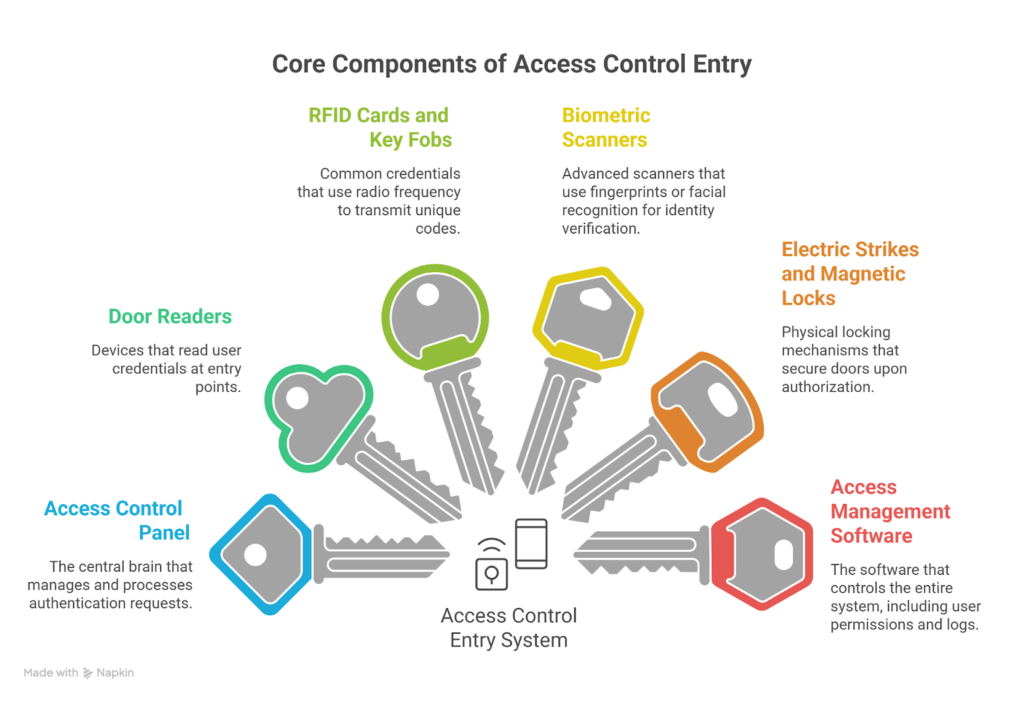
An access control entry system is not just a card reader on the wall. It is a complete security infrastructure made up of connected hardware and software components that work together to manage, monitor, and secure physical entry points.
For commercial buildings in Ontario such as warehouses, medical clinics, offices, retail stores, and condominiums, understanding these core components helps business owners choose the right system for long term reliability and performance.
Here are the essential parts of a modern commercial access control entry system.
Access Control Panel
The access control panel, also called the door controller, is the brain of the system. It receives data from door readers, processes authentication requests, checks authorization permissions, and sends signals to locking hardware.
It connects to the access management software through a network. In multi door commercial properties, panels can control several entry points from a centralized system.
Door Readers
Door readers are installed near entry points and are responsible for reading credentials. These may include RFID readers, key fob readers, keypad readers, or biometric scanners.
When a user presents a credential, the reader captures the data and sends it to the control panel for verification. Reliable readers are critical for secure access control in high traffic commercial environments.
RFID Cards and Key Fobs
RFID cards and key fobs are common access credentials used in offices, warehouses, and condo buildings. They use radio frequency identification to transmit a unique code to the reader.
These credentials are easy to issue, revoke, and manage through the access control software. If a card is lost, it can be deactivated instantly without replacing locks.
Biometric Scanners
Biometric access control uses fingerprint recognition or facial authentication to verify identity. This method adds a higher level of security because credentials cannot be shared. Biometric scanners are often used in secure areas such as server rooms, medical record storage, and restricted inventory zones.
Electric Strikes and Magnetic Locks
Electric strikes and magnetic locks secure the door physically. When authorization is approved, the system releases the lock for entry. Magnetic locks are common in commercial glass doors, while electric strikes are often used in office and warehouse entry doors.
Access Management Software
Access management software controls the entire system. It stores user credentials, assigns role based permissions, sets time schedules, and generates entry logs.
Cloud based access control software allows remote monitoring and centralized management across multiple Ontario locations. This software is what turns hardware into a complete commercial security solution.
What Types of Access Control Entry Technologies Are Available Today?
Modern access control entry systems use different authentication technologies depending on the level of security, type of commercial property, and operational needs. Warehouses, medical clinics, office buildings, retail stores, condominiums, and industrial facilities across Ontario often choose different technologies based on traffic volume, compliance requirements, and risk level.
Some systems focus on speed and convenience. Others focus on high security identity verification. Below are the main access control technologies used in commercial security installations today.
RFID Card and Key Fob Systems
RFID card and key fob systems are the most common commercial access control solution. RFID stands for radio frequency identification. Each card or fob contains a unique credential that communicates with the door reader. When presented, the reader sends the credential data to the access control panel for authentication and authorization.
If approved, the system releases the electric strike or magnetic lock. If denied, access is restricted. These systems are widely used in office buildings, warehouses, retail stores, and condominium properties because credentials can be issued, revoked, and managed easily through access management software.
Biometric Access Control Systems
More than 78 percent of corporate facilities worldwide adopted at least one form of electronic access control solution such as smart card systems, biometric scanners, or keypad entry systems in 2024
Biometric access control uses fingerprint recognition or facial authentication instead of physical credentials. This method verifies identity based on unique biological data.
Biometric systems are ideal for high security commercial environments such as server rooms, medical file storage areas, cannabis retail inventory rooms, financial institutions, and restricted manufacturing zones. Because credentials cannot be shared, biometric authentication improves accountability and reduces internal risk.
Keypad and PIN Based Entry Systems
Keypad entry systems require users to enter a personal identification number to unlock the door. They are cost effective and simple to deploy, especially for secondary doors or smaller commercial offices.
However, PIN codes can be shared. For stronger security, many Ontario businesses combine keypad entry with RFID credentials for two factor authentication, improving overall protection.
Mobile Phone Based Access Control Systems
Nearly 39 percent of organizations now use mobile identities and mobile credential access in their access control systems, pushing contactless entry solutions forward.
Mobile access control systems use secure digital credentials stored on a smartphone. Authentication occurs through Bluetooth or NFC communication with the reader.
This technology allows remote credential provisioning, instant revocation, and centralized cloud based access management. It is increasingly popular in modern commercial buildings across Toronto, Mississauga, Vaughan, and Brampton because it reduces physical card handling and improves operational control.
Which Commercial Properties in Ontario Require Access Control Entry the Most?
Across Ontario, certain commercial properties rely heavily on access control entry systems because of higher security risks, compliance requirements, and operational complexity. These businesses cannot depend on traditional locks. They require controlled entry, user authentication, audit trails, and centralized access management.
Warehouses in Mississauga (L5T, L4W)
Industrial warehouses in Mississauga handle inventory, equipment, and high value goods daily. Commercial access control entry systems for warehouses in Mississauga help restrict loading dock access, secure inventory storage zones, and track employee movement.
With role based access permissions and real time entry logging, managers maintain operational control and reduce internal theft. Integration with CCTV and alarm systems adds another security layer.
Condo Buildings in North York (M2N, M3C)
High rise residential buildings require condo access control entry systems in North York to manage residents, visitors, and contractors. RFID key fob systems and mobile credentials allow property managers to issue and revoke access instantly.
Secure entry to parking garages, fitness areas, and shared amenities improves resident safety and liability control.
Retail Stores in Downtown Toronto (M5V)
Retail businesses in downtown Toronto need retail store access control entry solutions in M5V to secure stock rooms and cash handling areas. Entry logs provide accountability for staff access after hours. Combined with video surveillance, access data supports internal investigations if incidents occur.
Medical Clinics in Hamilton (L8P)
Healthcare facilities require medical clinic access control systems in Hamilton Ontario to protect patient records and prescription storage. Biometric authentication and restricted file room access improve compliance and privacy protection.
Cannabis Dispensaries in Scarborough (M1P)
Cannabis retail locations must meet strict regulatory security standards. Cannabis dispensary access control entry in Scarborough M1P ensures restricted inventory room access and documented entry logs for compliance inspections.
Logistics Hubs in Brampton (L6T)
Logistics operations depend on industrial access control entry systems in Brampton L6T to secure shipping areas and manage multi shift employee access.
Manufacturing Facilities in Vaughan (L4K)
Manufacturing plants use access control entry systems for industrial facilities in Vaughan L4K to limit access to production zones, hazardous areas, and equipment rooms.
For these commercial properties, professional installation and integration are critical. This is where Sense Group provides full system design, hardware installation, and secure configuration across Ontario.
What Essential Features Should Businesses Look for in an Access Control Entry System?
Choosing the right access control entry system is not just about installing card readers on doors. For commercial properties in Ontario, the real value comes from the system’s functionality, scalability, and integration capability.
Warehouses, medical clinics, retail stores, condominiums, logistics hubs, and manufacturing facilities all require structured access management that supports daily operations while protecting assets and personnel.
Below are the essential features every business should evaluate before investing in a commercial access control solution.
| Essential Feature | What It Does | Why It Matters for Ontario Businesses |
| Role-Based Access Permissions | Assigns access levels based on job roles or departments | Restricts sensitive areas like server rooms, inventory zones, or financial offices to authorized personnel only |
| Time-Based Scheduling | Controls entry permissions based on date and time | Prevents after-hours access and reduces internal security risks |
| Real-Time Monitoring | Displays live access activity across entry points | Allows managers to monitor movement instantly and respond to suspicious activity |
| Audit Trail Reporting | Records all entry and exit attempts with timestamps | Provides accountability, compliance documentation, and incident investigation support |
| Emergency Lockdown Function | Instantly secures all controlled doors | Critical for security incidents, workplace threats, or emergency response situations |
| CCTV Integration Capability | Syncs access events with surveillance footage | Links entry logs with video evidence for stronger security validation |
| Alarm System Integration | Connects door access events to intrusion detection systems | Enhances perimeter protection and triggers alerts during unauthorized attempts |
| Remote Management via Cloud Software | Enables off-site control of credentials and permissions | Ideal for multi-property businesses across Toronto, Mississauga, and Vaughan |
| Multi-Location Scalability | Centralizes access management for several facilities | Supports expanding companies with operations in multiple Ontario cities |
A professional access control entry system must do more than unlock doors. It should authenticate users, manage permissions, log activity, and integrate with video surveillance and alarm infrastructure. Businesses across Ontario require centralized security control, especially when managing multiple departments or multiple locations.
For example, a logistics company in Brampton may need role-based permissions for warehouse staff while corporate offices require separate credential management. A retail chain in Toronto may need centralized cloud-based monitoring across several storefronts.
These features create operational efficiency, reduce liability, and strengthen physical security. When properly installed and configured, a commercial access control system becomes a long-term security asset rather than just a door locking solution.
This is where professional system design, integration, and configuration from an experienced installer like Sense Group ensures the system operates securely and reliably from day one.
What Are the Key Benefits of Installing Access Control Entry for Commercial Operations?
Installing a commercial access control entry system delivers far more than controlled door access. For businesses across Ontario, it strengthens physical security, improves operational control, and creates measurable accountability.
Warehouses, retail stores, clinics, logistics facilities, and corporate offices benefit from structured entry management that supports both security and compliance requirements.
Below are the core advantages that make access control systems a critical investment for modern commercial properties.
Reduction of Internal Theft and Unauthorized Access
Access control entry systems restrict access to sensitive areas such as inventory rooms, server rooms, financial offices, and restricted production zones. With credential based authentication and role based permissions, only authorized employees can enter specific areas.
Elimination of Lost Key Liability
Traditional keys create long term risk. Lost or duplicated keys often require full lock replacement. Electronic credentials such as RFID cards, key fobs, or mobile access tokens can be instantly revoked through access management software.
This removes the expense and security vulnerability tied to physical key control while improving credential lifecycle management.
Improved Compliance and Documentation
Many industries in Ontario require documented entry records for regulatory compliance. Access control systems generate audit trail reporting that records user identity, date, time, and door location.
This documentation supports workplace safety standards, privacy regulations, and security audits. In sectors like healthcare, cannabis retail, and finance, controlled access with reporting capability is essential.
Lower Insurance Risk Exposure
Insurance providers assess physical security measures when evaluating commercial policies. Controlled entry points, electronic locking mechanisms, and documented access logs demonstrate proactive risk management. Businesses with modern access control infrastructure may benefit from improved insurability and reduced liability exposure.
Centralized Multi Site Security Management
For companies operating multiple facilities in Toronto, Mississauga, Vaughan, or across Ontario, cloud based access management allows centralized control. Administrators can assign permissions, monitor entry activity, and manage credentials across several locations from one secure platform.
This improves operational efficiency, reduces administrative overhead, and strengthens enterprise level security oversight.
Modern commercial environments demand more than simple door locks.
An access control entry system provides structured identity verification, controlled authorization, detailed reporting, and centralized security management. Businesses across Ontario that invest in electronic access management gain long term protection, improved accountability, and scalable security infrastructure that grows with their operations.
However, selecting the right system is only part of the decision. Understanding potential limitations and planning considerations is equally important before moving forward with installation.
What Are the Limitations or Considerations Before Installing Access Control Entry?
While access control entry systems provide strong security and operational benefits, commercial property owners must understand the practical considerations before installation. Proper planning prevents future system failures, compliance issues, and unnecessary expenses.
Initial Installation Investment
A single door office setup will cost far less than a multi door warehouse with biometric authentication and cloud management. Infrastructure such as electric strikes, magnetic locks, control panels, and structured cabling also impact cost.
Businesses often compare this with how much CCTV installation costs when budgeting a complete security upgrade. A properly designed system delivers long term return by reducing theft and liability.
Structured Network Cabling Requirements
Most commercial grade systems require low voltage wiring and network connectivity. Door readers connect to control panels, which connect to the access management server. In many buildings, upgrading cabling is part of the process.
Planning similar to wiring a home for modern security ensures clean installation and system stability. Wireless options exist, but wired infrastructure remains the most reliable for high traffic commercial properties.
Power Outage Considerations
Access control systems rely on power. Without battery backup, doors may default to fail safe or fail secure mode depending on configuration. Commercial installations include backup power supplies to maintain operation during outages. This is particularly critical for warehouses, clinics, and regulated facilities.
Cybersecurity Risks
Professional configuration protects credential databases, access permissions, and audit logs. Businesses integrating entry systems with security cameras installation in Toronto must also secure the entire network ecosystem.
Importance of Professional Configuration
Improper system setup can result in doors unlocking incorrectly, incomplete audit trails, or failed integrations. Professional installers design permission structures, test door hardware, and configure emergency lockdown functions correctly.
For businesses operating within our Toronto service areas, expert installation ensures compliance and long term reliability.
How Does Access Control Entry Compare to Traditional Lock and Key Systems?
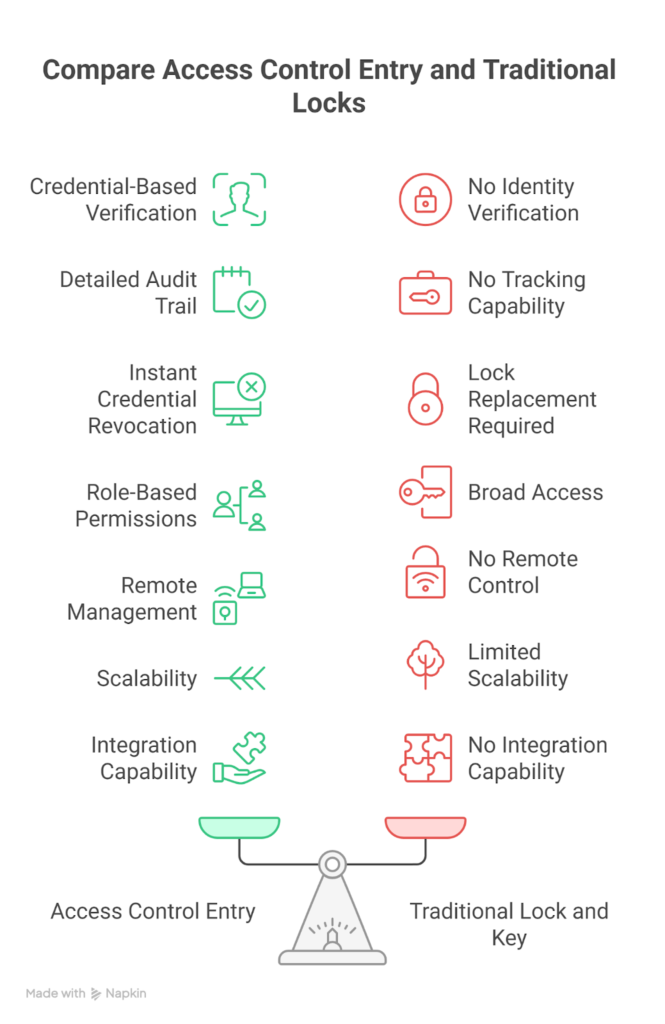
When evaluating commercial security solutions, many Ontario business owners still compare access control entry systems with traditional lock and key setups. At first glance, mechanical locks seem simple and affordable.
However, modern commercial environments demand accountability, scalability, and real time control. Warehouses, retail stores, clinics, and office buildings require more than physical restriction. They require identity verification, entry tracking, and centralized access management.
Below is a clear comparison to help businesses understand the practical differences.
| Feature | Access Control Entry System | Traditional Lock and Key |
| User Authentication | Credential based verification using RFID, biometric, PIN, or mobile access | No identity verification beyond physical key |
| Access Tracking | Detailed audit trail with entry logs and timestamps | No tracking or reporting capability |
| Lost Key Management | Credential can be instantly revoked through software | Requires lock replacement or rekeying |
| Role Based Permissions | Different access levels for departments and staff | Same key often grants broad access |
| Remote Management | Cloud based control across multiple locations | No remote control capability |
| Scalability | Easily expandable to multiple doors and sites | Limited scalability, requires hardware replacement |
| Integration | Can integrate with CCTV and alarm systems | No integration capability |
From an operational perspective, access control entry systems provide structured security management. They reduce internal risk, improve compliance documentation, and centralize multi site oversight. Traditional locks may appear cost effective at first, but over time, rekeying costs, lost key liability, and lack of accountability create hidden expenses.
As security expectations grow and regulatory standards tighten across Ontario, businesses must evaluate whether basic physical locks are enough. Understanding these differences leads naturally to the next important factor: overall cost and long term investment planning.
How Much Does Access Control Entry Installation Cost in Ontario?
The cost of installing an access control entry system in Ontario depends on several technical and operational factors. There is no flat price because every commercial property has different door counts, credential types, infrastructure conditions, and integration requirements. Warehouses, office buildings, retail stores, clinics, and industrial facilities all require customized system design.
A professionally planned system delivers long term value, improved security, and reduced liability.
Below are the key cost factors businesses should understand.
How Door Count and Hardware Affect Pricing
The number of controlled doors is the biggest pricing factor. Each door requires a reader, electric strike or magnetic lock, cabling, and configuration. A single office entry will cost significantly less than a warehouse with multiple loading docks and restricted zones.
Hardware selection also impacts cost. Biometric scanners cost more than RFID card readers. Heavy duty commercial maglocks cost more than standard electric strikes. High traffic commercial doors require durable components.
Wired vs Wireless Systems
Wired access control systems require structured low voltage cabling and network infrastructure. They offer higher reliability and are ideal for warehouses and large commercial buildings.
Wireless systems reduce cabling work and may lower installation labor in certain properties. However, they may have limitations depending on building structure and network stability. For most GTA commercial facilities, wired systems remain the preferred long term solution.
Cloud Based Management Costs
Cloud based access control software adds monthly subscription fees but provides remote management, centralized credential control, and multi location scalability. Businesses operating across Toronto, Mississauga, Vaughan, and Brampton benefit from centralized cloud access management.
On premise systems may reduce recurring fees but require local server maintenance.
Realistic Budget Expectations for GTA Businesses
For small offices with one or two doors, installation may start in the lower thousands. Mid size commercial facilities with multiple doors and integrated security systems can range significantly higher depending on scope. Large warehouses or regulated facilities require comprehensive system design and advanced authentication.
At Sense Group, we provide professional access control system installation in Toronto and across the GTA. Every project begins with a site assessment to evaluate door hardware, cabling pathways, power supply requirements, and integration needs.
Our team designs scalable commercial access control solutions that integrate with CCTV systems, alarm systems, and network infrastructure.
We focus on long term reliability, proper configuration, and clean installation so businesses avoid costly future upgrades. If you operate in Toronto or surrounding Ontario regions, our experienced technicians can provide a clear cost breakdown and recommend the right system for your property.
Final Thoughts
Access control entry is no longer a luxury feature for large corporations. It has become a practical and necessary security standard for commercial properties across Ontario.
From warehouses in Mississauga to retail stores in Downtown Toronto and medical clinics in Hamilton, controlled entry systems provide structure, accountability, and operational control that traditional locks simply cannot match.
Businesses today face higher expectations around safety, compliance, and internal risk management. Electronic access systems offer credential authentication, role based permissions, real time monitoring, and detailed audit trail reporting. When integrated with CCTV surveillance and alarm systems, they form a complete physical security infrastructure that protects assets, staff, and daily operations.
However, the real value does not come from hardware alone. Proper system design, professional installation, secure configuration, and long term scalability are what turn an access control system into a dependable commercial solution.
For Ontario businesses planning to upgrade their physical security, the key is choosing a system that fits both current needs and future growth. With the right strategy and expert implementation, access control entry becomes more than door management. It becomes structured security management built for long term protection and performance.