
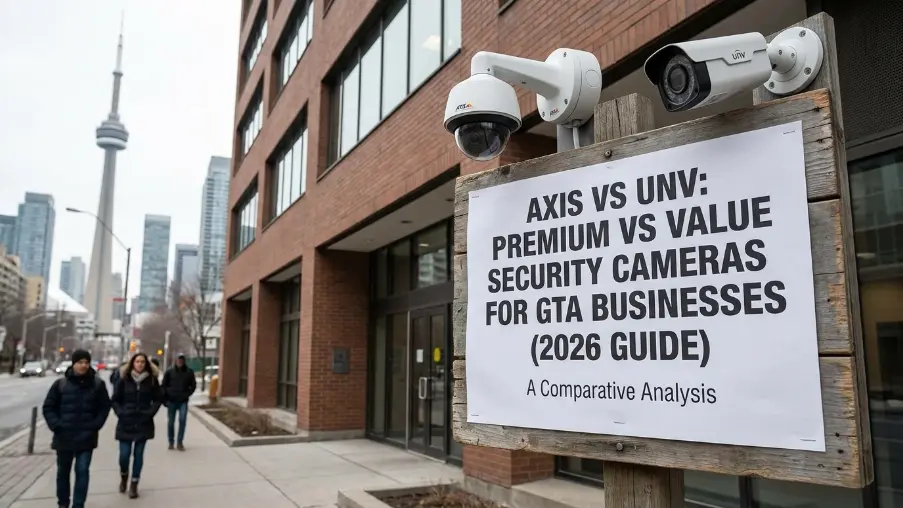
For most commercial properties, the honest answer is simple. Choose Axis when you need top-tier low-light performance and a 10-year lifespan. Choose UNV when you want strong, reliable coverage at roughly half the cost.
That single trade-off sits behind nearly every quote we write. You are likely weighing it right now, and you are not alone. Business owners across the region face rising high-value theft, tighter insurance demands, and new rules on which brands they can even buy.
Read on to see exactly which brand fits your property, your risk, and your budget.
Axis vs UNV: Quick Comparison
Here is the fast version before we dig into the details. The table below sums up how these two commercial security cameras stack up on the factors that matter most to a buyer.
| Factor | Axis (Premium) | UNV / Uniview (Value) |
| Price tier | Higher upfront cost | 40-60% lower upfront |
| Low-light performance | Lightfinder, class-leading | LightHunter / ColorHunter, strong |
| AI video analytics | Deep, mature, edge-based | Solid, model-dependent |
| Build & lifespan | 10-15 years typical | 5-8 years typical |
| Software ecosystem | Open, 85+ VMS platforms | ONVIF, best within UNV |
| Storage tech | Zipstream compression | Ultra 265, cuts storage ~75% |
| Warranty | Long, enterprise-grade | 3-year standard |
| Best fit | High-stakes zones, integration | Broad coverage, tight budgets |
Understanding Axis vs UNV: Brand Overview
Axis
Axis Communications is a Swedish firm that invented the world’s first network camera in 1996. The brand built its name on image quality, cybersecurity, and an open platform. Axis cameras work with most major video management systems, so they suit phased upgrades and mixed-vendor sites.
Many integrators treat Axis as infrastructure, not a gadget. That reputation is exactly why a careful Axis camera installation in the GTA tends to reward owners who plan for the long haul.
UNV
Uniview (UNV) is one of the largest IP surveillance manufacturers in its region. The brand earned trust by giving businesses professional-grade features at a fair price. UNV cameras carry strong low-light tech, useful analytics, and a standard 3-year warranty.
For budget-conscious owners who still want commercial quality, UNV hits a genuine sweet spot. A well-planned UNV camera installation for your business often stretches a tight security budget further than people expect.
Axis vs UNV: Head-to-Head Comparison
Specs only matter when they change what you see on screen or pay at the till. So let us skip the brochure language. Below, we break down each factor the way we explain it to clients during a site visit across the GTA.
1. Video Quality and Sensor Performance
Axis leans on Lightfinder technology to hold full-colour images in near-darkness. Larger sensors and refined processing give it an edge in tricky, backlit, or dim spaces. That clarity matters at a loading dock at 3 a.m.
On the other hand, UNV answers with LightHunter and ColorHunter for bright night colour. Image quality is genuinely strong for the price. Just remember that sensor size, not megapixels alone, drives real low-light detail.
2. AI Features and Analytics
Whereas Axis offers deep, mature analytics that run on the camera itself, reducing server load. Think reliable line-crossing, intrusion detection, and object classification. These tools cut false alarms and speed up footage searches.
UNV, by contrast, packs a capable analytics set that covers most commercial needs. People counting, smart intrusion, and vehicle detection all feature. The depth varies by model, so the exact camera you pick matters.
3. Build Quality and Hardware Durability
Axis hardware is built to last, with many units running 10 to 15 years in the field. Rugged housings handle Ontario winters and harsh outdoor mounts. Fewer failures mean fewer return visits.
In contrast, UNV cameras typically serve 5 to 8 years of solid duty. Vandal-resistant and IP67 weatherproof options are standard. For many businesses, that lifespan still matches their planning horizon.
Read More: Cloud Cameras vs Local NVR: What Happens If the Internet Goes Down?
4. Software Ecosystem and Management Platforms
Axis is an ONVIF founding member with famously open integration. Its cameras connect to over 85 third-party VMS platforms like Milestone and Genetec. That flexibility protects you if you mix brands later.
On the other hand, UNV performs best inside its own ecosystem of cameras and NVRs. ONVIF support still allows cross-brand setups. Pairing it with the right recorder keeps everything running smoothly.
5. Cybersecurity and Firmware Updates
Axis treats firmware and encryption as core features, with frequent, well-documented updates. That track record reassures regulated industries and IT teams. Secure boot and signed firmware are standard.
UNV, meanwhile, has improved its security posture and pushes regular updates too. Changing default passwords and segmenting the camera network still matters. Good practice protects any brand on your system.
6. Scalability for Large Systems
Whereas Axis scales cleanly across multi-site enterprises with central management. Distributed edge processing reduces single points of failure. It suits corporate campuses and growing portfolios.
UNV scales impressively for the money, supporting large channel counts on its higher-end recorders. Multi-location viewing runs from one app. That makes it practical for warehouse groups and retail chains.
Read More: Wide-Angle vs More Cameras: Which Is Better?
7. Ease of Installation and Configuration
Axis installs cleanly and reliably, which is why pros value fewer call-backs on big jobs. Stable firmware and clear tools save labour hours. On large sites, that predictability adds up.
On the other hand, UNV is straightforward to deploy and configure for most setups. Support teams are responsive when issues arise. A skilled installer smooths out either brand quickly.
8. NDAA Compliance and Regulatory Requirements
This factor became urgent after the Government of Canada ordered Hikvision to cease its Canadian operations in June 2025 on national-security grounds. Axis states its full product line is NDAA Section 889 compliant. That makes it a safe pick for government-adjacent work.
UNV compliance, by contrast, is model-dependent rather than universal. Specific UNV lines meet NDAA standards, but not the entire catalogue. A knowledgeable installer should confirm compliance per camera.
9. Real-World Use Cases
Different GTA properties face different threats, so the right brand shifts with the job. Here is where each one earns its place on the ground.
Where Axis Fits Best
Axis works efficiently on high-stakes zones where image quality and uptime cannot slip.
- Loading docks and warehouse gates where cargo theft hits hardest.
- Building lobbies that need clean, professional office security camera installation.
- Retail entrances and POS counters that demand sharp evidence.
- Multi-site portfolios that rely on deep VMS integration.
- Regulated sites that require guaranteed NDAA compliance.
Where UNV Fits Best
UNV stretches a budget across wide areas without cutting corners on quality.
- Warehouse interiors and aisles that need many cameras at once.
- Active builds, where rugged professional construction site CCTV installation deters tool and copper theft.
- Retail floors and stockrooms covering everyday shrinkage.
- Parking lots paired with professional access control systems to limit who gets near vehicles.
- Growing businesses that want strong coverage on a tighter budget.
10. Total Cost of Ownership
Sticker price tells only half the story. Because Axis lasts longer, the gap narrows over a full deployment cycle. The table shows how the two compare over time.
| Cost factor | Axis | UNV |
| Upfront hardware | Higher | Lower (40-60% less) |
| Expected lifespan | 10-15 years | 5-8 years |
| Replacement frequency | Rare | More likely mid-term |
| Storage cost | Reduced via Zipstream | Reduced via Ultra 265 |
| Service call-backs | Fewer | Occasional |
| Long-term value | Strong on long horizons | Strong on tight budgets |
Read More: Verkada vs. Traditional NVR Systems: Which Security Solution Is Better?
Advantages & Disadvantages of Axis and UNV

Pros of Axis Cameras
Axis earns its premium through performance, longevity, and openness. These strengths stand out most on demanding commercial sites.
- Class-leading low-light colour imaging.
- 10 to 15 year typical lifespan.
- Open platform with 85+ VMS integrations.
- Strong cybersecurity and firmware support.
- Full NDAA Section 889 compliance.
Cons of Axis Cameras
The downsides come down to cost and complexity. Not every property needs this level of capability.
- High upfront cost per camera.
- Many features go unused on simple sites.
- Overkill for small coverage needs.
Pros of UNV Cameras
UNV delivers serious value without feeling cheap. It fits owners who want quality coverage on a sensible budget.
- 40 to 60% lower upfront cost.
- Strong night colour with LightHunter.
- Ultra 265 compression cuts storage sharply.
- Standard 3-year warranty.
- Scales well for large camera counts.
Cons of UNV Cameras
The trade-offs show up over the long run. Knowing them upfront prevents surprises later.
- Shorter hardware lifespan than Axis.
- NDAA compliance varies by model.
- Works best inside its own ecosystem.
Axis vs UNV: Which One Should You Choose?
Your property, risk level, and budget decide the winner, not the brand name. Here is the part most sales pitches skip: you do not have to choose just one. Most GTA businesses actually benefit from a hybrid system. We design these every week through our expert commercial security camera installation across the region.
Choose Axis If You Need:
- The best low-light and image clarity.
- A 10-year-plus lifespan and fewer replacements.
- Deep integration with existing VMS platforms.
- Guaranteed NDAA compliance for regulated work.
Choose UNV If You Need:
- Strong commercial coverage on a tighter budget.
- Many cameras across a large site.
- Lower storage and running costs.
- A solid 3-year warranty without premium pricing.
Conclusion
The Axis vs UNV choice is not about premium versus value alone. It is about matching the right camera to each zone of your property. Smart owners often blend both, putting Axis where stakes are highest and UNV everywhere else.
You have worked hard for what you have built, so protecting it should not feel like a gamble. Want a system designed around your actual risks, not a sales quota? Book a free on-site assessment for commercial security camera installation in Toronto and the wider GTA today.
Frequently Asked Questions
Is UNV good enough for a commercial property? Yes. UNV delivers professional-grade coverage, useful analytics, and a 3-year warranty. It suits most GTA businesses that want quality without premium pricing.
Can I mix Axis and UNV cameras on one system? Yes, through ONVIF and a compatible recorder or VMS. Many businesses run Axis on key zones and UNV elsewhere to balance cost.
Are UNV cameras NDAA compliant? Some are; compliance is model-dependent, not catalogue-wide. Always confirm the specific model meets NDAA Section 889 before buying.
How long do commercial security cameras last? Axis units often run 10 to 15 years. UNV cameras typically serve 5 to 8 years of reliable duty.
Do you install both brands across the GTA? Yes. As a brand-neutral installer, we fit Axis, UNV, and other trusted systems. We recommend based on your property, never a quota.