

For most cases, multiple cameras are the better choice because they provide stronger identification, fewer blind spots, and better coverage across different areas. However, a wide-angle camera can still be the right solution for certain open spaces.
Choosing between a wide-angle camera and multiple cameras is not always as simple as comparing costs. The right setup depends on what you need to monitor, the level of detail you require, and how your property is laid out.
A camera that captures an entire space may seem convenient, yet it might miss the facial details or licence plates needed after an incident. Meanwhile, adding more cameras can improve visibility but also increases equipment and installation requirements.
Read on to compare both options across the factors that matter most and determine which setup best suits your business.
Wide-Angle vs Multi-Camera: Quick Comparison
Here is the short version before we examine each factor in detail.
| Factor | Wide-Angle Camera | Multiple Cameras |
| Coverage area | Broad, one viewpoint | Targeted, many viewpoints |
| Detail at distance | Declines quickly | Stays sharp |
| Face/plate capture | Weak past 15 feet | Strong at choke points |
| Blind spots | Few in one zone | Few across the whole site |
| Upfront camera cost | Lower (fewer units) | Higher (more units) |
| Cabling and NVR load | Light | Heavier |
| Best use | Open-area awareness | Identifying people and vehicles |
What Is a Wide-Angle Camera?
A wide-angle camera is one unit with a broad lens that captures a large area in a single frame. Fisheye and panoramic models reach 180 to 360 degrees. One camera watches a whole room or yard.
It works by spreading a fixed pixel count across a wide scene. A 2.8mm lens, for example, sees roughly 100 to 110 degrees. Fisheye models stretch even wider, then rely on software “dewarping” to flatten the curved image. Because those pixels cover so much ground, fewer of them land on each face or plate. In short, the wider the view, the softer the detail at any given point.
What Are Multi-Camera Systems?
A multi-camera system uses several fixed cameras, each aimed at one zone. Instead of one wide view, you get many focused views. Each camera does one job well, from the loading dock to the till.
It works by placing detail exactly where it matters. You mount high-resolution cameras at entrances, gates, and cash points. Then you add wider cameras for general awareness elsewhere. Each feed runs to your commercial security camera system over its own cable, so every zone records at once with no gaps. As a result, no critical area sits unwatched, even during a power flicker or staff changeover.
Read More: Axis vs Hikvision vs Ubiquiti Security Camera: Which Brand Is Right for Your GTA Business?
Wide-Angle vs Multi-Camera: A Detailed Comparison
Both setups protect property, yet they perform best under different conditions. Below, we compare ten factors that determine real-world results for GTA businesses.
1. Image Quality
Wide-angle cameras spread their resolution across a large scene. The wider the lens, the lower the pixel density at any given distance. Industry guidance from JVSG’s pixel density standard sets reliable identification near 76 pixels per foot. A wide view rarely reaches that figure beyond close range.
On the other hand, multiple cameras keep those pixels concentrated. Since each unit covers less ground, faces and licence plates stay sharp. A camera aimed at a single doorway delivers court-ready clarity. Ultimately, that level of detail is what police and insurers actually ask for after an incident.
2. Zoom and Flexibility
Wide-angle and fisheye cameras let you zoom into recorded footage digitally. In practice, you pan around one large image after an event. However, digital zoom only enlarges the pixels already captured, so it cannot recover detail that was never recorded. A soft, low-pixel face stays soft no matter how far you zoom.
Whereas multiple fixed cameras provide genuine detail across more angles. Because every zone records continuously, no incident slips by unrecorded. PTZ models can zoom optically, yet they cover only one spot at a time. So while a PTZ tracks a vehicle on the left, your right-side entrance captures nothing.
3. Field of View
Wide-angle cameras lead on raw coverage area. A single fisheye captures an entire showroom or warehouse aisle in one frame. As a result, it eliminates blind spots within that one open space. For broad situational awareness, a single wide lens is the most efficient option.
On the other hand, four fixed cameras at roughly 110 degrees each cover most of a property at all times. Together, they monitor every direction simultaneously, not one angle in turn. So for an irregular building with corners, aisles, and offices, layered angles deliver fuller coverage. Put simply, open space favours wide coverage, while complex space favours more cameras.
4. Low-Light Performance
Wide-angle cameras lose performance after dark. Spreading light collection across a large scene weakens the night image. Many fisheye models also carry a limited infrared range, often recording in black and white only. Yet overnight break-ins are precisely when clear footage matters most.
Whereas focused cameras gather light over a smaller, tighter area. That concentration produces sharper night images exactly where you need them. This matters most on dark sites, which is why our construction site CCTV builds rely on strong low-light cameras at every access point.
Read More: Security Camera Laws in Ontario: What Every Business Must Know Before Installing
5. Depth and Distance Detail
Wide-angle footage flattens depth and bends edges. Objects far from a fisheye lens lose definition quickly. Reading a licence plate across a parking lot becomes unreliable. The lens curvature also distorts faces near the edge of the frame.
On the other hand, a narrow-lens camera holds long-range detail with consistency. A 6mm or 12mm lens captures plates and faces clearly at distance. For retail stores, office lobbies, and parking areas, that reach enables positive identification. In fact, licence plate recognition depends entirely on this focused, distance-detail approach.
6. Video Recording Performance
Wide-angle setups record a single large stream. That keeps storage requirements simple and predictable. With fewer cameras, you also manage fewer recorded files. However, fisheye dewarping demands extra processing power from your recorder.
Whereas more cameras create more streams and larger storage needs. Naturally, each feed adds load to your NVR and network. So plan your cabling and drive space upfront, not after the install. Clean, professional network cabling keeps every feed stable and recording around the clock.
7. Channels and Processing Impact
Wide-angle cameras use one NVR channel each. That leaves room for growth on your recorder. One camera, one channel, light bandwidth. The recorder rarely strains under a single wide feed.
On the other hand, many cameras consume channels, ports, and bandwidth quickly. An eight-camera system requires an eight-channel NVR and a matching network switch. Each added PoE port and cable run also raises the install cost. So size your recorder and switch for the full camera count from day one.
8. Cost and Device Pricing
Wide-angle cameras lower your upfront hardware cost. On paper, one unit replaces several cameras. Fewer cameras also mean less mounting and cabling labour. For that reason, the initial price often appears lower than a multi-camera quote.
Whereas a multi-camera system costs more in both units and installation time. Still, the more useful measure is total system value, not the price of a single camera. A wide camera that fails to identify an intruder costs far more after a loss. So weigh evidence quality against the upfront savings before you decide.
9. Ease of Use
Wide-angle cameras simplify setup. One camera, one mount, one feed to watch. Fisheye software builds the panorama for you automatically. Fewer devices mean a cleaner dashboard.
On the other hand, multi-camera systems take more planning and skilled placement. Yet modern recorders make many feeds easy to view together. One caution: not every NVR supports fisheye dewarping or multi-sensor streams. A proper install checks compatibility before mounting anything.
10. Durability and Maintenance
Wide-angle and fisheye cameras have no moving parts. That means fewer failures and lower upkeep over the years. A sealed dome resists weather and tampering. Less mechanical wear equals a longer service life.
Whereas PTZ cameras add motors that wear down and require periodic servicing. Fixed multi-camera setups stay as simple and reliable as fisheye units. For outdoor GTA sites, specify IP66 weather and IK10 vandal ratings. That hardware withstands Ontario winters and demanding job-site conditions.
Read More: The Best Security Cameras for Retail Stores to Prevent Theft in 2026
Wide-Angle vs More Cameras: Which One Should You Choose?
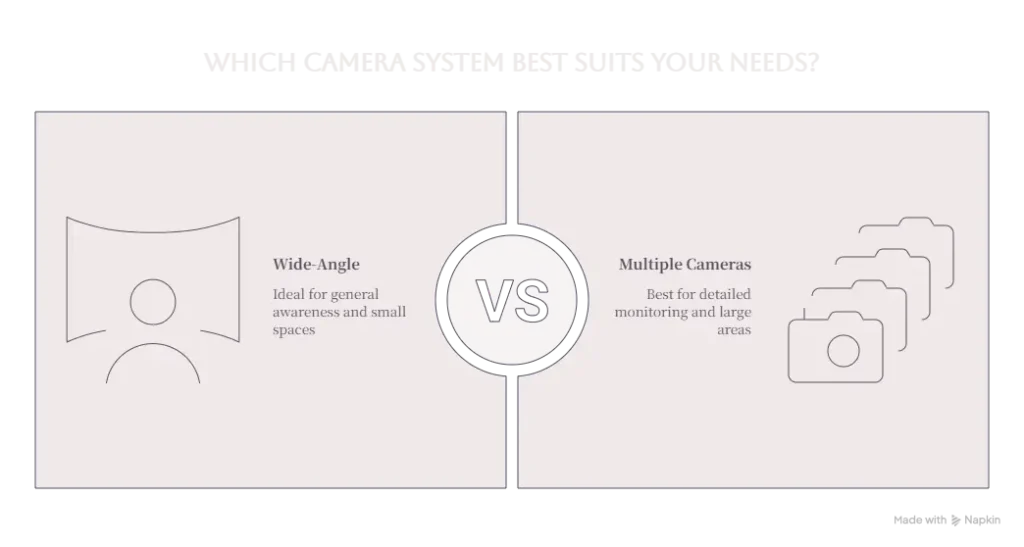
Your choice depends on the space and on what you actually need to capture.
Choose Wide-Angle If…
- You watch one open space, such as a small shop floor or office.
- You want general awareness, not licence-plate detail.
- You need fewer cables and a simpler recorder setup.
- You monitor an indoor area under 30 feet across.
Choose Multiple Cameras If…
- You run a warehouse, retail store, or fenced job site.
- You must identify faces or read licence plates clearly.
- You have multiple entrances, aisles, or blind corners to watch.
- You want every zone recording at the same time.
- You plan to pair cameras with access control for full entry tracking.
Common Mistakes When Choosing a Camera Setup
Most underperforming systems trace back to a few avoidable errors. These mistakes leave footage useless at the exact moment you need it. Careful planning at the design stage prevents every one of them.
- Buying on per-camera price instead of total evidence quality.
- Assuming one wide camera “identifies” when it only detects.
- Overlooking lighting, since poor light undermines any number of cameras.
- Skipping high-detail cameras at the one entrance that matters.
- Forgetting NVR, cabling, and storage in the budget.
- Choosing a PTZ with no presets, leaving zones unwatched.
Conclusion
For dependable protection, more cameras generally outperform one wide-angle camera. Use wide lenses for open-area awareness, then add focused cameras for faces and plates. The strongest systems combine both, positioned by people who understand local theft patterns.
That is exactly the work we do at Sense Group for businesses across the GTA. Book a free on-site assessment today and protect what you have built.
Frequently Asked Questions
How many security cameras does my business need?
It depends on entry points, layout, and high-value zones. Most commercial sites start with one camera per key entrance plus wider coverage for open areas.
Are 4K cameras enough on their own?
No. A 4K camera spread across a wide field of view still loses detail at distance. Placement and lens choice matter as much as resolution.
Do wide-angle cameras work for licence plate recognition?
Rarely. Plate capture needs a narrow, focused lens aimed at a fixed lane. Wide and fisheye views blur plates past close range.
Is a fisheye camera better than four fixed cameras?
For one small open room, often yes. For warehouses, lots, or multi-room sites, four fixed cameras capture more usable detail and fewer blind spots.
Can I mix wide-angle and multiple cameras in one system?
Yes, and most experts recommend it. Use wide cameras for awareness and focused cameras at choke points for identification.